The Project on Defense Alternatives (PDA) is saddened to learn of the passing on 19 May 2026 of former US House Rep. Barney Frank of Massachusetts – a brilliant and effective progressive voice in Congress for 32 years. Among his many accomplishments, Frank sought ways to better secure America at a lower cost and with less resort to force.
PDA worked with Rep. Frank most notably on the Sustainable Defense Task Force in 2010. Frank led the effort to ensure that debt-related budget cuts would be drawn 50% from the Pentagon budget in a safe and constructive manner. Characteristically, he reached across the aisle to build a bipartisan effort that included former Rep. Ron Paul (R-TX) as a co-sponsor. We are honored to have supported him in this effort. The Report of the Sustainable Defense Task Force can be found here: Debt, Deficits, and Defense: A Way Forward
Throughout 2025, the United States, its European allies, and Ukraine advanced various ceasefire and peace proposals. Pres Trump proposed simple unconditional ceasefire plans early in the year. These were followed by US, European, and Ukrainian comprehensive peace proposals (and counter proposals) in November and December. (The main proposals are summarized here)
None of these proposals put ending the war forthwith as its primary goal, however. And none corresponded to the battlefield and strategic realities of the war. Rather than suggesting reality-based compromises, they were either veiled efforts for partisan victory outcomes or, in the case of Trump’s November proposal, a pretext for America to simply exit the war. All exemplify “diplo-fare”- war by means of diplomacy. Most share the aim of painting one’s opponent as intransigent and, in this way, boost home support for continuing the fight. But what should be the primary concern is something else.
The Russia-Ukraine war has become a disaster for the world – a consumptive Pyrrhic conflict that has so far claimed 300,000 Ukrainian and Russian lives as well as claiming that many lives again outside the conflict zone due to its knock on effects. These realities underpin the imperative to end the war forthwith by negotiated compromise.
A pivotal fact driving the conflict is that state managers on both sides see existential interests at risk. For Kyiv, it is obviously a fight for national sovereignty, Western alignment, and preservation of the Maiden revolution. For Moscow, it is a fight to preserve defensive depth, rebuff the encroachment of an adversarial military alliance, block regime-change efforts, and preserve its status as a regional hegemon and global power.
The type of proposal that would least excite existential fears and reflexes on all sides is a simple ceasefire – somewhat like the ones proposed by President Trump early last year, but with a critical difference. Trump’s unconditional ceasefire initiative was a non-starters because it failed to take into account current battlefield and sustainment realities, which were strongly trending againstUkraine. For this reason, the proposal was partisan; It benefited Kyiv more than Moscow. Intentionally or not, it was a move within war, not against it.
Putin cited these factors when he rhetorically asked if Ukraine would use the ceasefire period “to continue forced mobilization, get weapons supplies, and prepare its mobilized units?” Of course, free to do so, it would. So could Moscow. But Ukraine needed the breather badly and Russia did not – quite the contrary: A ceasefire would take the wind out of Russia’s advance. In this light, the way forward would be to compensate Moscow for its loss of momentum and initiative, directly or indirectly. Certainly a distasteful choice for Kyiv, but better than losing ground and lives under fire while short on troops and supplies.
A Realistic Ceasefire Proposal would:
Freeze the Russian line while moving the Ukrainian line back 15 km, creating a demilitarized zone as large as any that Moscow might hope to occupy in the near future.
Insert neutral observers – not US or other NATO member troops – in the zone and bring it under air surveillance
Lift all sanctions and blockades for the duration of the ceasefire; Open the Dnieper River to Ukrainian commercial traffic. In this way, incentivize a ceasefire.
For the Ukrainian side surrendering even a small slice of space will be onerous after such a costly fight against aggression. But its armed forces need time, material replenishment, and relief from fire.
On the Russian side, surrendering momentum may seem exceptionally imprudent after such a costly confrontation. Moreover, for Moscow a pivotal goal – the full capture of four provinces – may feel within reach given mounting difficulties on the Ukrainian side. On the other hand, the progress of Russian forces has been agonizingly slow and costly. And the prospect of the USA remaining in the fight due to Russian intransigence favors acceptance.
The lifting of Russian sanctions, even temporarily, would counter-balance the revival and re-stocking of Ukrainian units during negotiations, although it might be additionally necessary to briefly pause external Ukrainian supplies until Russian sanction relief takes hold. Keep in mind that the pause for resupply is critical for Kyiv’s effort, not Moscow’s. In this light, the temporary lifting of some sanctions would serve to counter-balance Kyiv’s critical sustainment relief. And what matters is when relief is felt on both sides; Simultaneous relief (or as close as reasonably possible) would seem most neutral.
Even if this proposed conditional ceasefire is accepted by both sides, moving forward to the type of comprehensive solutions demanded by Putin and envisioned by the November and December plans seems unlikely. However, the conditional ceasefire proposal just outlined might form the foundation for a truncated but stable longer-term agreement too.
Elements of a Stable Long-term Ceasefire would include:
Freeze the front line where it stands; Implement a small buffer zone and surveil it, as above.
Each contestant may claim the areas occupied by Russian troops as rightfully their own, but major powers East and West would agree that sovereignty is to be finally decided by peaceful negotiation between the contestants. In the meantime all would recognize that the area in dispute is being administered by Russia, which is not to be challenged by force.
A balanced coalition of the powers (including the USA and China) would guarantee the arrangement, pledging to oppose a return to war by either party.
In all other respects, nations and international institutions will unconditionally restore normal relations, including the lifting of all sanctions and blockades
Both sides would proceed with reconstruction and revitalization of the areas under their supervision and joint or divided work on shared infrastructure. The immobilized assets of the Russian National Wealth Fund and Central Bank would be freed for reconstruction of the areas under Russian administration and for the Russian share of joint work. This allocation need not be designated as a “penalty” – what matters is the allocation, not what it is called.
NATO or leading NATO members including the USA would guarantee and declare that the question of Ukraine’s future NATO membership is tabled and moot until the sovereignty of Russian occupied areas is settled by agreement between the contestants. The contestants may also address the issue of NATO membership directly as part of their negotiations.
It is presumed that final agreement on the disposition of the occupied areas might never occur, and that these areas might remain under Russian administration in perpetuity. Such a state would also preclude NATO membership for Ukraine.
Notably, this proposal incorporates some ideas first advanced by Ukraine in the Istanbul Communiqué (March/April 2022) – namely that the final status of the occupied areas be deferred. It also draws on US policy regarding the dispute between Japan and China over the sovereignty of the Senkaku/Diaoyudao Islands. In that case, the USA considers the conflicting claims to be a matter for the two parties to resolve while recognizing that Japan currently administers the islands. Moreover, the USA opposes any attempt to settle the matter unilaterally or by force, and considers Japan’s administration of the islands to be covered by the US-Japan Security Treaty.
The Senkaku/Diaoyudao framework has been essentially in place since 1972 – more than 50 years. And, make no mistake, the application of this framework to the Russia-Ukraine dispute would not likely lead to a resolution of the dispute unless one or both parties undergo substantial governmental change.
Complicating factors: How this war might actually end
Weighing against the pressure for a ceasefire anytime soon is the hope that America or Europe may dramatically increase their support for Ukraine. For Zelenskyy, this prospect is key to his resisting the pressure to settle, regardless of current battlefield realities. Uncertainty regarding potential outside intervention or support makes it hard to discern a “good deal” in peace negotiations.
Given Ukraine’s personnel and sustainment crises, Putin may hope to secure his territorial objectives (and something more) within a year or so. And there is a fair likelihood that the Ukrainian front may face an operational collapse in the next 15-18 months. Also, Ukraine’s economy is on continuous life support. That said, would the West allow the Ukraine prospect to simply collapse? Western rhetoric, sunk costs, and political commitments suggest not.
European public opinion is running against spending more on the war; Already $400 billion in Western aid has been diverted to support the fight and care for refugees. And there is both public and official concern about escalatory dynamics. At the extreme, there is concern that direct Western involvement might spark a regional war with associated nuclear risks. Short of that, Russia has considerable potential to boost its own efforts in response to increased international support for Ukraine. Indeed, Russia could more than double its war effort in terms of personnel and defense expenditure without suffering half the economic and personnel pressure that Ukraine has endured for four years. So the prospective result of increased Western involvement might be, at best, a stalemate at a higher level of spending and destruction.
Nonetheless, should an operational fracture of the Ukrainian front seem likely, European security policy managers will be inclined to substantially boost support. In addition to a surge in material provisions, this might involve anti-missile and anti-drone operations conducted from or over Western territory, the increased presence of foreign “volunteer” units in Ukraine, or Western troops entering the country to take up non-combat support roles. Direct combat intervention is also possible; Although controversial, this option is being routinely ventilated in public.
Direct intervention by a subset of European powers – the Coalition of the Willing – might aim to form a passive but strong defensive line in western Ukraine some distance from the Russian front. In that case this war might “end” with a standoff inside Ukraine between Russian forces and a coalition of Ukrainian and select European powers – a new East-West “central front” frozen by the risk of regional and possibly nuclear war. Should it happen, this recreation of the past in miniature would testify to the failure of the post-Cold War order, its architects and practices.
Carl Conetta, 12 January 2026 – Full text⇒ HTML – PDF
During 2025 multiple contending Ukraine peace and cease-fire proposals were put forward by the Trump administration and America’s European partners. This article examines how the leading official proposals fell short. And it presents two, simpler proposals better aligned with battlefield realities. The article also explores the evolution of US, Ukrainian, Russian, and West European public opinion on the war.
The Russia-Ukraine war has been a disaster – not only for the two principal combatants, who together have suffered 300,000 deaths, but for the entire world. This fact drives the imperative to end this conflict forthwith via negotiated compromise. Yet, as the article shows, none of the official proposals embrace this imperative. Instead, all exhibit efforts to win advantage for one side or the other. They are instances of diplo-fare – war by means of diplomacy. As such, their aim may be rejection not agreement, with an eye toward painting one’s opponent as intransigent and, in this way, build support for continuing the fight – or, in the case of President Trump’s preference, establish a pretext for US withdrawal.
The simplest proposals may be the most practicable but these must reflect current battlefield realities rather than attempting to “correct” or “re-balance” them. This principle guides the independent cease-fire options suggested in this article. Otherwise, the article explores the possibility that Europe’s so-called Coalition of the Willing will respond to any serious fracture of Kyiv’s effort – a distinct possibility – by establishing a new nuclearized Europe-vs-Russia “central front” inside Ukraine. (With an Appendix summarizing the official November and December peace proposal texts.)
During 2025 multiple peace and cease-fire proposals addressing the conflict in Ukraine were advanced. Most prominent among them are several put forward by the Trump administration beginning in February (2/28), May (5/8), and November(11/19). The November proposal was a fully articulated 28-point “peace plan”. This plan inspired a quick 28-point rejoinder by the “E3″ nations (11/23) – France, Germany, and the UK – who perceived a pro-Russian tilt in Trump’s original. Subsequently, the USA and Ukraine developed a joint “20-point framework” (12/23) that re-balanced toward Ukraine. Alongside this was a statement by the leaders of ten European countries and the EU proposing, among other things, to form a European-led “multinational force, Ukraine.” (The November and December proposals are summarized in an Appendix.)
None of these proposals can count as a balanced effort that puts ending the war forthwith as its primary goal. And none reflect or correspond to the battlefield and strategic realities of the war. Rather than suggesting reality-based compromises, they are either veiled ploys for partisan victory outcomes or, in the case of Pres. Trump’s 28-point plan, a pretext for America to simply exit the war. In all cases, the various proposals are intended to elicit not agreement but disagreement. Their point is to paint one’s opponent (or even one’s own allies) as intransigent.
This short article examines how 2025’s main proposals fall short, and it will briefly present two proposals better aligned with battlefield realities. One entails guidelines for a “Near-term Ceasefire.” The other outlines essential elements of a “Long-term Stable Ceasefire.” The article also suggests one likely endpoint for the war that is too seldom explored: a frozen critical state – a new militarized Russia-NATO “central front” inside Ukraine.
A Disaster for the World
US President Trump’s commitment to having the US disengage from the war (and NATO generally) is one motivating factor for the 2025 effusion of Ukraine peace and cease-fire proposals. Against this, there are the contending “victory camps” who seek or counsel to “stay the course.” The Kremlin represents one victory camp; The other comprises Kyiv, NATO and EU security managers, and an array of liberal hawks and neo-cons on both sides of the Atlantic. Of course, political leaders on all sides must to some degree assuage public opinion and this has increasingly favored finding a way to end the war diplomatically as soon as possible. Commensurate with this has been fairly uniform public support for allocating less resources to the war.
While publics on both sides of the conflict may continue to “support the troops” as well as the declared goals of the fighting, war weariness springs from a perception that the war has become a protracted, high-cost, no-winner stalemate reminiscent of the First World War’s Western Front. There has been growing public sentiment on both sides over the past two years that the costs of the war have outstripped its goals. (USA, Europe1, Europer2, Europe3, Poland, Germany, Russia1, Russia2)
The Russia-Ukraine war has been a disaster not only for the two combatants but for the entire world. Total Ukrainian and Russian deaths, both civilian and combatant, may exceed 300,000 as of January 2026. A greater number may have died outside the conflict zone, especially in the Global South, due to the plight of refugees, the impact of sanctions affecting fuel, food, and agriculture, and also due to foreign aid realignment. (Tens of billions of dollars in development and humanitarian assistance has been redirected from the Global South to Ukraine war support and relief.)
The total cost of the war 2022-2025, encompassing increased internal war funding by Russia and Ukraine, plus outside support for Ukraine and Ukrainian refugees, is almost $800 billion. This sum is roughly equivalent to all the Official Development Assistance (including humanitarian aid) offered by the world’s 30 leading contributor countries for those years. It also is 2.5 times greater than the budget for the UN and all its agencies for that period. The wars have also spurred increased allocation of scarce resources to military-industrial establishments outside Russia and Ukraine. NATO countries (including the USA) are today spending $300 billion more per year on their armed forces than in 2021, corrected for inflation.
That is the cost of moving the RU-UA front line 100 kilometers this way or that over four years.
The Decisive Factor: Battlefield and Sustainment Realities
Neither President Trump nor the prime opponents of his November Russia-Ukraine peace plan have advanced practical proposals for peace.
Trump’s earlier February and May 2025 proposals for a complete and unconditional ceasefire actually favored Ukraine, which was losing ground and suffering personnel and logistics shortages. And they disfavored Russia, which was gaining ground. The bias of Trump’s proposals was not intentional. He was narrowly focused on gaining credit for a halt in the fighting without attention to practical battlefield realities and how these would shape the responses of the contestants. There should be little surprise that President Zelenskyy eventually accepted the deal while President Putin refused it.
To summarize the battlefield and sustainment realities that determined the balance between the contestants:
These realities have affected Ukrainian public opinion. So has the staggering number of fatalities suffered since the war began – probably more than 85,000 soldiers and 30,000 civilians killed.
In 2022, 73% of Ukrainians had favored continuing to fight for as long as it took to drive out the Russians and reclaim all lost territory. Only 22% favored a negotiated resolution at the time. By July 2025, however, the preferences had reversed: 69% favored a negotiated end to the war ASAP, while only 24% wanted to continue to fight until total victory. Although a slight majority – 51% – continues to oppose ceding territory to Russia that position was expressed by many more Ukrainians in 2022: 71%. The softening support for fighting probably also plays a role in Ukraine’s mobilization crisis.
In rejecting Trump’s February and May proposals Putin asserted that any negotiated settlement must go further than a simple ceasefire to address the root causes of the war. The Trump administration’s much more ambitious 28-point peace plan, which was made public in November, purported to do just that. But if the earlier proposal favored Ukraine, the November plan tilted in the other direction.
While offering Ukraine an ill-defined security guarantee and redevelopment package, it granted several core goals sought by Moscow: outright possession of three Ukrainian oblasts, effective control of two others, a blanket amnesty for war crimes, a limit on Ukrainian military strength, preclusion of Ukraine NATO membership, and a formal end to NATO expansion.
Demitriev, Witkoff, Kushner
The plan was drafted in late October 2025 by Steve Witkoff and Jared Kushner working with Russian envoy Kirill Dmitriev in Miami. This occurred shortly after the acceptance of the Gaza ceasefire plan by Israel and Hamas, gaining some impetus from it. It drew at least in part on a “non-paper” transmitted by a Russian government official. This doesn’t entail that the Kremlin was writing Trump administration policy, however – as some critics contend. Such documents are a common non-committal way of communicating government policy positions and options.
Defense Secretary Pete Hegseth had already set out in early February the view that restoring Ukraine’s pre-2014 borders was an “unrealistic objective” which would only prolong the war. Overturning current battlefield realities would demand much greater US and allied commitments. Conversely, pressuring Kyiv to accept these realities would reduce demands on the USA in either of two ways: By resolving the war or, in the case that Kyiv refused these terms, by giving the White House a pretext to end cooperation. Still, the extent of Ukrainian concessions proposed in the November plan implied that Kyiv’s immediate plight was worse than it was actually.
Obviously the plan was unlikely to win agreement from Ukraine or America’s leading NATO and EU allies – and that may have been the point. Ukraine’s rejection of the plan could have served as a pretext for US exiting the war. In that case the proposal might have served more as a US exit plan than a practicable peace plan. However, while Zelenskyy predictably dissented, he did so only in provisional terms, wisely signaling an intent to continue negotiations, offering Trump no easy exit.
Whether viewed as an exit plan or a peace plan, Trump’s 28-point proposal inspired a firestorm of criticism from war hawks.(CAP, Foreign Policy,The Hill, Politico) It also precipitated an opposition alliance by America’s European partners. Top European NATO and EU security managers retain the liberal hawk perspective on the war characteristic of the previous US administration.
NATO Allies Fire Back: Stay the Course!
While Kyiv’s plight is indeed serious and immediate, the capacity of its European partners to counter-balance Russian power is prodigious. For various reasons, European material support has been limited so far and its direct combat support, marginal. But the degree and nature of European support is subject to political and strategic pressure and calculation. It increased significantly in 2025. It is more than plausible that leading NATO countries and especially those bordering Ukraine will not simply stand by and let the Ukrainian front collapse. Zelenskyy depends on this prospect, which undergirds his recalcitrant response to demands for concessions.
On Nov 23, just four days after the administrations offered its detailed proposal, the E3 nations (France, Germany, and the UK) offered a 28-point counter-proposal to the Trump plan. This was framed as a series of amendments but, in fact, involved a dramatic reversal of terms. The counter-proposal called for a permanent ceasefire along the current line of contact and protracted negotiations on the eventual disposition of occupied territories. Notably, unlike the administration’s plan, this E3 counter involved no immediate transfer of territories.
Both plans offered security guarantees, but the European one anchored these to NATO, while the US administration’s proposal relied on US initiative and a coalition of the willing. A more consequential difference concerned the specific outcome that each plan proposed to cement in place.
In the original proposal, the guarantee was a follow-on to Ukraine surrendering the occupied oblasts and closing the door on NATO membership – key Russian goals. In that case, the guarantee was supposed to relieve Ukrainian concerns about future Russian aggression. By contrast, in the E3 proposal, which does not grant Russia sovereignty over the oblasts, the guarantee blocks Russia’s return to war should negotiations break down and the deposition of the occupied territory remains forever undecided. In the meantime, sanctions would continue to bleed Russia, in prospect leading eventually to its bankruptcy.
In sum, the Euro proposal relieves the pressure on Ukraine by deterring RU military action while sustaining pressure on Russia. It is a slow-motion Ukraine victory plan carrying forward some elements of the proposal Kyiv advanced in the Istanbul Communiqué of March/April 2022. Under the Euro plan all Ukraine need do is hold steady while shielded from attack as Moscow is progressively sapped via sanctions. The Euro plan also leaves open the door to NATO membership, does not limit NATO expansion, allows a larger Ukrainian military, and retains the prospect of Russian war reparations and prosecution for war crimes.
It is easy to see why Russia would reject these terms given its more advantageous domestic situation and current battlefield realities, which favor Russian forces. In this light, the Euro proposal is not a “peace plan” but a form of lawfare or diplo-fare – the conduct of war by diplomatic means. Its true aim is public and elite opinion – especially American. The side that refuses an ostensibly honest ceasefire or peace plan is marked as the principal obstacle to ending the conflict, and this can help renew or increase public and elite support for the other side and for sustaining the fight.
The Euro rejoinder to Trump’s 28-point proposal created a dilemma for the President because it better corresponded with shifts in US public and elite opinion than did Trump’s own November plan. That was a dilemma of the President’s own making. It was his handling of the Ukraine contingency during the course of 2025 that increased support for Ukraine and strengthened the hand of US neo-cons and liberal hawks
Public Opinion and the Vicissitudes of Trump War Policy
President Trump’s shifting engagement with the war’s principal antagonists does not evince an erratic approach to the war. Nor does the fact that his proposals seem to tilt first one way and then the other show capriciousness. Trump is employing a flexible transactional approach aiming to walk the opponents toward a pause in fighting for which he can claim credit and/or create a justification for the USA to exit the war. In this approach it matters not much (if at all) who eventually exercises dominion over Crimea and the Donbas. What matters is self-aggrandizement and national disengagement. But the President’s idiosyncratic approach has had unintended effects on public opinion which have rebounded to the advantage of neo-cons and liberal hawks.
Prior to Donald Trump taking office US public opinion had been shifting toward greater support for seeking a quick end to the war even if this meant that Ukraine had to surrender territory. That changed soon after Trump’s election. By March, majorities again expressed support for staying the course “as long as it took.” In Gallup polls a plurality of Americans also said US support for Ukraine was insufficient, whereas in late 2024 a plurality had judged US support to be “too much.”
The change in sentiment partly reflected a backlash to the administration’s cutoff of Ukrainian arms and intelligence support in late-February. However, aid was partly restored in response to Ukraine’s acceptance of Trump’s proposed unconditional ceasefire in March – a plan that Moscow resisted. Following Zelenskyy’s acceptance and Putin’s rejection of Trump’s offer Gallup recorded a distinct rebound in support for the Ukrainian war effort; This, after several years of decline. Throughout the summer and into the fall, Trump was increasingly critical of Putin’s intransigence. In July he bluntly said “We get a lot of bullshit thrown at us by Putin, if you want to know the truth. He’s very nice all the time, but it turns out to be meaningless.”
Not surprisingly, Trump’s turn had an impact on the Republican base and also amplified the views of GOP Russia hawks and neo-cons. Indeed, a late July 2025 poll by the Chicago Council on Global Affairs poll found 51% Republicans then favoring US military aid to Kyiv – a 21-point shift since March. Overall, 62% of Americans were found to support sending military supplies to Kyiv – up from 52% in March. This corresponded well with Trump’s imposition of serious new sanctions on the Russian oil industry in October. It was less auspicious for the administration’s late-November 28-point peace plan, which was lambasted Left and Right as a surrender to Russian demands. The new plan seemed at odds not only with public opinion but with the 8-month anti-Putin drift of administration pronouncements. In fact, it was not at all at odds with the President’s fundamental orientation regarding the war.
President Trump primarily seeks to rollback America’s foreign obligations and especially its European security commitments. He rejects that America’s best interests are served by prosecuting the Ukrainian war, and he believes his transactional approach can bring it to a quicker (if not quick) conclusion.
One need not agree with Trump’s view to see how it might inform a seemingly erratic series of actions and statements as the President seeks leverage over the war’s contestants. Complicating this play are domestic developments and reactions that can affect his broader agenda. Trump’s overall program depends on a high level of at least tacit approval from GOP leaders and influencers. His 28-point peace proposal lacks that approval, although it corresponds with his disposition on European disengagement and the Ukraine war. The shift in US public opinion on the war and the administration’s other troubles compel some movement toward the European alternative approach to the war, which will make Moscow’s assent unlikely.
The December “Peace” Plan Kabuki: Bringing the USA Back In
During December 2025, US and UA negotiators settled on a joint 20-point negotiating position on the war while a group of European leaders produced a supportive plan. Soon after, European leaders and US representatives produced several draft statements outlining very substantial security guarantees, military assistance plans, and development packages for Ukraine. If the administration’s 28-point November plan tilted toward Russian concerns, the December plans and statements tilted much more heavily toward supporting Ukraine. Although less detailed than the November European rejoinder, the 20-point framework adopts most of its key planks, reflecting a significant Administration retreat from its earlier position – even though the administration’s lead architect in both cases was Steve Witkoff.
Unsurprisingly, the US-UA joint proposal asks Ukraine to commit to surrendering very little except temporarily, and it rewards Kyiv’s cooperation substantially with security and economic commitments. The 20-points, summarized below, give the impression that Russia needs a ceasefire more than does Ukraine, which was manifestly not true. Thus the proposal will not nearly gain Moscow’s assent, and Putin’s rejection seems to be part of the play. Reflecting on that eventuality, Zelenskyy has said, “I think America will apply sanctions pressure and give us more weapons if he (Putin) rejects everything.” In this way, the proposal may serve only to refuel the war effort.
The full-text of the 20-point plan is available in an Appendix. To summarize some key features:
The proposal, if accepted, would stop Russia’s advance in its tracks. It also requires some immediate Russian troop withdrawals (albeit minor) and finalizes no de jure transfer of Ukrainian territory. The final disposition of occupied territories is to be decided in the course of negotiations, which may prove interminable.
While prescribing a ceasefire-in-place where Russian and Ukrainian troops are in contact, it does not address the issue of Crimea. Presumably the disposition of Crimea is among the territorial issues to be discussed once a ceasefire takes hold.
The framework does not address the issue of NATO membership or the peacetime presence of NATO troops in Ukraine. It does allow the possibility of an international inter-position force to separate the combatants. It also allows for a peacetime Ukrainian military comprising 800,000 troops and presumably allows outside military provisioning of Ukraine to continue unabated.
Ukraine also would receive a development package, preferential access to the European market,” and “a clearly designated” deadline for EU membership.
The framework makes no mention of Russia’s frozen assets. Nor does it prescribe lifting Russian sanctions. (Ancillary commentary suggests that phased conditional relief may occur.) In the meantime, the sanctions and the asset freeze may remain in place as bargaining chips while the final disposition of Ukrainian territory is negotiated.
The 14 Dec 2025 European “Leaders’ Statement on Ukraine” stands alongside the 20-point framework. Its most important addition is an envisioned “European-led ‘multinational force Ukraine’. This would, in prospect, draw on the 35-nation European “Coalition of the Willing” (which was formed in March 2025) and be supported by the USA “to assist in the regeneration of Ukraine’s forces, secure Ukraine’s skies, and support safe seas, including through operating inside Ukraine.” Elements of this might also serve as an inter-position force during the ceasefire period.
It is notable that America’s European partners – especially the E3 – have stepped up to reassure Kyiv and back-fill for the USA, at this time of difficulty for Ukraine. How far they will go, given domestic needs and sentiments, is unclear. Despite ventilating the idea of a European “multi-national” force for Ukraine, the European leaders’ statement is not a blueprint or solid commitment to form or deploy such a force. What is key is the Euro group’s commitment to stay the course despite America’s reduced role, Ukraine’s difficulties, and recent Russian battlefield advances. This is a counter to the anti-war drift of European public opinion. All this is intended to and may weigh against Putin’s confidence while giving Kyiv’s beleaguered troops hope.
The most remarkable of the December developments is the return – however tenuous – of the USA to the heart (and head) of the Ukraine war coalition. As the NYT reports “For the first time in months, European officials said they were working well with American negotiators and President Trump.” Measuring the import of this convergence is difficult, however. While the USA is “back in” giving security guarantees, pledging a cease-fire monitoring role, and offering development deals, the extent and nature of its routine military sustainment help is unclear. It will certainly be much less than that provided previously by the Biden administration; Reducing routine military burdens in Europe is a central plank of Trump’s foreign policy program. Moreover, most of the promised assistance will materialize only if Kyiv signs a peace deal. Nonetheless, by keeping the United States more involved than previously expected, the December meetings create the hope of bridging some relatively lean years until a more Atlanticist US administration takes office. And this matters in both Ukraine’s capital and along its front lines.
What brought America back into the pro-Ukraine war camp? The quick and concerted response of America’s European allies was key in several ways. First, it echoed and amplified the alarm of both liberal and conservative US hawks referencing “the lessons of Munich” and suggesting that Trump’s Nov 28-point proposal had communicated weakness, naivete, and deference to Putin. Second, the willingness of European allies to assume the financial lead in supporting Ukraine, buy US weapons, and propose a non-NATO European force for duty inside Ukraine signaled the type of “burden sharing” Trump advocates. This lowers the costs and risks of American leadership (although, in light of US security pledges, they remain considerable). Finally, the plan and related statements ensure a US economic foothold in Ukraine and prescribe a distinguished oversight role for President Trump as chair of a “Peace Council” involving the USA, Ukraine, Russia, and European institutions.
Getting to Yes. The Counsel of Realism
The type of proposal that would least excite existential fears and reflexes on all sides is a simple unconditional ceasefire in place – much like the one proposed by US President Trump on May 8, 2025, but with a critical difference. As noted previously, Trump’s March and May initiatives were non-starters because they failed to take into account current battlefield and sustainment realities, which were strongly trending against Ukraine. For this reason the proposal benefited Kyiv more than Moscow. Putin cited these factors when he rhetorically asked if Ukraine would use the ceasefire period “to continue forced mobilization, get weapons supplies, and prepare its mobilized units?” Of course, free to do so, it would. So could Moscow. But Ukraine needed the breather badly and Russia did not – quite the contrary: A ceasefire would take the wind out of Russia’s advance. In this light, the way forward would be to compensate Moscow for its loss of momentum and initiative, directly or indirectly. Certainly a distasteful choice for Kyiv, but better than losing ground and lives under fire while short on troops and supplies.
A Realistic Ceasefire Proposal would:
1. Freeze the Russian line while moving the Ukrainian line back 15 km, creating a demilitarized zone as large as any that Moscow might hope to occupy in the near future.
2. Insert neutral observers – not US or Coalition of the Willing troops – in the zone and bring it under air surveillance
3. Lift sanctions and blockades for the duration of the ceasefire; Open the Dnieper River to Ukrainian commercial traffic
For the Ukrainian side surrendering space will be onerous after such a costly fight against aggression. But its armed forces need time, material replenishment, and relief from fire.
On the Russian side, surrendering momentum may seem exceptionally imprudent after such a costly confrontation. Moreover, a pivotal goal – the full capture of four provinces – may feel within reach given mounting difficulties on the Ukrainian side. On the other hand, the progress of Russian forces has been agonizingly slow and costly. And the prospect of the USA remaining in the fight due to Russian intransigence favors acceptance.
The lifting of Russian sanctions, even temporarily, counter-balances the revival and re-stocking of Ukrainian units during negotiations, although it might be additionally necessary to briefly pause external Ukrainian supplies until Russian sanction relief takes hold. Keep in mind that the pause for resupply is critical for Kyiv’s effort, not Moscow’s. In this light, the temporary lifting of some sanctions would serve to counter-balance Kyiv’s critical sustainment relief. And what matters is when relief is felt on both sides; Simultaneous relief (or as close as reasonably possible) would seem most neutral.
Even if this proposed conditional ceasefire is accepted by both sides, moving forward to the type of comprehensive solutions demanded by Putin and envisioned by the November and December plans seems unlikely (for reasons discussed below). However, the conditional ceasefire proposal just outlined above might form the foundation for a truncated but stable longer-term agreement too.
Elements of a Stable Long-term Ceasefire would include:
1. Freeze the front line where it stands; Implement a small buffer zone.
2. Each contestant may claim the areas occupied by Russian troops as rightfully their own, but major powers East and West would agree that sovereignty is to be finally decided by peaceful negotiation between the contestants. In the meantime all would recognize that the area in dispute is administered by Russia, which is not to be challenged by force.
3. A balanced coalition of the powers (including the USA and China) would guarantee the arrangement, pledging to oppose a return to war by either party.
4. In all other respects, nations and international institutions will unconditionally restore normal relations, including the lifting of all sanctions and blockades
5. Both sides would proceed with reconstruction and revitalization of the areas under their supervision and joint or divided work on shared infrastructure. The immobilized assets of the Russian National Wealth Fund and Central Bank would be freed for reconstruction of the areas under Russian administration and for the Russian share of joint work. This allocation need not be designated as a penalty
6. NATO or leading NATO members including the USA would guarantee and declare that the question of Ukraine’s future NATO membership is tabled and moot until the sovereignty of Russian occupied areas is settled by agreement between the contestants. The contestants may also address the issue of NATO membership directly as part of their negotiations.
It is presumed that final agreement on the disposition of the occupied areas might never occur, and that these areas might remain under Russian administration in perpetuity.
Notably, this proposal incorporates some ideas first advanced by Ukraine in the Istanbul Communiqué (March/April 2022) – namely that the final status of the occupied areas be deferred. It also draws on US policy regarding the dispute between Japan and China over the sovereignty of the Senkaku/Diaoyudao Islands. In that case, the USA considers the conflicting claims to be a matter for the two parties to resolve while recognizing that Japan currently administers the islands. Moreover, the USA opposes any attempt to settle the matter unilaterally or by force, and considers Japan’s administration of the islands to be covered by the US-Japan Security Treaty.
The Senkaku/Diaoyudao framework has been essentially in place since 1972 – more than 50 years. And, make no mistake, the application of this framework to the Russia-Ukraine dispute would not likely lead to a resolution of the dispute unless one or both parties undergo substantial governmental change.
The Counsel of Munich
1938 Munich Agreement was signed here, today a university room
Weighing against the imperative to immediately end the conflict via negotiated compromise and instead seek a Ukrainian victory is the concern that any compromise with aggression will lead to more aggression. This concern is standard in international affairs and for good reason. But the danger of “conciliation” or “appeasement” admits degrees depending on the circumstances or genesis of the violation and the security arrangements that follow conflict. The counsel of Munich needs to be contextualized. Some cases are manageable and worth the risk when measured against a brutal interminable morass like the RU-UA war, which has deleterious effects worldwide.
It is relevant that the present case is a Pyrrhic or “no-winner” war. Much of what Moscow has “won” are shattered towns and a broken battlefield. Whatever Moscow may gain through diplomacy will be far less than what it sought in 2022 and at a much greater cost than anticipated. This was due to Russian weakness, now exposed, and a powerful cooperative defensive response that leaves behind a more ready bulwark against aggression. Russia’s experience is hardly a good brief for an ongoing campaign of conquest – and none has been seriously advanced.
Among the circumstances leading to Moscow’s Ukraine intervention were the steady march of an adversarial military alliance toward Russia’s border, steadfastly disregarding Moscow’s continuing complaint. Also there was 20-years of competitive Great Power interference in Ukraine’s internal affairs as well as irresolute pre-war efforts to mitigate Ukrainian competition and conflict, both internal and external. There were many opportunities in the past to sincerely pursue cooperative approaches, advocate and exercise restraint, and avoid war. And there will be more opportunities in the future. This is a war that could and should have been avoided had great powers on either side exercised restraint in their long march to war.
The complicating factor: How far will the Western alliance go?
A realistic appraisal of the RU-UA battlefield and strategic balance might illuminate a practicable approach to conflict mitigation and resolution. Complicating the Ukraine war, however, is the fact that the conflict is not simply a binary standoff between Russia and Ukraine. It is a quasi-coalition war also involving to some uncertain and varying extent the power of the USA and many European countries arrayed against Russia. The potential variability in the level of outside material support for Ukraine makes it hard to discern a “good deal” in peace negotiations. Part of every negotiation is an assessment of potential changes in outside involvement.
How to weigh the prospective commitment of Ukraine’s supporters in material terms is not straight forward. The approach of these powers reflect their own goals and cost-benefit calculus, which are not identical to Ukraine’s. And they shift with the winds of war and with changes in domestic conditions including public opinion.
What is an existential contest for Ukraine demanding maximum commitment is not so for its supporters. For them, commitment to the war must compete with more pressing national priorities, other foreign policy activities, and domestic political imperatives. That said, the alliance-wide commitment to Ukraine has been very modest, comprising about 1/4 of 1 percent of their aggregate national government spending. This means there is ample leeway for expansion before allies face serious domestic difficulties – should the alliance or some subset of it see an urgent and manageable need.
The Western alliance could potentially bring to the conflict a type and level of resources that would completely transform the war’s balance of power. Today Russia’s GDP is ten times larger than Ukraine’s (in Purchasing Power Parity or PPP terms). Its defense budget is twice as large. And its active-duty armed forces personnel roster is at least 50% larger. But these ratios are much more favorable for Ukraine today than in 2022 due to the efforts of the Ukrainian people and $400 billion in outside transfers. These transfers (of cash and goods) were equivalent to more than two years of the country’s pre-war GDP. But outside supporters could do much more if they chose, as noted above.
Today, the coalition of countries supporting Ukraine stand in aggregate wealth and power to Russia as Russia once stood to Ukraine. The aggregate GDP of NATO countries is nine times greater than Russia’s (in PPP terms). NATO armed forces field more than 2.5 as many active-duty personnel. And NATO defense spending is at least four-times greater than Russia’s (in PPP terms).
Some of the factors limiting foreign contributions have already been mentioned above: competing priorities and domestic politics. Public support for increasing war contributions has already been trending downward in most places. There is also concern about escalatory dynamics. At the extreme, there is concern about provoking a regional war with associated nuclear risks. Short of that, Russia has considerable potential to boost its own efforts in response to increased international support for Ukraine. And increased outside involvement in the war would substantiate the Kremlin’s effort to depict the war as a defensive one. So the prospective result might be, at best, a stalemate at a higher level of spending and destruction – and this war is already a catastrophe for the world.
How this war may end
Both Moscow and Kyiv are captured by this war and not presently seeing an acceptable exit via negotiation. Neither sees a way out except on terms that essentially amount to “victory.” Even the Stable Long-term Ceasefire proposal outlined above is unlikely to find mutual acceptance unless and until both sides are in crisis and perceiving an intractable stalemate.
Today, both capitals are gripped by the sunk costs of the war. And both are enthralled by what they see as an existential struggle: for Kyiv, it is a fight for national sovereignty and preservation of the Maiden revolution; For Moscow, it is a fight to preserve defensive depth, rebuff the encroachment of an adversarial military alliance, block regime change efforts, and preserve its status as a regional hegemon and global power. Also, both nations have become, in political-economic terms, “war states.” Among other things, this means that the fate of their leadership cohorts probably hinge on the outcome of the war. Neither Putin nor Zelenskyy can easily step back.
Given Ukraine’s current mobilization crisis, Putin may hope to secure his territorial objectives (and something more) within a year. It is feasible that the Ukrainian front may face an operational collapse in the next 15-18 months. And Ukraine’s economy is on continual life support. For Zelenskyy, the prospect of a substantial boost in the type and amount of Western aid seems key. And while Trump’s machinations make a big boost seem unlikely, it also seems unlikely that European NATO leaders will uniformly let the Ukrainian prospect simply collapse.
Despite the fact of European public opinion running increasingly against the option of deeper involvement, an operational fracture of the Ukrainian front could prompt direct intervention by a subset of European powers. These might set out to form a passive but strong defensive line in western Ukraine some distance from the Russian line. In that case this war might “end” with a standoff inside Ukraine between Russian forces and a coalition of Ukrainian and select European powers – a new East-West central front frozen by the risk of regional and possibly nuclear war. Short of this, a broader Western response to a crisis in Ukrainian’s posture might include Western troops entering to take up support roles, increased presence of foreign “volunteer” units, anti-missile and anti-drone operations conducted from or over Western territory, and a surge in Western material and financial support. Of course, a great deal depends on America’s stance.
US-NATO declaratory policy on the war has focused not only on defense of Ukrainian sovereignty, but more generally on a putative Russian threat to all of Europe and, indeed, the entire liberal world order. US-NATO official talk of a Russian attack or invasion threat to Europe has certainly amplified public fears, but this talk is greatly overwrought. There was no general invasion goal or plan in Russian strategy, and the Ukraine war itself showed the limits of contemporary Russian power. As for a threat to the liberal world order and the rule of law, these are found on both sides of the Russia-NATO divide, whether the issue is political values or international practice. What is real and perilous is Great Power Competition between Russia and the United States (and by extension much of NATO).
War of the Worlds
Great Power Competition (GPC) has been a driving force of East-West relations regarding Ukraine ever since NATO expansion got underway (1997-1999) and especially since the Orange Revolution took off (2004). Ukraine might have served as a bridge between Moscow and Washington-Brussels. Instead, it became first a political battleground and then a military one. One theater of Great Power conflict is being fought out and perhaps decided on this battleground. Failing to see this or discounting it entails failing to understand or accurately communicate the Ukrainian war and its dynamics.
In recent decades, Moscow has opposed numerous western international initiatives, beginning with the 1999 Kosova war. Major turning points in the relationship were the 2007 Munich Security Conference, where Putin vehemently criticized American unipolar dominance and NATO expansion, and the 2008 Russian military intervention in the Georgian civil conflict. Washington and Moscow have also been at loggerheads over Libya, the 2003 Iraq war, Syria, Iran, Cuba, and Venezuela. Recently, Russian private military companies have been displacing Western troop presence in Niger, Mali, and Burkina Faso.
Across the globe Moscow maintains close relations with 36 nations as a leading member of several security and geopolitical cooperation organization: Commonwealth of Independent States (CIS), the Collective Security Treaty Organization (CSTO), the Shanghai Cooperation Organization (SCO), and BRICS – a virtual antipode to Western-led networks. Especially vexing to leaders of the Atlantic Alliance are Moscow’s relatively good relations with several NATO members: Hungary, Turkey, and Slovakia.
Perhaps most consequential is Moscow partnerships with China and India, and its special role in mediating relations between these two. This role was obvious during the 2020 China-India Ladakh standoff, but also more regularly in the Russia-India-China (RIC) trilateral meetings.
Recent US strategic policy has seen China and Russia as the nation’s principal strategic challenge.(NSS-2022, NSS-2017, US Mil Strategy-2018) Similar views are stated in NATO and EU security documents. Russian destabilization or regime change would have a profound impact on China, opening a vulnerable flank in China’s northeast and favoring closer US-India coordination on China policy. Change in Russia would similarly have a profound impact on North Korea.
In sum, the USA and other leading NATO powers bring more to the Ukraine war than simple support for Ukraine’s sovereignty and the rule of law. The war and their role in it involves a broader coalescence of interests that puts them at odds with Moscow – at least in the view of US and NATO security policy managers.
Regardless of the war’s outcome, the USA and leading NATO countries see the depletion of Russian global power as a positive, even pivotal end. NATO has also experienced a related revival of its strength and relevance due to the Russian invasion. And the war has prompted a substantial boost in military budgeting across the Atlantic alliance. (Alliance military spending has grown 22% in real terms since 2022. NATO is today spending about $300 billion more per year on defense than it did in 2021.) All these factors argue against a negotiated peace before Russia is unsettled and substantially degraded. While this war is an ongoing disaster for the world, it also is a pivotal engagement in the contest of great powers. And that is why it is most likely to be fought to the end, regardless of the global cost and attendant risk of an even greater conflagration.
20-point US-UA framework peace proposal – 23 Dec 2025
1. The signatories affirm that Ukraine is a sovereign state.
2. The document constitutes a full and unquestionable non-aggression agreement between Russia and Ukraine. A monitoring mechanism will be set up to oversee the conflict line using satellite-based unmanned surveillance, ensuring early detection of violations.
3. Ukraine will receive security guarantees.
4. The size of Ukraine’s Armed Forces will remain at 800,000 personnel during peacetime.
5. The U.S., NATO, and European signatory states will provide Ukraine with “Article 5–like” guarantees. Following points apply:
(a) If Russia invades Ukraine, a coordinated military response will be launched, and all global sanctions against Russia will be reinstated.
(b) If Ukraine invades Russia or opens fire at Russian territory without provocation, the security guarantees will be considered void. If Russia opens fire on Ukraine, the security guarantees will come into effect.
(c) Bilateral security guarantees are not excluded under this agreement
6. Russia will formalize its non-aggression stance towards Europe and Ukraine in all necessary laws and documents, ratifying them by Russia’s State Duma.
7. Ukraine will become an EU member at a clearly designated time and will receive a short-term preferential access to the European market.
8. Ukraine will receive a strong global development package, detailed in a separate agreement, This will cover a broad range of economic areas, including but not limited to:
(a) The establishment of a Ukraine Development Fund for investing in fast-growing industries, including technology, data centers, and artificial intelligence.
(b)The USA and US companies will work with Ukraine to jointly invest in the restoration, modernization, and operation of Ukraine’s gas infrastructure, including pipelines and storage facilities.
(c) Joint efforts will be made to rebuild war-torn areas, focusing on restoring and modernizing cities and residential neighborhoods.
(d) Infrastructure development will be prioritized.
(e) Extraction of minerals and natural resources will be expanded.
(f) The World Bank will provide a special funding package to support the acceleration of these efforts.
(g) A high-level working group will be established, including the appointment of a leading global financial expert as the prosperity administrator to oversee the implementation of the strategic recovery plan and future prosperity.
9. Several funds will be established to address the recovery of Ukraine’s economy, the reconstruction of damaged areas and regions, and humanitarian issues.
(a) The United States and European countries will establish a capital and grants fund with a target size of $200 billion for transparent and effective investment in Ukraine.
(b) A broad range of capital investments and other financial instruments will be deployed for Ukraine’s post-war reconstruction. Global reconstruction institutions will use mechanisms to bolster and facilitate these efforts.
(c)Ukraine will implement best global standards to attract foreign direct investment.
(d) Ukraine reserves the right to compensation for the damage inflicted.
10. Ukraine will accelerate the process of negotiating a free trade agreement with the U.S.
11. Ukraine reaffirms its commitment to remaining a non-nuclear state, in accordance with the Treaty on the Non-Proliferation of Nuclear Weapons.
12. The Zaporizhzhia Nuclear Power Plant will be jointly operated by three countries: Ukraine, the United States, and Russia.
13. Ukraine and Russia will introduce school courses that promote understanding and tolerance of different cultures, fight racism and prejudice. Ukraine will approve EU rules on religious tolerance and minority language protection.
14. In Donetsk, Luhansk, Zaporizhzhia, and Kherson oblasts, the line of military positions on the date of signing will be recognized as the de facto front line.
(a). A working group will convene to determine the redeployment of forces necessary to end the conflict, as well as to define parameters for potential future special economic zones.
(b) After an equivalent basis for the movement of forces, international forces will be deployed along the line of contact to monitor compliance with this agreement. (President Zelensky has proposed that both sides will withdraw an equivalent amount from the point of contact to create a zone where international forces will deploy.) Should a decision be made to establish such a zone, it will require special approval by the Ukrainian parliament or a referendum.
(c) The Russian Federation must withdraw its troops from the Dnipropetrovsk, Mykolaiv, Sumy, and Kharkiv regions for this agreement to take effect.
(d) The parties agree to adhere to the rules, guarantees, and obligations of the 1949 Geneva Conventions and their additional protocols, which apply in full to the territory, including universally recognized human rights.
15. Russia and Ukraine commit to refraining from using force to alter territorial arrangements and will resolve any disputes through diplomatic means.
16. Russia will not obstruct Ukraine’s use of the Dnipro River and the Black Sea for commercial purposes. A separate maritime agreement will ensure freedom of navigation and transport, with the Russian-occupied Kinburn Spit being demilitarized.
17. Establishment of a humanitarian committee that will ensure the following:
(a) All-for-all prisoner exchange.
(b) All detained civilians, including children and political prisoners, will be freed.
(c) Actions will be taken to address the problems and alleviate the suffering of conflict victims.
18. Ukraine must hold presidential elections as soon as possible after the deal is signed.
19. The deal will be legally binding. Its implementation will be monitored by the Peace Council, chaired by U.S. President Donald Trump. Ukraine, Europe, NATO, Russia, and the U.S. will be part of this process. Violations will lead to sanctions.
20. The ceasefire will take effect immediately once all parties agree to the deal.
European “Leaders’ Statement on Ukraine” – 14 Dec 2025
1. UA armed forces should remain at a peacetime level of 800,000.
2. The Coalition of the Willing should establish a European-led ‘multinational force Ukraine’ supported by the US to assist in the regeneration of Ukraine’s forces, secure Ukraine’s skies, support safe seas, including through operating inside Ukraine.
3. There should be a US led cease-fire monitoring and verification mechanism and early conflict warning effort
4. There should be a legally binding multi-national commitment to restore peace and security in the case of a future armed attack. These measures may include armed force, intelligence and logistical assistance, economic and diplomatic actions.
5. Europe should invest in the future prosperity of Ukraine, including making major resources available for recovery and reconstruction, mutually beneficial trade agreements
6. Postwar plans should take into account the need for Russia to compensate Ukraine for the damage caused, using Russian sovereign assets.
7. The leadership group strongly support Ukraine’s accession to the European Union.
US-UA “19-point Framework,” Geneva – 24 Nov 2025
This amended most elements of the Trump 28-point Plan drawing on the E3 alternative. Below are those key features and revisions publicly available circa 20 Dec 2025:
1. The revised framework drops the 600,000 personnel limit on the armed forces and in some summaries adopts the 800,000 peacetime force level proposed in the E3 plan.
2. Removes language barring Ukraine from ever joining NATO
3. Includes stronger security guarantees backed by the USA and European partners.
4. Does not include territorial concessions by Kyiv. Sets the front line as the basis for future discussions between Pres Trump and Pres Zelensky on disposition of territory.
5. Drop the provision in the US 28-point plan for full amnesty for acts committed during the war and adds a requirement to address “the grievances of those who suffered in the war”.
6. Reportedly drops the specific plan for handling the frozen Russian assets set out previously in the 28-point plan
7. Reports indicate that the new framework makes no clear statement about NATO or European coalition troops stationed in or deploying to Ukraine.
8. Drops the plan to allocate frozen Russian assets to US-led reconstruction and investment efforts in Ukraine.
9. Defers to future US-UA talks a variety of decisions on key political, economic, and security issues that had been addressed in both the original 28-point plan and the E3 rejoinder
E3 Ukraine War Cease-fire Proposal – 23 Nov 2025
1. Ukraine’s sovereignty to be reconfirmed.
2. There will be a total and complete non-aggression agreement reached between Russia and Ukraine and NATO. All ambiguities from the last 30 years will be resolved.
(Point 3 of U.S. plan is deleted. A draft of that plan seen by Reuters said: “There will be the expectation that Russia will not invade its neighbors and NATO will not expand further.”)
4. After a peace agreement is signed, a dialogue between Russia and NATO will convene to address all security concerns and create a de-escalatory environment to ensure global security and increase the opportunity for connectivity and future economic opportunity.
5. Ukraine will receive robust Security Guarantees
6. Size of Ukraine military to be capped at 800,000 in peacetime.
7. Ukraine joining NATO depends on consensus of NATO members, which does not exist.
8. NATO agrees not to permanently station troops under its command in Ukraine in peacetime. (This leaves open deployment during war, temporary deployment during peace, and European member state deployments that are not under NATO command.)
9. NATO fighter jets will be stationed in Poland
10. US guarantee that mirrors Article 5
(a) US to receive compensation for the guarantee
(b) If Ukraine invades Russia, it forfeits the guarantee
(c) If Russia invades Ukraine, in addition to a robust coordinated military response, all global sanctions will be restored and any kind of recognition for the new territory and all other benefits from this agreement will be withdrawn.
11. Ukraine is eligible for EU membership and will get short-term preferred market access to Europe while this is being evaluated
12. Robust Global Redevelopment Package for Ukraine including but not limited to:
(a) Creation of Ukraine Development fund to invest in high growth industries including technology, data centers and Al efforts
(b) The United States will partner with Ukraine to jointly restore, grow, modernize and operate Ukraine’s gas infrastructure, which includes its pipeline and storage facilities
(c) A joint effort to redevelop areas impacted by the war to restore, redevelop and modernize cities and residential areas
(d) Infrastructure development
(e) Mineral and natural resource extraction
(f) A special financing package will be developed by the World Bank to provide financing to accelerate these efforts.
13. Russia to be progressively re-integrated into the global economy
(a) Sanction relief will be discussed and agreed upon in phases and on a case-by-case basis.
(b) The United States will enter into a long-term Economic Cooperation Agreement to pursue mutual development in the areas of energy, natural resources, infrastructure, AI, datacenters, rare earths, joint projects in the Arctic, as well as various other mutually beneficial corporate opportunities.
(c) Russia to be invited back into the G8
14. Ukraine will be fully reconstructed and compensated financially, including through Russian sovereign assets that will remain frozen until Russia compensates damage to Ukraine.
15. A joint Security taskforce will be established with the participation of US, Ukraine, Russia and the Europeans to promote and enforce all of the provisions of this agreement
16. Russia will legislatively enshrine a non-aggression policy towards Europe and Ukraine
17. The United States and Russia agree to extend nuclear non-proliferation and control treaties, including the Start I Treaty.
18. Ukraine agrees to remain a non-nuclear state under the NPT
19. The Zaporizhzhia nuclear power plant will be restarted under supervision of the IAEA, and the produced power shall be shared equitably in a 50-50 split between Russia and Ukraine.
20. Ukraine will adopt EU rules on religious tolerance and the protection of linguistic minorities.
21. Territories: Ukraine commits not to recover its occupied sovereign territory through military means. Negotiations on territorial swaps will start from the Line of Contact.
22. Once future territorial arrangements have been agreed, both the Russian Federation and Ukraine undertake not to change these arrangements by force. Any security guarantees will not apply if there is a breach of this obligation
23. Russia shall not obstruct Ukraine’s use of the Dnieper River for purposes of commercial activities, and agreements will be reached for grain shipments to move freely through the Black Sea
24. A humanitarian committee will be established to resolve open issues:
(a) All remaining prisoners and bodies will be exchanged on the principle of All for All
(b) All civilian detainees and hostages will be returned, including children
(c) There will be a family reunification program
(d) Provisions will be made to address the suffering of victims from the conflict
25. Ukraine will hold elections as soon as possible after the signing of the peace agreement.
26. Provision will be made to address the suffering of victims of the conflict.
27. This agreement will be legally binding. Its implementation will be monitored and guaranteed by a Board of Peace, chaired by President Donald J. Trump. There will be penalties for violation.
28. Upon all sides agreeing to this memorandum, a ceasefire will be immediately effective upon both parties withdrawing to the agreed upon points for the implementation of the agreement to begin. Ceasefire modalities, including monitoring, will be agreed by both parties under US supervision. Trump
28-Point Ukraine Peace Plan – 20-21 Nov 2025
1. Ukraine’s sovereignty to be reconfirmed.
2. There will be a total and complete comprehensive non-aggression agreement between Russia, Ukraine and Europe. All ambiguities of the last 30 years will be considered resolved.
3. There will be the expectation that Russia will not invade its neighbors and NATO will not expand further.
4. A dialogue between Russia and NATO, moderated by the United States, will convene to address all security concerns and create a de-escalatory environment to ensure global security and increase the opportunities for connectivity and future economic opportunity.
5. Ukraine will receive robust security guarantees.
6. The size of the Ukrainian Armed Forces will be capped at 600,000.
7. Ukraine agrees to enshrine in its constitution that it will not join NATO, and NATO agrees to pass in its bylaws not to accept Ukraine at any point in the future.
8. NATO agrees not to station any troops in Ukraine.
9. European fighter jets will be stationed in Poland.
10. The U.S. guarantee:
(a) The U.S. to receive compensation for the guarantee
(b) If Ukraine invades Russia, it forfeits the guarantee
(c) If Russia invades Ukraine, in addition to a robust coordinated military response, all global sanctions will be restored and recognition for the new territory and all other benefits from this agreement will be withdrawn
(d) If Ukraine fires a missile at Moscow or St. Petersburg then, the security guarantee will be considered null and void.
11. Ukraine is eligible for EU membership and will get short-term preferred market access to the European market while this issue is being evaluated.
12. Robust Global Redevelopment Package for Ukraine including but not limited to:
(a) Creation of Ukraine Development Fund to invest in high-growth industries including technology, data centers, and AI efforts
(b) The United States will partner with Ukraine to jointly restore, grow, modernize, and operate Ukraine’s gas infrastructure, which includes its pipelines and storage facilities
(c) A joint effort to redevelop areas impacted by the war to restore, redevelop and modernize cities and residential areas
(d) Infrastructure development
(e) Mineral and natural resource extraction
(f) A special financing package will be developed by The World Bank to provide financing to accelerate these efforts
13. Russia to be re-integrated into the global economy:
(a) Sanction relief will be discussed and agreed upon in phases and on a case-by-case basis.
(b) The United States will enter into a long-term Economic Co-operation Agreement to pursue mutual development in the areas of energy, natural resources, infrastructure, artificial intelligence, data centers, rare earth metal projects in the Arctic as well as other mutually beneficial corporate opportunities.
(c) Russia to be invited back into the G8.
14. Frozen funds will be used as follows:
(a) $100 billion of the frozen Russian funds will be invested in a US-led effort to reconstruct and invest in Ukraine.
(b) The US will receive 50% of the profits from this venture.
(c) Europe will match this $100 billion contribution to increase the investment available to rebuild Ukraine.
(d) The European funds that are frozen will be released.
(e) The balance of the frozen Russian funds will be invested in a separate US-Russia investment vehicle that will pursue joint United States Russia projects in areas to be defined. This fund will aim to strengthen the relationship and increase joint interests to build a strong motivation not to return to conflict.
15. A joint US-Russian Security taskforce will be established to promote and enforce compliance with all of the provisions of this agreement.
16. Russia will legislatively enshrine a non-aggression policy towards Europe and Ukraine.
17. The United States and Russia will agree to extend nuclear non-proliferation control treaties, including the START I Treaty.
18. Ukraine agrees to be a non-nuclear state under the NPT (Treaty on the Non-Proliferation of Nuclear Weapons).
19. The Zaporizhzhia Nuclear Power Plant will be restarted under supervision of the IAEA, and the produced power shall be equitably in a 50-50 split between Russia and Ukraine.
20. Both countries commit to education programs in schools and throughout their society that promotes the understanding and tolerance of different cultures and eliminates racism and bias:
(a) Ukraine will adopt EU rules of religious tolerance and the protection of linguistic minorities.
(b) Both countries agree to repeal all discriminatory measures and guarantee the rights of Ukrainian and Russian media and education.
(c) All Nazi ideology or activity should be renounced and forbidden.
21. Territories:
(a) Crimea, Luhansk and Donetsk to be recognized De-Facto as Russian, including by the United States.
(b) Kherson and Zaporizhzhia to be frozen at the contact line, which would mean a De-Facto recognition at the contact line.
(c) Russia to give up other agreed upon territories they control outside of the five regions.
(d) Ukrainian forces will withdraw from the part of Donetsk region that they currently control, and this withdrawal area will be considered a neutral demilitarized buffer zone, internationally recognized as territory belonging to the Russian Federation. Russian forces will not enter this demilitarized zone.
22. Once future territorial arrangements have been agreed, both the Russian Federation and Ukraine undertake not to change these arrangements by force. Any security guarantees will not apply in the event of a breach of this obligation.
23. Russia shall not obstruct Ukraine’s use of the Dnieper River for purposes of commercial activities and agreements will be reached for grain shipments to move freely through the Black Sea.
24. A humanitarian committee will be established to resolve open issues:
(a) All remaining prisoners and bodies will be exchanged on the principle of ‘all for all’.
(b) All civilian detainees and hostages will be returned, including children.
(c) There will be a family reunification program
(d) Provisions will be made to address the suffering of victims from the conflict.
25. Ukraine to hold elections in 100 days.
26. All parties involved in this conflict will receive full amnesty for wartime actions during the war and agree not to pursue claims or further settle grievances.
27. This agreement will be legally binding. Its implementation will be monitored and guaranteed by a Board of Peace, Chaired by President Donald J. Trump. There will be penalties for violation.
28. Upon all sides agreeing to this memorandum, a ceasefire will be immediately effective upon both parties withdrawing to the agreed upon points for the implementation of the agreement to begin.
History does not teach lessons. Lessons are distilled at best, often selectively. The standard lesson of the 1938 Munich Agreement is that any compromise with aggression will lead to more aggression. But the danger of “conciliation” or “appeasement” admits degrees depending on the circumstances or genesis of the violation and the security arrangements that follow conflict. The counsel of Munich needs to be contextualized, as the following articles argue:
Pete Hegseth wears his masculinist panic on his sleeve when declaring that henceforth all US military personnel will be tested to the “highest male standard” for physical strength and endurance. Why not simply test and talk about a requisite “combat standard.” What does male have to do with it? Everything…in Hegseth’s calculus.
Army standards for combat roles were already supposed to be gender and age neutral before he arrived. Exceptions would sometimes be made, however – as should be the case. “Should be” because no team wants to lose its smartest recruit, best shot, or strongest leader because, for instance, they fall short of the stated standard for throwing a heavy medicine ball backward over their head. Or some such. My point: To gain in some areas you may accept a slight deficit in some other. Discretion and flexibility builds the best team.
There are important areas of combat skill were men and women test equal – riflery, for instance – and others were women on average out-perform men, such as standing alert watch or exercising fine-motor control. The armed forces test for a variety of skills: General intelligence, cognitive aptitude, visual acuity and tactical awareness, motor control under stress, social and communication skills, leadership skills, and teamwork. In most areas men and women on balance test within range. Not, however, in most areas of brute physical strength. Women may need to train harder – and still fall short of the “highest male standard.” That’s Hegseth’s game. Not “standard,” but “male.” Balance and discretion be damned.
A critical gain in opening the armed forces to women has been that it doubles the recruitment pool. This is especially beneficial for a professional (or voluntary ) military. Overall it can mean less “settling,” not more – assuming a balanced and realistic sense of what is needed. You don’t need to believe that one sex is smarter than the other to appreciate that doubling the recruitment pool increases a recruiter’s chance of filling slots with high achievers.
Hegseth intends not only to strictly apply the so-called “highest male standard” in physical tests for combat roles, but to raise the bar. Make it more difficult. Again, why? What’s the problem that piques him?
Tests of physical strength and stamina are meant to mirror combat requirements, although neither tests nor exercises can adequately do that. But what about the “test” of actual experience in the field? Have actual combat failures inspired Hegseth’s campaign regarding standards? There certainly have been serious, repeated US military failures at the strategic level. But what and where are the supposed causal links to woman in combat? There aren’t any.
A similar inquiry is due regarding his decision to ban beards (except for Special Operations personnel). How does this purportedly improve performance? When promoting it he cites the practice of “broken windows” policing, once extolled as a means to generally lower urban crime rates. But this just shows him ignorant of current assessments of that practice. It also still begs the question: What’s the problem he’s hoping to solve?
Is it relevant that 60% or more of Black men suffer pseudofolliculitis barbae (PFB) – a painful inflammatory condition caused by ingrown hairs and aggravated by shaving? Hegseth will allow temporary exemptions, but the condition is a chronic one. Beard growth is also common among Muslim and Sikh men.
Whatever else it does, banning beards may reduce the prevalence of Black and Muslim men in the US military. And the exception for Special Operators won’t affect this outcome much. While Black Americans currently comprise ~20% of the US armed forces, they comprise only a few percent of Special Operators.
Returning to the issue of strength testing: Hegseth also aims to end the practice of taking age and gender into account when setting standards for filling occupational specialties other than combat – areas where physical requirements are significantly less demanding (and where other attributes are more important). This will have an even greater impact on women in the military because 90% or more serve in non-combat areas. Moreover, it may also precipitate the early departure of many current male leaders.
A 50-year-old male colonel serving in Cyber Command may struggle to meet physical standards geared to test young infantry soldiers – which his role does not demand at any rate. So why pursue such a “cleansing” of the guard?
By pushing the old guard out and selectively moving new leaders up Hegseth can change not just the complexion of the US military, but its culture and orientation. Hegseth has shown no compunction about tossing out years of military experience, telling the hundreds of officers assembled at his Sept 30 sermon, “If the words I’m speaking today are making your heart sink, then you should do the honorable thing and resign.”
Although some reporting suggests that Hegseth’s brusque and presumptuous manner has alienated many service people, he probably also commands a significant following. Trump certainly does, probably havinng won about 60% of the active and retired military vote. What’s earned Hegseth in particular an audience is his earlier leadership (albeit troubled) of veterans’ organizations and causes, his best selling books on US military policy, and his seven-year stint as weekend co-host of “Fox & Friends.”
Some significant numbers of service people may agree with Hegseth that efforts to oppose sexual assault, racism, and extremist activity in the ranks have been overwrought (even though the opposite is true). Indeed, DOD Workplace and Equal Opportunity surveys show that as many as 30% of white male service members believe equal opportunity efforts are overdone. Some may also affirm his defense of soldiers accused or found guilty of war crimes. About 40% of Americans did support a series of related pardons in Trump’s first term.
These are among the issues that animate Hegseth’s crusade and they affirm its ideological nature. So does the diatribe against earlier administrations that appears in his 2024 book, “The War on Warriors.” There he avers that an “unholy alliance of political ideologues and Pentagon pussies has left our warriors without real defenders in Washington.” Well, the man is nothing if not vile.
Where Hegseth hopes to lead goes beyond transforming America’s armed forces. He emphatically asserts that his oath of service is to defend the constitution “against all enemies — both foreign and domestic.” In this light, it’s portentous that President Trump, speaking at Hegseth’s Sept 30 meeting of top military leaders, said that the administration’s effort to straighten out cities “run by radical left Democrats” will have “a major part for some of the people in this room.”
How far and how fast can Hegseth turn the Pentagon? Well, what might impede him is the value that the armed services place on professionalism. Against this, Hegseth seems more ideological and disruptive than the policies he rails against. He may also convey as too zealous and histrionic – more like a right-wing militia chief than an armed forces commander. Polls of US service people find that they do not, in fact, see themselves as crusaders. But Hegseth? He’s wears a large Crusader’s Cross tattooed on his chest.
With the advent of the Trump administration, Ukraine has lost its primary war sponsor. This makes especially relevant Lutz Unterseher’s “Ukraine: Options for a Confidence-Building Defense” which outlines a “self-sustaining, emphatically defensive military” posture “without integration into a military alliance and suitable as a possible building block of an all-European security system.”
Carl Conetta, 22 January 2025. Full text ⇒ HTML – PDF
The most critical international security goal regarding Syria today is the country’s stabilization – and that requires immediate and substantial aid and sanction relief. The question on which recognition of the new government should most hinge is whether it can achieve sovereign authority in the country and do so without the type of human rights abuses or cross-border militancy that pose a threat to regional peace. Given the urgency of stabilizing the country, the new government provisionally meets this criteria. Should it change course and pose a threat to regional peace, the international community can adjust policy accordingly.
Two outstanding challenges to sovereignty and legitimacy are the presence of foreign troops – Israeli, Turkish, and US – and the status of Kurdish areas. Especially acute is the triangular relationship among Damascus, Ankara, and Syria’s Kurdish community, which is among the issues addressed in this viewpoint. As for foreign troops: 15,000-20,000 currently occupy the country. Affirming Syrian sovereignty entails expeditiously withdrawing all those forces not explicitly invited by the new government.
A related concern is the remnants of the Islamic State (ISIL) in Syria, including the 40,000+ cadre, family members, and displaced persons interned in camps run by the Kurdish authorities. Going forward, the task of managing and combating IS remnants on Syrian territory should fall to Damascus, acting together with Kurdish and foreign partners as it sees fit. The threat that IS affiliates and aspirants pose to the United States and the broader international community have been and are most effectively addressed through measure of homeland security and law enforcement. Securing the US homeland does not require the ongoing deployment of US troops in Syria, which would inadvertently undermine the legitimacy of the new government
At present, the most critical international security concern regarding Syria is its stabilization – and that requires immediate and substantial aid and sanction relief. It also hinges on the new government’s capacity to restore sovereignty. Should the new government reverse course and pose a threat to global peace, the international community can adjust policy accordingly. But first things first. Full article: Lift the Syria Sanctions: The Principal Danger in Syria Today is Instability
Whatever else may be said of Hay’at Tahrir al-Sham, its recent practice belies the terrorist label. (See addendum on why terrorism designations are sometimes problematic.) Especially relevant in this case, HTS has disavowed extra-territorial violence. At present, the most critical international security concern regarding Syria is its stabilization – and that requires immediate and substantial aid and sanction relief. It also hinges on the new government’s capacity to restore sovereignty. Should the new government reverse course and pose a threat to global peace, the international community can adjust policy accordingly. But first things first.
Finding and underwriting a stable balance among the security concerns of Damascus, Turkey, and Syria’s Kurdish community is key to the country’s stability as well as the stability of contiguous states. The essential formula would be a secure Turkey-Syria border and a real guaranteed degree of local autonomy for Kurdish areas within a unitary Syrian state. But Washington must resist any temptation to establish a “protectorate” – a client Kurdish proto-state dependent on a persisting US military presence. This would not be a recipe for peace, but rather the opening chapter of renewed internationalized civil war.
Background
More than simply a civil conflict, the Syrian war has had from the start a regional and global character. Foreign states and non-state actors intervened pursuing conflicting agendas. The interlopers included Russia, Iran, Turkey, Lebanon, Libya, the United States, the UK, France, and several Gulf States as well as Al Qaeda, ISIL, and other Iraqi, Iranian, Lebanese, Uzbek, and Chechen Islamist militias. These fed money, munitions, and/or fighters into the conflict contributing to its intractable character and appalling death toll. This did not serve the Syrian people or the region well.
Today, the defacto governing authority of Syria, the transitional government, is led and essentially controlled by Hay’at Tahrir al-Sham (HTS) – a militant Islamist organization incorporating among its constituent parts some strains of jihadism and salafism and with leading elements that were an Al Qaeda associated movement (AQAM) eight years ago. That said, with its leaders having disavowed association with Al Qaeda in 2016, its more recent past and popular success are due to moderation, pragmatism, professionalism, and social service. Ruling a disparate population effectively and efficiently has required some liberalization. Still, their practice in governing Idlib was not been democratic. “Consultative authoritarianism” may best describe it, although their application of Sharia law has not been totalitarian.
HST’s record on respect for human rights as defined by the UN’s Universal Declaration falls short. It certainly gives reason for concern – although HTS’ practice since 2016 is much better than that of its principal precursor, the Al-Nusra Front, and incomparably better than the Islamic State or the Assad regime. Examining 505 reported incidents of unlawful killing by HTS and its precursor since 2012, the Syrian Network for Human Rights found that 67% occurred during the period 2012-2015 while 8.5 percent occurred during 2020-2021, which on a yearly basis implies a four-fold improvement. (Of course, this sample may not accurately reflect the distribution of such events.)
More recently, the UN human rights investigation unit that visited Syria in December 2024 after the transition reported “encouraging signs by new authorities to engage on human rights issues.” Looking forward, efforts by the new government to extend its writ beyond the areas it currently controls could easily involve an uptick in repressive measures. (As of January 1, 2025, it seems the transitional government exercises reliable control over areas containing more than 70% of the population.) However, videos are already circulating online purportedly showing HTS allies attacking refugee Syrian Alawites in Lebanon. Their origin and authenticity are not clear, but concern is due.
While substantial, these concerns do not warrant a “probationary period” before lifting sanctions and lending relief, however. Such would unnecessarily add to the difficulties facing the new government, weakening its writ and possibly giving more radical elements sway. Most important, a “wait and see” approach fails to appreciate that instability and centrifugal tendencies pose the most real and greatest danger at present.
Recognizing and assisting the new provisional government in stabilizing Syria also should not depend on whether the government adheres to any external model of social and economic organization – Islamic, Socialist, or Democratic. It is past time for crusading nations to set aside discredited visions of regime change and coercive nation building. The Syrian war, like the Iraq and Afghan wars before it, shows such efforts to be not only exorbitant but, on balance, ineffective and subject to quagmire and blowback. Major global and regional powers should eschew attempts to leverage Syria’s current dire circumstance in hope of “shaping” the new government in ways that conform to exclusive foreign interests.
Given the urgency of stabilizing the country, the new provisional government provisionally meets the criteria for assistance, which should be immediately forthcoming. As noted in the introduction, should the new Syrian government reverse course and pose a threat to regional and global peace, the international community can adjust policy accordingly.
Issues related to re-establishing Syrian sovereignty
The presence of foreign troops on Syrian soil directly violates the nation’s sovereignty, excepting those invited by national authorities and operating under the equivalent of a Status of Forces Agreement. Today, there are significant contingents of foreign forces operating inside Syria (not including the occupied Golan Heights): 8,000- 10,000 Turkish troops, 2,000+ US troops, and 4,000-5,000 Israeli troops. Of these, only the Turkish contingent is likely acceptable to the new government, although even in this case the new government’s control over the contingent is probably limited. Turkey also exercises controlling influence over one portion of the Syrian rebel coalition – arguably the largest: the Syrian National Army, comprising a multitude of factions.
Affirming Syrian sovereignty entails expeditiously withdrawing all foreign forces not explicitly invited by the new government. Among the reasons that both Turkey and Israel would resist exiting is their concern about active cross-border threats. (The case of the US intervention forces is addressed below.) Although Israeli and Turkish concerns don’t justify seizing Syrian territory to serve as buffer zones, there are ways to address these concerns if Damascus agrees – as it has done before. Neutral “imposition forces” could occupy and patrol those buffer zones that have already or recently been defined along the Golan Heights and the Turkey-Syria border. However, in both cases, future imposition forces should operate under UN mandate and control.
Although a northern buffer zone was once briefly sufficient to address Turkish President Erdogan’s concern about cross-border Kurdish activity, he has more recently been intent on deploying the Turkish military to destroy the Kurdish Autonomous Administration of North and East Syria (AANES) altogether. How the new Syrian government integrates AANES and its armed forces may alter Turkey’s stance. Also, both the United States and the European Union could employ positive inducements to moderate Erogan’s position. Substantial material support for robust UN imposition forces would certainly help insulate Turkey from cross-border threats (while insulating the Kurd’s from Turkish assaults).
The future of Syria’s Kurdish community
The disposition of Syria’s Kurdish region poses other challenges apart from Turkey-AANES relations. Negotiating a practicable plan for reintegration is key to both stability and to the central government’s legitimacy. But what degree of autonomy will the Kurdish region enjoy? Damascus will certainly resist the region conducting independent foreign relations. The disposition of oil resources is another point of possible contention. Seventy percent of Syria’s oil resources are in the Kurdish-controlled area. Damascus will certainly require that control of these resources – which remain largely untapped by the Kurds – return to national authorities. This, the Kurdish authorities have said they are willing to do, provided a fair distribution of il resources among Syria’s provinces.
Also at issue: What will be the future disposition of the Kurdish armed forces, which are mostly mobile and mechanized infantry? Clearly, Syria cannot go forward hosting two independent mechanized armed forces. It would be a challenge to the nation’s sovereignty. However, until the Turkey-Syria border is secured and the status of the Kurdish area agreed, the maintenance of the Kurdish armed forces can serve for the Kurds as a confidence and security-building measure – provided that central government officers are added as observers to leading bodies. A transitional period of 2-4 years seems reasonable given present levels of threat (from the Islamic State and Turkey) and distrust.
Eventually, heavier Kurdish mechanized and artillery units should be integrated into Syrian national armed forces, although the unique Kurdish identity of the units could be maintained – a not uncommon practice. Lighter paramilitary units might remain in association with future Kurdish provincial authorities.
Relevant to efforts to reform ISIL members is the distinction between the Islamic State and Bin Laden’s core al-Qaeda. Unlike Bin Laden’s cabal, the Islamic State in Syria was not a small tightly-knit insular group. It has more resembled an indigenously-rooted mass insurgency organization whose extremism grew in reaction to a specific local circumstance: the occupation of Iraq by western forces, the rise to dominance of the Iraqi Shiite community, and the prison camps established by the Coalition Authority. This localism is true regardless of the international spread of its brand. Under new circumstances, a significant number of ISIL members and fellow travelers might be peeled away from the group’s communal violence, its takfir ideology, and integrated in Syria’s new Islamic polity. Already Arab tribes are playing a role in managing the internment and reintegration of ISIL members, although the process is too slow and under-supported.
Addendum:The critical distinction between extremist cabals and mass insurgency organizations and movements
The definition and designation of “terrorist” entities (states, groups, or individuals) is problematic. Security policy would benefit by distinguishing between groups like bin-Laden’s Al Qaeda and indigenous insurgencies. Unfortunately, counter-terrorism rubrics usually do not. There’s a meaningful distinction between these two types of organization even when indigenous insurgencies seek to borrow on the militant Al Qaeda brand.
Al Qaeda (ALQ) was a rootless clandestine group famed for mass casualty attacks on soft and civilian targets as a form of messaging. Its objective was to catalyze global jihad through such acts in some diffuse way. Core ALQ’s practice did not depend on mass mobilization, nor was it in any way rooted among specific indigenous communities and their struggles. Even in Pakistan and Afghanistan, Al Qaeda was an interloper. Its violence – including mass casualty attacks – is unbounded in time, place, and scope. And that constitutes its unique threat.
Carnegie Endowment, Eastern Syria After Assad; The SDF has expanded its control over Deir al-Zor, but may soon find itself overstretched and facing Turkish allies, 10 Dec 2024
Author James Durso offers a rather harsh assessment of Zelensky’s war leadership: The former head of UA military, Gen Zaluzhnyi, argued that in 2023 that the war would stalemate and attention should turn to negotiations. “But Zelensky had no interest in diplomacy, because ending the war would mean ending the state of emergency, new elections and a change in the structure of international assistance. In his own political interest, he ousted Zaluzhnyi and continued a war he was warned would waste lives and money without result.” From The Hill, article links HERE.
Graeme Wood’s argument in The Atlantic (view report here) is almost exactly wrong in a key regard. Reflecting on the New Orleans killings, he contends: “The most effective antidote to attacks like this is probably just to do what the United States” has done in the past: work to “to dismantle the Islamic State and relegate it to obscurity…” First, which IS is the target? It’s a brand name with many and various groups adopting its flag. Strike at all of them everywhere? That approach has killed many innocents and has failed to stem terrorism generally. It just mutates and/or relocates. Second, disgruntled and deranged individuals like Jabbar and Livelsberger don’t need IS. Al Qaeda will do. Or Boko Haram. Or the Symbionese Liberation Army. Or the Unabomber’s manifesto. The link is usually opportunistic and psychological. It’s seldom organizational… and when it has been in the past (usually thinly or remotely), it’s homeland security efforts and domestic law enforcement not the US armed forces overseas that provide the surest block.
“The SADM (Special Atomic Demolition Munition) was a top secret nuclear weapon no different from the one dropped on Hiroshima, but with one crucial difference: it was small enough to fit inside a rucksack.” In 1983, a squad of Green Berets thought they were headed to Cuba to parachute in with mini-nukes. Not so. Just a practice run. ??? Daily Mail,The secret US soldiers who trained for WWIII by free-falling with a NUKE between their legs.
“The war in Gaza has provoked widespread humanitarian concerns, ranging from famine to ethnic cleansing. A United Nations special committee even warned Israel’s tactics in the Palestinian enclave were “consistent with genocide… But since the war was launched in October 2023, the US has been unwavering in its support for Israel’s campaign. The Biden administration provided at least $17.9bn in military aid to Israel in the first year of the war — a record sum for the Middle East country.” Al Jazeera,Enabling Genocide
“At least four people were killed and 21 others injured in the attack on [Dec 26] after Israel struck the international airport in Sana and the city of al Hodeida.” Common Dreams,WHO Chief OK But Others Killed in Israeli Strike
“The International Committee of the Red Cross (ICRC) reiterates its urgent call for the respect and protection of medical facilities in line with international humanitarian law. This protection is a legal obligation and a moral imperative to preserve human life.” International Committee of the Red Cross report HERE
Rajan Menon: Syria is doomed to instability Outside agents will stoke chaos, Menon tours the multiple strains of instability likely to manifest in post-Assad Syria especially targeting “meddling foreigners.” Well, with Russia and Iran presently on the run, the USA, Turkey, and Israel are the meddlers of note, all having boots on the ground. Menon also notes that “the West…won’t provide sweeping sanctions relief anytime soon: it will first test HTS’s governance practices.” Probably true but certainly a mistake. The paramount threat at present is instability. So humanitarian, stability, and reconstruction aid should commence immediately. The Assad sanctions should depart as he did. Don’t grandfather in the new government. If necessary, new sanctions can be designed and imposed in the case of threats to international peace (including gross human rights violations). Otherwise, avoid efforts at coercive regime shaping – they’ve proved worse than ineffective.
Orange Zone is controlled by the US-supported Syrian Democratic Forces (SDF) led by the Kurdish People’s Protection Units (YPG) which is the armed wing of the Syrian-based Democratic Union Party (PYD). (The PYD links with the Turkey-based Kurdistan Workers’ Party which leads a Kurdish insurgency in Turkey, earning both it and the Syrian groups the deadly ire of Ankara.)
Teal Zone: Turkish Armed Forces and Turkey-supported rebel alliance, the Syrian National Army
Olive Green Zone: Hayʼat Tahrir ash-Sham (Organization for the Liberation of the Levant), chief rebel coalition. A prominent component was formerly called Jabhat Fatah al-Sham, which earlier was Jabhat al-Nusra – an official local branch of al-Qaeda.
Dark Green Zone: The Southern Operations Room is a coalition of rebel groups that took up arms beginning in 2011 but joined the Russian-sponsored “reconciliation process” in 2018 (which allowed them to retain light arms while central government agencies returned to southern towns). More recently, they joined with the efforts of HTS to depose Assad.
Purple Zone: The “Syrian Free Army” (aka the Revolutionary Commando Army and/or the New Syrian Army) is a rebel alliance with a US-sponsored group at its core which is associated with the US-operated al-Tanf military base in Syria’s eastern Homs Governorate
Report from Armed Conflict Location & Event Data (ACLED): “Despite the recent coordination between opposition groups in the Military Operations Command (MOC) coalition led by Hayat Tahrir al-Sham (HTS), the future shape of Syria remains uncertain due to historical hostilities and ongoing divisions among the different armed groups throughout the country. ACLED data highlights previous confrontations between these groups since April 2020.”
To generalize Netanyahu’s example: Nations fearing a neighbor’s potential military capability may pro-actively destroy that capability, if they can. Also, they may occupy a portion of that neighbor’s territory as a buffer and hold it for as long as they see fit.
By Dec 11, the IDF fighter aircraft had struck Syria 350 times, while drone and missiles had struck another 130 times. Since then, the staunchly anti-Assad UK-based Syrian Observatory For Human Rights (SOHR) has recorded 30-60 additional strikes per day. Also, Israeli ground forces have moved into the buffer zone between Syria and the Israeli-controlled Golan Heights with the aim of controlling the 400-square-kilometer (155-square-mile) zone.
In 480 air strikes (as of Dec 12), Israel has decimated much of what remained of Syrian military assets and infrastructure. The result will be ongoing internal struggle and instability as the new Syrian Salvation Government gets no big boost in the balance of internal military power. Who will gain? Turkey and the Turkey-aligned Syrian National Army, US-aligned groups including the Kurdish-led Syrian Democratic Forces and Maghawir al-Thawra (which operates near the Jordanian border), and possibly ISIS. From Al Jazeera:
David Ignatius reports in a Washington Post op-ed that “according to sources familiar with Ukrainian military activities abroad, Kyiv provided support to the Islamist militia, Hayat Tahrir al-Sham (HTS), in it successful effort to topple Syrian President Bashar al-Assad. Specifically, it dispatched “about 20 experienced drone operators and about 150 first-person-view drones to the rebel headquarters in Idlib.” Although modest, Ukrainian support to the rebellion has been ongoing: Kyiv Post,Ukrainian Special Forces and Syrian Rebels Decimate Russian Mercenaries in Syria.
Manbij is a cross-roads city on the western side of the Euphrates not far from the Tishrin Dam hydroelectric plant. It’s the centerpiece of the small-slice of territory west of the river held by the US-backed Kurdish-led Syrian Democratic Forces. It has been for years a focus of struggle between the Turkey-backed Syrian National Army and the SDF (which Ankara considers a terrorist organization due to its informal relation to the Turkey-banned Kurdistan Workers’ Party.)
Given the collapse of the Assad government and departure of its Russian and Iranian supporters, the Syrian National Army is unrestrained. And the Manbij salient is hard to defend. So Washington reportedly brokered an agreement for the SDF to exit the city and surrounding area. This accommodation will not secure the peace for long. The principal Syrian rebel group – the HTS – will also want to extend Syrian government control over the Kurdish area. Some form of autonomy might be negotiated. But what makes the Kurdish-SDF controlled area especially valuable is oil. Loss of control over this asset contributed to the evisceration of the Assad regime.
Unrelated to the current pressure on the SDF, but important is the fact that the Kurdish group presently oversees ~20 prison camps in Syria holding 10,000 ISIS fighters and upwards of 55,000 related (or possibly related) people. Oil, ISIS, and Erdoğan’s ire define the tension over the SDF’s future. So does the new government’s desire to assert and command national sovereignty.
⇒ Rojava Information Center, Explainer – Turkish and SNA offensive on Manbij (Note: The source is supportive of the Kurdistan Workers Party and partial to the SDF.)
The warbirds and scavengers are circling: “The US has struck targets associated with Islamic State (IS) in central Syria, while Turkey has attacked US-backed Kurdish forces.” [ Comment: There has been some question about the identity of targets in some strikes. Notably, some local Sunni tribes have been in contention with the Kurdish presence in some areas. These may be tied in to Turkey-supported Sunni militiants, not ISIS. ]
“‘Israel also confirmed that it had sent forces into the buffer zone beyond the Israeli-occupied Golan Heights and into former Syrian military positions on Mount Hermon… It said it would continue with airstrikes on former regime sites associated with missiles and chemical weapons, and with airstrikes reported on Monday evening at an air defence installation near the port of Latakia. The Britain-based Syrian Observatory for Human Rights war monitor said on Tuesday that Israel had “destroyed the most important military sites in Syria” with about 250 airstrikes since the fall of the Assad regime. The strikes had targeted airports and warehouses, aircraft squadrons, radars, military signal stations, and multiple weapons and ammunition depots over the past 48 hours, it said.”
“The Turkish president, Recep Tayyip Erdoğan, however insisted that Turkey has no interest in expanding its reach into Syria, despite its backing of the Syrian rebels. ‘Turkey has no eye on the territory of any other country,’ said Erdoğan. ‘The only aim for our cross-border operations is to save our homeland from the terrorist attacks,’ he added, referring to raids targeting the Kurdish-led YPG, based in northeastern Syria.
from The Jerusalem Post: “Most of the strikes were in southern Syria and around the city of Damascus, targeting Syrian army bases, with an emphasis on air defense systems and stores of surface-to-surface and surface-to-air missiles.” Sources also report strikes on air bases housing jets and helicopters. “The air force also reportedly struck several strikes on a research center on the outskirts of Damascus and a center for electronic warfare near the Sayeda Zainab area of the capital. Jerusalem Post, Israeli jets strike 300 targets in Syria, aircraft and naval fleet destroyed
There are several NGO efforts in Ukraine to identify troops killed in war by name, gleaned from public announcements, mostly internet. These offer estimates of between 58,000 and 65,000 dead. A similar effort by dissident Russians working with the BBC has found the names of 82,000 Russian soldiers killed in war. BBC, 43,000 troops killed in war with Russia, Zelensky says.
The Defense Postreports the activation of the Kim-Putin defense pack. A serious setback for counter-proliferation efforts – a collateral effect of war. The treaty “obligates both states to provide military assistance ‘without delay’ in the case of an attack on the other, and to jointly oppose Western sanctions.”
from USNews article: “Blinken’s comments, in an interview with Reuters, reflect a growing view among Western officials that Kyiv urgently needs more manpower as well as money and munitions to reverse Russian battlefield gains. The call-up is currently from the age of 25.” Yes, but take note: Ukrainian public opinion on the war is shifting – currently war-vs-negotiation opinion is split 50/50. And lowering the draft age is bound to grow opinion for settlement.
US forces may well have attacked (or counter-attacked) Syrian government or Iranian militia units while supporting operations by America’s Syrian Kurdish allies. The possible US attack on Syrian government and/or allied units may well have been inadvertent. But the events go to show that involvement in a chaotic situation leads to chaotic outcomes.
“On Monday, the Pentagon’s top spokesman was asked if the SDF was preparing ‘to launch an operation in seven villages controlled by al-Assad regime near Conoco oil field.’”
Air Force Maj. Gen. Patrick Ryder responded: “So as I’m sure you can appreciate, we are in contact with the SDF as they are one of our key partners on the enduring defeat of ISIS mission. I won’t speak for the SDF or talk about their potential future operations other than to say that again, we will continue to coordinate closely when it comes to the threat of ISIS and ensuring that they’re not able to resurge throughout Syria or into Iraq. I’ll just leave it there.”
“Ryder, emphasizing that the U.S. has no involvement in the rebel offensive, added that American forces have recently come under fire in the Deir Ezzor area and responded with defensive actions.”
“The U.S. carried out defensive strikes in eastern Syria after MSS Euphrates was attacked, Ryder told reporters… He was quick to point out that they had nothing to do with the rebel offensive or against regime forces.”
“‘This morning, U.S. Central Command forces successfully destroyed several weapons systems in the vicinity of Military Support Site Euphrates in Syria, that included three truck-mounted multiple rocket launchers, a T-64 tank and mortars that presented a clear and imminent threat to U.S. and coalition forces,’ Ryder explained. ‘The self-defense strike occurred after the mobile multiple rocket launchers fired rockets that landed in the vicinity of MSS Euphrates and mortars were fired towards U.S. forces.’
“The US is ‘still assessing who is operating these weapons,’ Ryder continued. ‘But you do know that there are Iranian-backed militia groups in the area that have conducted attacks on MSS Euphrates in the past. There are also Syrian military forces that operate in the area. To be clear, these self-defense actions successfully eliminated imminent threats to U.S. personnel and were not linked to any broader activities in northwest Syria by other groups.’” Warzone,Claims Swirl Around U.S. Strikes In Eastern Syria

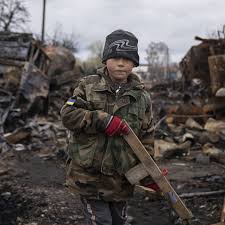 Carl Conetta, 4 Feb 2026
 Carl Conetta, 12 January 2026 – Full text⇒
 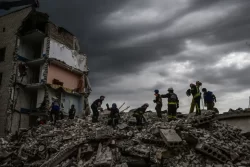 Carl Conetta, 12 January 2026
 US President Trump’s commitment to having the US disengage from the war (and NATO generally) is one motivating factor for the 2025 effusion of Ukraine peace and cease-fire proposals. Against this, there are the contending “victory camps” who seek or counsel to “stay the course.” The Kremlin represents one victory camp; The other comprises Kyiv, NATO and EU security managers, and an array of liberal hawks and neo-cons on both sides of the Atlantic. Of course, political leaders on all sides must to some degree assuage public opinion and this has increasingly favored finding a way to end the war diplomatically as soon as possible. Commensurate with this has been fairly uniform public support for allocating less resources to the war.
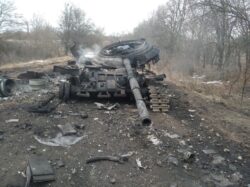 These realities have affected Ukrainian public opinion. So has the staggering number of fatalities suffered since the war began – probably more than 85,000 soldiers and 30,000 civilians killed.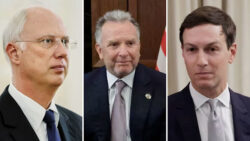
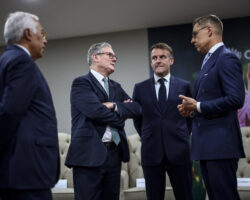 While Kyiv’s plight is indeed serious and immediate, the capacity of its European partners to counter-balance Russian power is prodigious. For various reasons, European material support has been limited so far and its direct combat support, marginal. But the degree and nature of European support is subject to political and strategic pressure and calculation. It increased significantly in 2025. It is more than plausible that leading NATO countries and especially those bordering Ukraine will not simply stand by and let the Ukrainian front collapse. Zelenskyy depends on this prospect, which undergirds his recalcitrant response to demands for concessions.
 President Trump’s shifting engagement with the war’s principal antagonists does not evince an erratic approach to the war. Nor does the fact that his proposals seem to tilt first one way and then the other show capriciousness. Trump is employing a flexible transactional approach aiming to walk the opponents toward a pause in fighting for which he can claim credit and/or create a justification for the USA to exit the war. In this approach it matters not much (if at all) who eventually exercises dominion over Crimea and the Donbas. What matters is self-aggrandizement and national disengagement. But the President’s idiosyncratic approach has had unintended effects on public opinion which have rebounded to the advantage of neo-cons and liberal hawks.
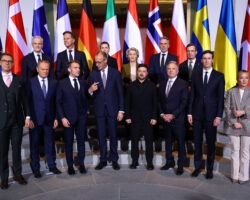 During December 2025, US and UA negotiators settled on
  The 14 Dec 2025 European “Leaders’ Statement on Ukraine” stands alongside the 20-point framework. Its most important addition is an envisioned “European-led ‘multinational force Ukraine’. This would, in prospect, draw on the 35-nation European “Coalition of the Willing” (which was formed in March 2025) and be supported by the USA “to assist in the regeneration of Ukraine’s forces, secure Ukraine’s skies, and support safe seas, including through operating inside Ukraine.” Elements of this might also serve as an inter-position force during the ceasefire period.
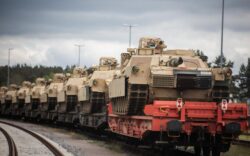 The type of proposal that would least excite existential fears and reflexes on all sides is a simple unconditional ceasefire in place – much like the one proposed by US President Trump on May 8, 2025, but with a critical difference. As noted previously, Trump’s March and May initiatives were non-starters because they failed to take into account current battlefield and sustainment realities, which were strongly trending against Ukraine. For this reason the proposal benefited Kyiv more than Moscow. Putin cited these factors when he rhetorically asked if Ukraine would use the ceasefire period “
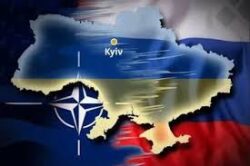 The Western alliance could potentially bring to the conflict a type and level of resources that would completely transform the war’s balance of power. Today Russia’s GDP is ten times larger than Ukraine’s (in Purchasing Power Parity or PPP terms). Its defense budget is twice as large. And its active-duty armed forces personnel roster is at least 50% larger. But these ratios are much more favorable for Ukraine today than in 2022 due to the efforts of the Ukrainian people and $400 billion in outside transfers. These transfers (of cash and goods) were equivalent to more than two years of the country’s pre-war GDP. But outside supporters could do much more if they chose, as noted above.
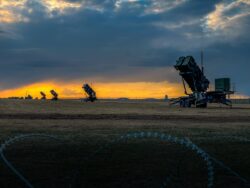 Despite the fact of European public opinion running increasingly against the option of deeper involvement, an operational fracture of the Ukrainian front could prompt direct intervention by a subset of European powers. These might set out to form a passive but strong defensive line in western Ukraine some distance from the Russian line. In that case this war might “end” with a standoff inside Ukraine between Russian forces and a coalition of Ukrainian and select European powers – a new East-West central front frozen by the risk of regional and possibly nuclear war. Short of this, a broader Western response to a crisis in Ukrainian’s posture might include Western troops entering to take up support roles, increased presence of foreign “volunteer” units, anti-missile and anti-drone operations conducted from or over Western territory, and a surge in Western material and financial support. Of course, a great deal depends on America’s stance.
 In recent decades, Moscow has opposed numerous western international initiatives, beginning with the 1999 Kosova war. Major turning points in the relationship were the 2007 Munich Security Conference, where Putin vehemently criticized American unipolar dominance and NATO expansion, and the 2008 Russian military intervention in the Georgian civil conflict. Washington and Moscow have also been at loggerheads over Libya, the 2003 Iraq war, Syria, Iran, Cuba, and Venezuela. Recently, Russian private military companies have been displacing Western troop presence in Niger, Mali, and Burkina Faso.
 Carl Conetta, 15 Oct 2025
 With the advent of the Trump administration, Ukraine has lost its primary war sponsor. This makes especially relevant Lutz Unterseher’s “
 Carl Conetta, 22 January 2025. Full text ⇒
  At present, the most critical international security concern regarding Syria is its stabilization – and that requires immediate and substantial aid and sanction relief. It also hinges on the new government’s capacity to restore sovereignty. Should the new government reverse course and pose a threat to global peace, the international community can adjust policy accordingly. But first things first. Full article:
  Confounding current policy on the new Syria is
  Today, the defacto governing authority of Syria, the transitional government, is led and essentially controlled by
  The presence of foreign troops on Syrian soil directly violates the nation’s sovereignty, excepting those invited by national authorities and operating under the equivalent of a Status of Forces Agreement.
  Affirming Syrian sovereignty entails
  Also at issue: What will be the future disposition of the
  Another urgent matter is
  Author James Durso offers a rather harsh assessment of Zelensky’s war leadership: The former head of UA military, Gen Zaluzhnyi, argued that in 2023 that the war would stalemate and attention should turn to negotiations. “But Zelensky had no interest in diplomacy, because ending the war would mean ending the state of emergency, new elections and a change in the structure of international assistance. In his own political interest, he ousted Zaluzhnyi and continued a war he was warned would waste lives and money without result.” From The Hill, article links
 “The SADM (Special Atomic Demolition Munition) was a top secret nuclear weapon no different from the one dropped on Hiroshima, but with one crucial difference: it was small enough to fit inside a rucksack.” In 1983, a squad of Green Berets thought they were headed to Cuba to parachute in with mini-nukes. Not so. Just a practice run. ??? Daily Mail,
  “The war in Gaza has provoked widespread humanitarian concerns, ranging from famine to ethnic cleansing. A United Nations special committee even warned Israel’s tactics in the Palestinian enclave were “consistent with genocide… But since the war was launched in October 2023, the US has been unwavering in its support for Israel’s campaign. The Biden administration provided at least $17.9bn in military aid to Israel in the first year of the war — a record sum for the Middle East country.” Al Jazeera,
  “At least four people were killed and 21 others injured in the attack on [Dec 26] after Israel struck the international airport in Sana and the city of al Hodeida.” Common Dreams,
  “The International Committee of the Red Cross (ICRC) reiterates its urgent call for the respect and protection of medical facilities in line with international humanitarian law. This protection is a legal obligation and a moral imperative to preserve human life.” International Committee of the Red Cross report
  Rajan Menon:
  from Al Jazeera:
 New Arab,
  Daily Mail,

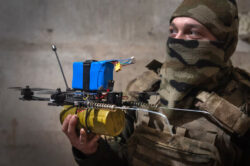 David Ignatius reports in a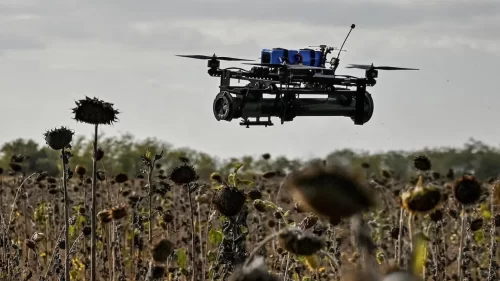
 Manbij is a cross-roads city on the western side of the Euphrates not far from the Tishrin Dam hydroelectric plant. It’s the centerpiece of the small-slice of territory west of the river held by the US-backed Kurdish-led Syrian Democratic Forces. It has been for years a focus of struggle between the Turkey-backed Syrian National Army and the SDF (which Ankara considers a terrorist organization due to its informal relation to the Turkey-banned Kurdistan Workers’ Party.)
 The warbirds and scavengers are circling: “The US has struck targets associated with Islamic State (IS) in central Syria, while Turkey has attacked US-backed Kurdish forces.” [ Comment: There has been some question about the identity of targets in some strikes. Notably, some local Sunni tribes have been in contention with the Kurdish presence in some areas. These may be tied in to Turkey-supported Sunni militiants, not ISIS. ]
 from The Jerusalem Post: “Most of the strikes were in southern Syria and around the city of Damascus, targeting Syrian army bases, with an emphasis on air defense systems and stores of surface-to-surface and surface-to-air missiles.” Sources also report strikes on air bases housing jets and helicopters. “The air force also reportedly struck several strikes on a research center on the outskirts of Damascus and a center for electronic warfare near the Sayeda Zainab area of the capital. Jerusalem Post,
  There are several NGO efforts in Ukraine to identify troops killed in war by name, gleaned from public announcements, mostly internet. These offer estimates of between 58,000 and 65,000 dead. A similar effort by dissident Russians working with the BBC has found the names of 82,000 Russian soldiers killed in war. BBC,
  The Defense Post
  from USNews
 US forces may well have attacked (or counter-attacked) Syrian government or Iranian militia units while supporting operations by America’s Syrian Kurdish allies. The possible US attack on Syrian government and/or allied units may well have been inadvertent. But the events go to show that involvement in a chaotic situation leads to chaotic outcomes.