
Carl Conetta
Media Hawks Make Case for War Against Iran
“Media Hawks Make Case for War Against Iran,” fair.org/home/media-haw – “The media hawks are flying high, pushing out bellicose rhetoric on the op-ed pages that seems calculated to whip the public into a war-ready frenzy.” Neocons have been talking for a long time about “Real Men Go to Tehran.” Odd it took a Democratic president to enable, provision, and okay the attack. Or, given the pending US election, maybe not so odd.
Zelensky’s ‘Victory Plan’ Is Old Wine in a New Bottle
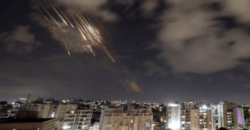
“Zelensky’s ‘Victory Plan’ Is Old Wine in a New Bottle,” https://newsweek.com/zelenskys-victory-plan-old-wine-new-bottle-opinion-1959980 – Yes, there’s nothing new. The new bottle? That might be labeled “Kursk”. 🔹The Kursk incursion gives the impression that Ukraine can retake the offensive in a lasting, decisive way. But the author argues: 🔹 wars are “won on mass. On this metric, the Russians have the advantage. Putin has more fighting-aged men to throw into the cauldron and more bombs to chuck at the problem.” 🔹 Author concedes that material advantage does guarantee victory, but it does guarantee a long war – and this one is a disaster for the world. Also, 🔹despite Ukraine’s counterstrokes, it hasn’t shown the wherewithal to exploit them effectively.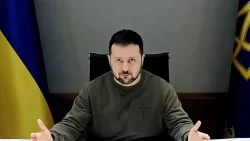
A Significant Change in Russian Doctrine on Nuclear Weapon Use
 Carl Conetta, 26 Sept 2024. Full text ⇒ HTML
Speaking to the Russian Presidential Security Council on Sept 25, 2024, Vladimir Putin asserted that “Aggression against Russia by any non-nuclear state… supported by a nuclear power should be treated as their joint attack.” But what does this imply for the Ukraine war and more generally? Although the announcement reaffirms several long-standing provisions of Russian nuclear weapon doctrine, it does add something new and portentous. It asserts that Russia may reply to a massive aerial attack on the homeland while it is underway even if the attack is purely conventional. The perceived “massiveness” of the attack is held practically speaking to be equivalent to an existential attack. The new view may also imply that such an attack by Ukraine would be considered a joint UA-NATO attack and possibly warrant a similar response.
Putin Announces Significant Change in Russian Nuclear Use Doctrine
Carl Conetta, 26 Sept 2024
Speaking to the Security Council on Sept 25, 2024, Russian Pres. Vladimir Putin asserted that “Aggression against Russia by any non-nuclear state… supported by a nuclear power should be treated as their joint attack.” What’s the implication of this?
Putin’s proposition simply raises the threat potential that he attributes to the Ukraine war. Asserting a critical linkage to a nuclear state supposedly increases the existential valence of the war. Of course, he has called it a “proxy war” before, but now he’s emphasizing that the involvement of a nuclear-weapon state lowers the threshold for nuclear use...in some new ways, as noted below.
Putin also said a nuclear response would be considered if Moscow receives “reliable information” about a “massive” missile, drone, or piloted aircraft strike against Russia or Belarus. What’s more, he declared that nuclear weapons might be used to blunt a “critical threat to either states’ sovereignty [even] through the use of conventional weapons” alone. This latter proposition is not actually new.
Existing doctrine allows for the use of nuclear weapons in several cases of conventional attack – not only existential challenges, but also those seeking to blunt Russia’s nuclear retaliatory capacity. (A relevant question: Does part of that retaliatory capacity now reside in Belarus?)
What’s not clear and demands clarification is, first, whether “reliable information” of a massive aerial attack will by the very fact of its perceived “massiveness” be taken to possible warrant a nuclear response even if the enemy may be using conventional means only? In other words, Putin may be warning: don’t attempt a massive conventional aerial attack because while underway it will be treated as a challenge to Russian nuclear retaliatory capacity or sovereignty – a challenge worthy of a nuclear riposte.
A second needed clarification pertains to whether a “massive” aerial attack launched by Ukraine alone might likewise warrant a nuclear response by virtue of its “massiveness” and the Ukraine-NATO link. This is a lower threshold for use than understood previously. Of course, if this is what Putin is implying, the fact of his saying it doesn’t necessarily make it more than another weak red line. Not necessarily. Ukraine has previously attacked Russia with well-over 100 drones simultaneously. What response would a much larger attack bring – especially if employing NATO ground-based missiles and F16-launched NATO-built cruise missiles?
Putin verbatim: Ukraine’s Use of NATO Deep Strike Missiles Would Put West at War with Russia
14 Sept 2024. Full Text = HTML
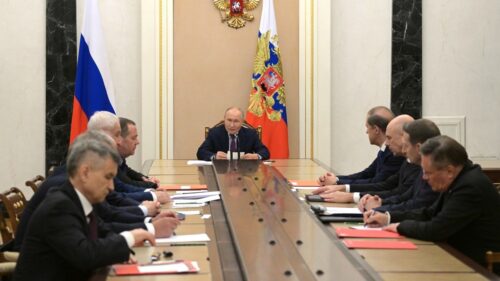
Pres. Putin says that Ukraine’s use of Western long-range high-precision weapons to strike deep inside Russia would require Western satellite guidance and personnel support to “assign flight missions to these missile systems.” Thus, as he sees it, the West would be directly involved in such strikes, and this would put “NATO countries… at war with Russia.” Contains full official statement.
Putin verbatim: Ukraine’s Use of NATO Deep Strike Missiles Would Mean West at War with Russia
Summary: Putin asserts that Ukraine’s use of Western long-range high-precision weapons to strike deep inside Russia would require Western satellite guidance and the involvement of Western personnel to “assign flight missions to these missile systems.” Thus, as he sees it, the West would have to be involved in the strikes. He says this would “mean that NATO countries – the United States and European countries – are at war with Russia.” Verbatim report follows:
Media Question: “Over the past few days, we have been hearing statements at a very high level in the UK and the United States that the Kiev regime will be allowed to strike targets deep inside Russia using Western long-range weapons. Apparently, this decision is either about to be made, or has already been made, as far as we can see. This is actually quite extraordinary. Could you comment on what is going on?”
President of Russia Vladimir Putin: “What we are seeing is an attempt to substitute notions. Because this is not a question of whether the Kiev regime is allowed or not allowed to strike targets on Russian territory. It is already carrying out strikes using unmanned aerial vehicles and other means. But using Western-made long-range precision weapons is a completely different story.
“The fact is that – I have mentioned this, and any expert, both in our country and in the West, will confirm this – the Ukrainian army is not capable of using cutting-edge high-precision long-range systems supplied by the West. They cannot do that. These weapons are impossible to employ without intelligence data from satellites which Ukraine does not have. This can only be done using the European Union’s satellites, or US satellites – in general, NATO satellites. This is the first point.
“The second point – perhaps the most important, the key point even – is that only NATO military personnel can assign flight missions to these missile systems. Ukrainian servicemen cannot do this.
“Therefore, it is not a question of allowing the Ukrainian regime to strike Russia with these weapons or not. It is about deciding whether NATO countries become directly involved in the military conflict or not.
“If this decision is made, it will mean nothing short of direct involvement – it will mean that NATO countries, the United States, and European countries are parties to the war in Ukraine. This will mean their direct involvement in the conflict, and it will clearly change the very essence, the very nature of the conflict dramatically.
“This will mean that NATO countries – the United States and European countries – are at war with Russia. And if this is the case, then, bearing in mind the change in the essence of the conflict, we will make appropriate decisions in response to the threats that will be posed to us.”
Source: President of Russia website: “Answer to a Media Question,” 12 Sept 2024,
Expert Letter on Ukraine: NATO Should Not Move Ukraine Toward Membership
 July 3, 2024 – Full letter with 61 signatories ⇒ PDF
The letter argues that “the closer NATO comes to promising that Ukraine will join the alliance once the war ends, the greater the incentive for Russia to keep fighting the war.” Moreover, the letter argues that the West can manage the challenges that Russia poses without bringing Ukraine into NATO. Indeed, “moving Ukraine toward membership in the alliance could make the problem worse, turning Ukraine into the site of a prolonged showdown between the world’s two leading nuclear powers.”
Why the Biden Cease-fire Proposal Will Not End the Gaza War Despite UN Approval
 Carl Conetta, 12 June 2024. Full text ⇒ HTML
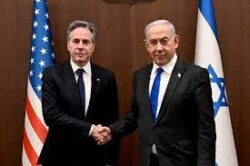
The proposal that the Biden administration attributes to Israel does not promise an end to the war, much less Israeli withdrawal from Gaza. While claiming to support the proposal, Prime Minister Netanyahu also asserts that “we have maintained the goals of the war, first of them the destruction of Hamas.” Is this consistent with the proposal? It is. How?
Why the Biden Cease-fire Proposal Will Not End the Gaza War Despite UN Approval
Carl Conetta, 12 June 2024
The UN Security Council resolution supporting the Biden ceasefire proposal evinces the broad support for ending the slaughter in Gaza. But Biden’s proposal does not promise an end to the war, much less Israeli withdrawal from Gaza, which is a key Hamas demand. By contrast, it does allow that Israel can accomplish its war aims by one means or another, following a humanitarian pause and partial hostage exchange. And while Washington plays the peacemaker, the Israeli offensive and US material support for it proceeds unimpeded. It’s a clever move, pushing a UN resolution that specifically pressures Hamas, while US-supplied Israeli bombs and shells continue to fall.
In some ways the proposal is similar to the one advanced in early May by Egypt and Qatar. Hamas accepted that proposal while Israel summarily rejected it, asserting that it was “far from Israel’s necessary requirements.” By contrast, Netanyahu’s response to the new proposal is more availing, although hardly the embrace implied by the UN resolution. Accordingly he has said “We reserve the right to return to war.” Does the new proposal allow that? It does. How?
In the earlier proposal, a temporary cease-fire leads organically to a permanent one should it hold for about 12 weeks. During this time humanitarian relief and some hostage exchange would supposedly occur. By contrast, in the Biden proposal, the transition to a permanent cease-fire is contingent on Israel and Hamas negotiating additional conditions for it. So, the move to a permanent cessation of military operations and hostilities remains contingent.
The proposal does provide that the cease-fire should continue for as long as the negotiations “are ongoing.” But what happens should either party decide the other is intransigent and exit the negotiations after six or more weeks? It is back to war – with the IDF still deployed in Gaza. So there’s no contradiction in Netanyahu claiming to accept the proposal while also asserting that “we have maintained the goals of the war, first of them the destruction of Hamas.” This does not bode well for ending the war.
Biden expressed the proposal’s true vector early in his May 31 remarks, promising a “‘day after’ in Gaza without Hamas in power.” But framing the proposal as guaranteeing the defeat of one side is hardly the basis for successful negotiations between contestants. Not surprisingly, Hamas has offered a counter-proposal seeking “written guarantees from mediators that a ceasefire would follow the hostage exchange.”
Brinkmanship and Nuclear Threat in the Ukraine War
 Carl Conetta, 31 May 2023. Full text ⇒ HTML – PDF
Western leaders and Kyiv pledge to “stay the course” despite Russian nuclear threats. But does western brinkmanship in the Ukraine war depend on denying there is a brink? This short article examines “nuclear threat denialism” and its function in war policy. It explores Moscow’s most likely but occluded nuclear option and the unique danger it represents. And the post examines the relevance of the Cuban Missile Crisis to the current conflict.
Brinkmanship and Nuclear Threat in the Ukraine War
Western brinkmanship in Ukraine depends on denying there is a brink. That’s a mistake.
Carl Conetta, 31 May 2023
How to assess the risk that Moscow will use nuclear weapons to rescue some part of its “special military operation” in Ukraine? Look to nuclear capability, operational effectiveness, the value of the asset or position Moscow hopes to protect, the likely retaliation it will face or price it will pay for nuclear use, and its ability to defer that price or parry retaliation.
There is no doubt that Russia has the capability to conduct a limited nuclear attack on Ukraine while retaining thousands of additional nuclear weapons, both strategic and tactical, to parry retaliation by third parties. This is a common (albeit delusional) “limited nuclear war” script entertained by both the USA and Russia for decades.[1]
Although a limited nuclear battlefield attack would not knock Ukraine out of the war – even in prospect – the goal of such an attack might be to prompt Brussels and Washington to seek a ceasefire out of fear of a broader war. Moscow’s wager would be that this is a more likely Western response than escalation. Moscow would also be betting specifically that the West would not risk the destruction of Washington, Berlin, or Paris in order to punish an attack on a Ukrainian field army. But would Moscow roll these dice?
For what it is worth, Russian nuclear doctrine provides considerable leeway for the use of nuclear weapons.[2] This helps shape the expectations of and planning by state and military security managers. In Russian doctrine, as in Western, there are provisions to “extend” the use of nuclear weapons to circumstances other than meeting a nuclear attack.[3] Over the past year and more, Russian leaders have pointed to Russian doctrine allowing nuclear use to blunt conventional attacks that challenge “the sovereignty and territorial integrity of the state,” put “the existence of the state under threat,” or attack state or military assets essential to nuclear retaliatory capacity.[4]
The threshold for several of these guidelines is unclear. How close and how fast can a NATO-supported Ukrainian offensive come to the Russian border before possibly triggering a response? Also, notably, Russia has laid claim to five Ukrainian oblasts as its own. Does the Russian nuclear umbrella cover these?
Russian doctrine also allows the use of nuclear weapons simply to limit the escalation of military conflict and help ensure its “cessation on conditions acceptable to the Russian Federation.” This seems to allow using nuclear weapons in some presumably “extreme” circumstance to prevent catastrophic battlefield defeat, regardless of where it happens. (The United States also extends its “nuclear umbrella” to additionally address places and circumstances beyond nuclear attack on the homeland.)[5]
The real question deciding the credibility of Russian threats concerns Moscow’s cost-benefit calculus should it face decisive defeat in Ukraine. What are the repercussions for Moscow’s regional and global sway of accepting a decisive defeat in Ukraine and allowing the likely advance of NATO (after decades of sternly inveighing against expansion)? How do these losses compare with the likely costs and risks of nuclear use?
Is there a nuclear brink?
Some observers flatly dismiss the likelihood of Moscow escalating to the nuclear level, arguing that its stakes in the Ukraine war are not great enough to warrant the likely retaliation and certain global censure that would follow. For instance, Steven Pifer, a former US ambassador to Ukraine, writes:[6]
 “It makes little sense for the Kremlin to run that risk in a conflict that is not existential. Russia can lose this war—that is, the Ukrainian military could drive the Russians out—and the Russian state will survive. The Ukrainian army will not march on Moscow.”
It is dangerous, however, for Westerners to presume to define for Moscow what it sees as an existential threat to the Russian state. Consistent Russian policy statements, investment, and action all suggest that Moscow views the nation’s critical interests to substantially exceed the mere survival of the state, writ small.
Pifer’s statement might be read as more motivational than predictive, aiming to shape allied opinion – reassure it – and convince Moscow that Westerners intend to “stay the course.” In this way, the statement might itself be an act of brinkmanship, evincing a stout willingness to risk an adverse outcome.
That said, it would be a grave error to underestimate or understate Russia’s strategic stakes in the war as it and they have evolved. Moscow accepting a dramatic defeat on its border (and presumably acquiescing to the eventual advance of NATO) would signal the eclipse of Russian global power. This expectation is shared by top US leadership.[7] Such a development would likely presage not only the wider advance of NATO – to Moldova and Georgia, for instance – but also the enervation of Moscow’s alliances and the eventual destabilization or realignment of its state partners. Russia’s political, economic, and military leadership would most likely view this chain of eventualities as undermining essential prerequisites of national power, security, and wealth. Thus the pressure to meet a dramatic challenge with dramatic action is considerable.[8]
Nonetheless, in a recent study, we too concluded that Putin would not likely execute a deadly nuclear attack in response to a decisive Ukrainian military advance.[9]
Moscow’s most likely nuclear option
We assess the likelihood of deadly nuclear use to be low not simply because the tactical effect of battlefield nuclear weapons would be unsatisfactory, nor simply because retaliation and censure would follow any such attack. The pivotal reason is that Moscow has a practicable lower-risk alternative option for compelling a ceasefire and a negotiated settlement short of Russia’s total defeat.
In the event of a decisive Ukrainian drive toward the Russian border or Crimea, Moscow could move to raise the war readiness of its strategic and tactical nuclear forces to a crisis level, while “reassuring” the West that this move is purely precautionary. The immediate aim would be to provoke a Russia-USA nuclear face-off short of war. Less likely but also possible would be a test explosion of a Russian nuclear weapon over Russian territory. (Nuclear demonstration shots accord with Russian doctrine.)
US-NATO would predictably respond to a real and evident spike in Russian nuclear readiness with a comparable increase in nuclear readiness, resulting in a stand-off. This stand-off would be more dangerous than the Cuban Missile Crisis because it would be rooted in a very bloody ongoing war on the border of Russia that involves a third party – Ukraine – not entirely under NATO control.[10] Moscow’s aim would be to collapse the NATO consensus for war – a quite plausible outcome, especially in light of French, German, Italian, Greek, and Hungarian sentiment.
A Russian feint toward nuclear use is still remarkably dangerous, of course. As we wrote previously, it is “crisis instability that poses the greatest danger of nuclear cataclysm.”[11] Any hair-trigger standoff increases the likelihood of rash, mistaken, or accidental nuclear use. During the Cuban crisis there were several close calls. And there have been others in other crises.[12]
We are closer today to a nuclear clash than at any time in the past 60 years. And we will grow closer still if, or when, the two nuclear weapon superpowers raise their war readiness levels. Some US leadership statements about war goals indicate that US brinkmanship is partially driven by the prospect of a dramatic reduction in Russian power and the possible demise of Vladimir Putin.[13] These prospects may also feed misplaced warnings about the dangers of diplomacy and problematic assertions about what Moscow may or may not consider an existential challenge. Both instances of nuclear danger denial may serve and evince brinkmanship.
As noted, Russia and the West have previously managed a confrontation similar in relevant respects to the current one – the 1962 Cuban Missile Crisis[14] – which can help illuminate the options and arguments we entertain today
JFK, McGeorge Bundy, and General Curtis LeMay
Reflecting on the crisis 26 years after the fact, US Pres. Kennedy’s national security advisor McGeorge Bundy estimated that the 1962 standoff had involved a 1/100 risk of nuclear war.[15] But how worrisome are those odds, if true? Trying to weigh the likely cost of nuclear war, Bundy thought (at least in retrospect) that the risk was too high to push forward with a more aggressive response to the Soviet placement of nuclear missiles in Cuba. Bundy wrote “In this apocalyptic matter the risk can be very small indeed and still much too large for comfort.”[16]
In the event, Pres. Kennedy decided to blockade the further transfer of Soviet missiles and seek a diplomatic solution – horse-trading, as it turned out – to remove the assets already in place. In this, he rejected the proposal to bomb Cuba put forward by the head of the US Air Force, General Curtis LeMay. Kennedy was worried that the Soviets would retaliate for a strike on Cuba with action in Berlin or elsewhere, and the two nations would climb the escalation ladder. LeMay dismissed this concern by saying that wherever the Soviets might act the USA could best them, and so they would be deterred or defeated. LeMay told Kennedy that the President’s alternative – which resolved the crisis with a single US fatality (U-2 pilot Maj. Rudy Anderson) – was “almost as bad as the appeasement at Munich.”[17]
This debate still resonates today – Kennedy vs LeMay – but one reality has been papered over, and the occluded variable is essential to setting a wise limit on brinkmanship. As McGeorge Bundy observed, a pivotal consideration in managing nuclear standoffs is (or should be) that even a very limited strategic nuclear exchange “would be a disaster beyond history.”[18] If the threat is even marginally credible, then caution is due and diplomacy wise.
Notes
1. Amy F. Woolf, “Nonstrategic Nuclear Weapons,” US Congressional Research Service, Washington DC, 07 Mar 2022. Also see: William A. Chambers, John K. Warden, Caroline R. Milne, and James A. Blackwell, “An Assessment of the US-Russia Nonstrategic Nuclear Weapons Balance,” Institute for Defense Analysis, Jan 2021.
2. Michael Kofman and Anya Loukianova Fink, “Escalation Management and Nuclear Employment in Russian Military Strategy,” War on the Rocks, 19 Sep 2022. Also see: Kofman, Fink, and , Russian Strategy for Escalation Management: Evolution of Key Concepts (Arlington Virginia: CNA, Apr 2020).
3. Extended nuclear deterrence
- Michael J. Mazarr, “Understanding Deterrence,” RAND Corp Perspective, 2018.
- Shannon Bugos, “Russia Releases Nuclear Deterrence Policy” Arms Control Today (July/August 2020).
- Valeriy Akimenko, “Russia and strategic non-nuclear deterrence,” Chatham House briefing, 29 Jul 2021.
- “Extend deterrence,” Air Force Doctrine Publication 3-72, Curtis LeMay Center for Doctrine Development and Education, USAF, 18 Dec 2020.
4. Center for Naval Analysis, translation, “Foundations of State Policy of the Russian Federation in the Area of Nuclear Deterrence,” June 2020.
5. US nuclear doctrine similarly allows globe-spanning nuclear use to protect US assets, critical interests, allies, and partners from a variety of devastating attacks – not just nuclear. However, US policy does importantly limit nuclear action to use only against other nuclear weapon states, non-members of the Non-Proliferation Treaty (NPT), and those NPT member states that Washington may view as in violation of their treaty obligations.
- US Dept of Defense, 2022 National Defense Strategy, Incorporating the Nuclear Posture Review and the Missile Defense Review (Washington DC: 2022).
- “Extend deterrence,” Air Force Doctrine Publication 3-72, Curtis LeMay Center for Doctrine Development and Education, USAF, 18 Dec 2020.
6. Steven Pifer, “Would Putin Roll the Nuclear Dice?” Time, 18 Oct 2022
7. US Officials foresee the eclipse of Russian power
- DNI Haines, “Opening Statement” on the “2023 Annual Threat Assessment of the US Intelligence Community,” DNI, 04 Apr 2023.
- “Russia-Ukraine war: Putin has already lost ‘strategically, operationally and tactically’, says US general,” The Guardian, 14 Feb 2023.
- “Russia Suffers ‘Catastrophic Strategic Disaster’ in Ukraine,” DOD News, 09 Nov 2022
8. Russian voices urging use of nuclear weapons
- “Russian Radio Host Pressures Putin to Change View of Nuclear Weapon,” Reuters, 10 May 2023.
- “Kadyrov says Russia should use low-yield nuclear weapon,” CNBC, 1 Oct 2022.
- “‘Only one option’: Pro-Russian commander urges nuclear war with NATO as Ukraine regains ground,” AlterNet.com, 14 Dec 2022.
9. Carl Conetta, “Tempting Armageddon: The Likelihood of Russian Nuclear Use is Misconstrued in Western Policy,” Project on Defense Alternatives Policy Report, 02 Feb 2023.
10. National Security Archive, “Cuban Missile Crisis at 60,” accessed 01 Jan 2023. Also see: Avalon Project, “The Cuban Missile Crisis,” Yale Lillian Goldman Library, accessed 01 Jan 2023.
11. op cit, Conetta, “Tempting Armageddon.” Subsection: “Crisis Instability: The Certain Danger”
12. There have been dozens of nuclear weapon-related accidents since the 1945 as well as a handful of publicly-known incidents of mistaken near-use due to faulty perception of attack. A high percentage of these false warnings occurred during conflict crises – in 1956 during the Suez Crisis, 1973 during the Arab-Israeli October War, and most critically during the Cuban Missile Crisis when a Soviet submarine nearly launched a nuclear torpedo, US radar operators separately mistakenly reported to the US air defense command that a missile attack was underway, and a US F-102 fighter armed only with nuclear air-to-air missiles rushed to protect a U-2 that had wandered into Soviet air space. It should not be surprising that mistaken perceptions or rash action cluster around crisis periods.
Patricia Lewis, Heather Williams, Benoît Pelopidas, and Sasan Aghlani, “Too Close for Comfort: Cases of Near Nuclear Use and Options for Policy,” Chatham House Report, April 2014.
13. US objectives
- “Biden adviser embraces effort to weaken Russia and make example of Putin,” Washington Examiner, 22 July 2022.
- “US war aims shift in Ukraine – and bring additional risks,” NPR, 27 Apr 2022.
- “The US has a big new goal in Ukraine: Weaken Russia,” Washington Post, 26 Apr 2022.
- “Pentagon chief says US wants to see Russia ‘weakened’,” The Hill, 25 Apr 2022.
- “Biden contradicts aides and reaffirms his call for Putin’s overthrow, NY Post, 28 Mar 2022.
- “Biden: ‘For God’s sake, this man cannot remain in power’,” The Mercury News (AP), 26 Mar 2022.
14. See ft. 10
15. McGeorge Bundy, Danger and Survival: Choices About the Bomb in the First Fifty Years (New York: Random House, 1988); Graham Allison, “The Cuban Missile Crisis at 60: Six Timeless Lessons for Arms Control,” Arms Control Today (October 2022).
16. McGeorge Bundy, Danger and Survival: Choices About the Bomb in the First Fifty Years (New York: Random House, 1988) p 461
17. Gen. Curtis LeMay, “This is Almost as Bad as the Appeasement at Munich,” transcript and recording, “The Fourteenth Day,” accessed 10 Jan 2023.
18. McGeorge Bundy, “To Cap the Volcano,” Foreign Affairs 48, no. 1 (October 1969).

“Nuclear Blackmail” – Misdirection in the Ukraine War Debate
Some say that turning to diplomacy in the face of nuclear threats will prompt a rash of nuclear proliferation and coercion. They’re wrong.
 Carl Conetta, 30 May 2023
Moscow’s repeated warnings about possible world war and nuclear conflict in response to Western support for Ukraine’s fighting forces have elicited calls in the West to resist “nuclear blackmail.”[1] Some observers go further to claim that moderating Western policy in light of nuclear dangers would actually increase the likelihood of nuclear war, if not now then in the future.[2] Prof Timothy Snyder (Yale University) advances the argument succinctly. He writes:
“All of you who are saying that we have to give in to [Russian] nuclear blackmail are making nuclear war more likely. Please stop. When you give in to it, you empower dictators to do it again, encourage worldwide nuclear proliferation, and make nuclear war much, much more likely.”[3]
The stratagem of this argument is to turn concern about nuclear war against itself; To see the concern itself as the problem. This is wrong headed. There are a variety of effective and sensible ways to inhibit nuclear weapons proliferation, but categorically daring nuclear threats made by nuclear weapon superpowers fighting wars on their borders is not one of them.
What to do in light of nuclear threats depends on assessments of threat capability, threat credibility, the value of what is at risk, and capacities for retaliation on all sides. Based on these factors, we might figure a rough likelihood of nuclear use, which weighs against any potential conventional gain or loss. How to respond admits a wide range of options, not just a binary choice between capitulation and absolute victory.
About the Russia-Ukraine war one thing is sure: Regardless of outcome at this point, it hardly stands as a positive advertisement for aggression or for Russian power generally.
Now, turning to the specific problem of nuclear-weapon proliferation:
The principle impetus for non-nuclear nations to pursue nuclear weapons is contention with existing nuclear weapon states or with adversaries who possess overwhelming conventional military superiority. These concerns seem sufficient to outweigh any doubts about the efficacy of nuclear deterrent threats. Reinforcing the pursuit of these weapons is the fact that both Washington and Moscow have long embraced and advocated strategies of extended nuclear deterrence – which amount in part to using nuclear threats to putatively stem non-nuclear ones.[4]
Thankfully, it’s a steep climb to nuclear weapon capability – dangerous, costly, and technically challenging. The most reliable way to inhibit the transfer of proscribed material and technology is close cooperation among all major nuclear-weapon states in non- and counter-proliferation efforts. In this light, it is worrisome that relations among the nuclear-weapon superpowers have become so badly frayed.
“Nuclear Blackmail”
The term “nuclear blackmail” has often been employed to introduce the idea of using nuclear weapons in coercive bargaining.[5] It allows a quick study because common blackmail is a well-known and understood form of coercion. In 2021, there were more than 12,000 US cases of blackmail and extortion recorded in the FBI crime database.[6] It is frequent because the number of potential perpetrators is enormous and the cost of entry into the practice is low. Indeed, most humans have probably already engaged in some coercive bargaining – and quite specifically, blackmail – by the time they reach adulthood. However, despite the utility of using the term “blackmail” to describe “nuclear coercion,” it can also confound policy-making if done without qualification.
The ease of entry into the practice of common blackmail sets it apart from nuclear coercion because, as noted above, the cost of entry into the club of nuclear-weapon states is very high. Also distinct is the relative ease by which a common blackmailer might remain anonymous and, thus, less vulnerable to interdiction or retaliation. Nation states, by contrast, cannot hide in the shadows when leveling nuclear threats. While common “blackmail” is a relatively low-cost, low-visibility, low-risk endeavor, nuclear coercion is none of the these things. Although the dynamics of bargaining are similar for all forms of coercion, the limits and frequency of various types is not. As always, analogy cannot substitute for analysis. And in the case of nuclear threats, the “blackmail” analogy limits our ability to manage them; It does this by distorting the risk calculus, by exaggerating the downside risk of negotiated settlement.
No matter how the Russia-Ukraine war resolves, the resolution will not alter the factors that limit capacities for nuclear acquisition and coercion. More pointedly, moderation of Ukrainian and US-NATO objectives in the war for the sake of reducing nuclear risks would not prompt a rash of proliferation. Nor will it prompt an epidemic of nuclear coercion. Visibility, counter-proliferation efforts, and the high cost of acquiring, holding, and using nuclear weapons will always weigh against proliferation. Capability, the credibility of one’s motivation, and vulnerability to retaliation will always serve as limiting factors to nuclear coercion. And nations that perceive an existential threat will always seek more powerful means of defense or alliance with those possessing it.
Notes
1. A selection of Russian nuclear threats related to the Ukraine war
- “Putin reminds everyone that Ukraine joining NATO could lead to nuclear war,” Bulletin of the Atomic Scientists, 11 Feb 2022.
- “Russia ready to defend itself with any weapon, including nuclear – Medvedev,” Tass, 22 Feb 2022.
- “‘No other option’: Excerpts of Putin’s speech declaring war,” Al Jazeera, 24 Feb 2022.
- “Putin waves nuclear sword in confrontation with the West,” AP, 25 Feb 2022.
- “Russian strategic deterrence forces go on enhanced combat alert – top brass,” Tass, 28 Feb 2022.
- “Russia’s Lavrov: A third world war would be nuclear, destructive,” Al Jazeera, 02 March 2022.
- “Putin’s spokesman Dmitry Peskov on Ukraine and the West: ‘Don’t push us into the corner’,” PBS News, 28 Mar 2022.
- “Russia’s Lavrov: Do not underestimate threat of nuclear war,” Reuters, 25 Apr 2022.
- “Angry Putin wields energy, nuclear threats against West,” Washington Times, 27 Apr 2022.
- “Russia’s Medvedev: new regions can be defended with strategic nuclear weapons,” Reuters, 22 Sep 2022.
- “Medvedev raises spectre of Russian nuclear strike on Ukraine,” Reuters, 27 Sep 2022.
- “Russian military leaders’ talk of nuclear attack rattles US calculus,” Washington Post, 02 Nov 2022.
- “The threat of nuclear war is rising, says Vladimir Putin,” MSN, 8 Dec 2022.
- “‘Only one option’: Pro-Russian commander urges nuclear war with NATO as Ukraine regains ground,”AlterNet.com, 14 Dec 2022.
- “Putin loyalist dials up nuclear rhetoric as NATO partners push for more weapons for Ukraine,” CNN, 19 Jan 2023.
- “Russian State Duma Head Joins Officials Warning Of Nuclear Retaliation In Ukraine,” RFE/RL, 22 Jan 2023.
- “Russia signs deal to deploy tactical nuclear weapons in Belarus,” AP, 25 May 2023.
- “Russia’s Medvedev Threatens Ukraine With Pre-Emptive Nuclear Strike,” Newsweek, 26 May 2023.
2. Max Boot, “Giving in to Putin’s nuclear blackmail would be a geopolitical disaster,” Washington Post, 11 Oct 2022. Also see: Andriy Zagorodnyuk, “Bowing to Putin’s nuclear blackmail will make nuclear war more likely,” The Atlantic Council blog, 18 Oct 2022.
3. Timothy Snyder, “All of you who are saying that we have to give in to nuclear blackmail are making nuclear war more likely,” Twitter, 14 Oct 2022.
4. On Extended Deterrence
- Michael J. Mazarr, “Understanding Deterrence” (PDF), RAND Corp Perspective, 2018.
- Shannon Bugos, “Russia Releases Nuclear Deterrence Policy,” Arms Control Today, July/August 2020.
- Valeriy Akimenko, “Russia and strategic non-nuclear deterrence,” Chatham House briefing, 29 Jul 2021.
- “Extend deterrence” (PDF), Air Force Doctrine Publication 3-72, Curtis LeMay Center for Doctrine Development and Education, USAF, 18 Dec 2020.
5. On Blackmail and “Nuclear Blackmail”
- Daniel Ellsberg , “The Theory and Practice of Blackmail,” RAND Paper, RAND Corporation, 1968. https://www.rand.org/pubs/papers/P3883.html
- Thomas Schelling, Arms and Influence (New Haven: Yale University Press, 1966), Chap 1, “The Diplomacy of Violence.”
- Richard K. Betts, Nuclear Blackmail and Nuclear Balance (Washington DC: Brookings Institution, 1 July 1987)
6. Federal Bureau of Investigation, “Crime Data Explorer,” accessed: 27 May 2023.
Catastrophe: The Global Cost of the Ukraine War
Carl Conetta, 02 May 2023
 The Russia-Ukraine war has been a disaster for Ukraine, obviously – but also a calamity for the entire world. Ukraine has already suffered levels of death and destruction reminiscent of the height of the Yugoslav wars (1992-1995, 1998-1999) and the worst months of the Iraq War (2003-2011, 2014-2018); It even calls to mind the 1980-1988 Iran-Iraq war.[1] The wealth, tenacity, and exceptional military power of the contestants – Russia, Ukraine, and USA-NATO – have made for a high-intensity war. Although physical destruction has been largely limited to Ukraine, the other effects of the war have not been limited. The impact on life and livelihood outside the combatant countries has been profound. In fact, many more people have died outside Ukraine due to the conflict than inside.
The war’s acute global effect is due partly to the importance of Russia and Ukraine to global agricultural and energy production. Amplifying this, however, is the intentional global economic warfare – sanctions, blockades, embargoes – that has accompanied the fighting. And that is only part of the war’s broader impact.
The conflict and the economic warfare it involves, have driven up food and energy prices worldwide, disrupted world trade, helped stall and reverse post-pandemic economic recovery, and drawn scarce resources away from other humanitarian crises and economic development efforts. The collateral effects of the war mean not only years of additional acute hardship for a billion global citizens and lowered living standards for billions more, but also reduced action on other global threats including climate change and health crises.
As outlined below, the financial expenditures associated with the war for Russia, Ukraine, and nations supporting Ukraine has been $25 billion a month. Longer term costs include reconstruction – presently estimated at $413 billion – and a sudden jump in the base-level of annual global military spending exceeding $300 billion. Already, this is a trillion dollar war.
The combatants’ cost in human lives
An evidence based estimate of Russian military fatalities is 35,000 (as of March 2023). Ukrainian combatant fatalities probably exceed 20,000.[2] A very rough initial estimate of Ukrainian civilian fatalities is 20,000 dead due to the war’s direct effects (such as bombardment) and another 20,000 due to indirect effects (such as lack of access to essential health care).[3] Outside Ukraine, we estimate that the war’s broader effects have caused the death of more than 250,000 people (as explained below).
So far, the average level of monthly fatalities due to this war has been 27,000 people. Twenty-five thousand dead – every month: 4,000 combatants, ~3,000 Ukrainian civilians, and ~20,000 non-Ukrainian civilians. Recent disclosures of US intelligence estimates reveal an expectation that the war will not end in 2023.[4] Excluding the possibility of nuclear use – which is low but non-zero probability – the war may nevertheless claim a total of 600,000 lives before being brought to a close.
A global economic tsunami
Due to the war and how it has been fought the volume of global trade has declined 3.4%, energy prices have doubled worldwide, food prices grew by 14% in 2022 – more than that for poor countries (25%) – and a pervasive global economic slowdown has set in: The IMF forecasts a 2.8 trillion loss in global output for 2023. This reflects a sharp contraction in global growth from 6% 2021 to 2.6% in 2023.[5] Such contraction obviously undermines wage growth everywhere and either causes job loss or stymies job growth. Unemployment is not only a matter of personal economic stress, it also is a factor increasing crime rates, especially among youth.[6] And it is a correlate of increased death rates among those cast out of work.[7]
The impact of energy cost inflation
Due to the energy cost increases attending the war, the number of people living in extreme poverty worldwide increased in 2022 by between 75- and 141-million (according to different estimates) – mostly in the Global South.[8] These are households already living on the edge who cannot accommodate sharp price hikes. Energy price inflation has also affected Europe, however. The Economist research unit calculated that, given the rise in energy costs, even a mild winter such as 2022-2023 would produce at least 32,000 excess deaths in Europe.[9] The example of Germany bears this out: It suffered 8,000 excess deaths in December 2022, compared with Dec 2021.[10] Inflation affecting fuel and food consumption is not a marginal inconvenience for those living on the edge. It is a matter of life and death.
The impact of food price inflation and other limits on food supply
The rise in food prices had an incomparable negative impact on the Global South. There the rise was 25% [11]. Also affecting access to food and fertilizer was reduced supply and disrupted international transport. The UN estimates that as a result the number of people suffering acute food insecurity jumped from 282 million at the end of 2021 to a record 345 million in 2022 – an increase of 63 million (which is about 18% of the total).[12] How many collateral deaths might this imply? A low-end estimate of the number of people who died due to hunger in 2022 is 3 million.[13] (Many more died due to hunger related disease, notably high blood pressure, heart disease, and diabetes.) The 2022 increase in severe malnutrition is probably not entirely due to the war’s effects, but even if only half the increase in acute hunger is due to the conflict, the associated number of excess deaths would be more than 250,000 people – due to hunger and hunger-related health problems alone.
The “Aid Void”
International support for humanitarian assistance increased from $20 billion in 2021 to $30 billion in 2022, largely to address the global impact of the Ukraine war. But it wasn’t enough. Total funding fell short of assessed need by more than $20 billion.[14] This shortfall in aid was worse than the previous year. And it was not felt uniformly. Half the 2023 increase was allocated directly to Ukraine. This met 82% of Ukraine’s assessed need. For the rest world, 54.5% of assessed need was met.[15] This difference is not due to fatality rates being higher in Ukraine than anywhere else. They were not; Ethiopia and Somalia faced comparable humanitarian disasters in terms of lives lost.[16]
There was also a substantial redirection of Official Development Assistance (ODA) in accord with war policy. Formally, the standing rationale for ODA is to assist the market development of less developed economies. In Europe and the United States about $35 billion in development assistance is now being diverted to support in-country refugees, mostly displaced Ukrainians.[17] This is about 20% of available global ODA. (The previous high-point of in-country donor use of ODA came in 2015 due to the surge in Syrian refugees.)
Ukraine War Support vs Other Global Assistance
In addition to humanitarian aid, direct support to Kyiv’s economy and war effort – about $200 billion in a single year – has far outpaced other recent international initiatives. It is equal to the total of global ODA and humanitarian aid combined.[18] (For comparison, US and other annual support to the Afghan Mujahideen during their fight against Russian occupation between 1979 and 1990 was barely one percent the sum granted Ukraine in its first year of war, corrected for inflation).[19]
Western support for the Ukrainian war may continue at a rate of $17 billion or more per month until the conflict ends. Postwar reconstruction will require additional funds. Kyiv and the World Bank currently estimate the cost of reconstruction and recovery to be $411 billion.[20] One measure of the extent of material destruction suffered by Ukraine is the number of residential buildings damaged or destroyed: 150,000+ as of August 2022.[21]
Financial Cost to Moscow
The war cost Moscow more than $107 billion in excess spending in 2022 with as much as $60 billion of this excess being allocated to the military and security services.[22] These figures do not account for the depletion of Russian war stocks, including the expenditure of thousands of missiles and millions of artillery rounds as well as the confirmed loss of 1900 tanks, 4000 other armored vehicles, 750 artillery pieces, 78 combat aircraft, and 80 helicopters.[23] These and other material expenditures and losses add tens-of-billions of dollars to Moscow’s war bill. Russia’s GDP is estimated by the World Bank and IMF to have declined by only 2.1% in 2022 compared with 2021, despite sanctions.
Financial Cost to Kyiv
Ukraine’s immediate financial costs include a 29% reduction in its GDP (down from about $200 billion in 2021)[24] and a year-end deficit of more than $24.5 billion.[25] Government expenditure on defense in 2022 was approximately $42 billion – equivalent to 30% of the nation’s 2022 GDP. That level of defense expenditure was $33.7 billion more than had been planned prewar.[26] Notably, Ukraine’s total government expenditure in 2022 was about $75 billion with $32 billion of this sum either borrowed or granted by allied governments.[27]
Impact on Global Defense Spending
A final financial burden that the world will carry for years to come is a 2022-2024 surge in baseline annual global defense spending exceeding $300 billion – a boost surpassing all current development and humanitarian assistance. In 2021, global defense expenditure exceeded $2.1 trillion.[28] Between 2021 and 2024, the US defense budget will increase by approximately $170 billion.[29] European NATO is also expected to significantly increase military spending.[30] Russia has already done so. And we should expect the spending boost to cascade throughout Asia as well. By 2025, global military spending may exceed $2.6 trillion.
Notes
1. Although more combatants and civilians have been killed in the Yugoslav wars and the interlinked Iraq and Syria wars, the Russia-Ukraine war has proven more intensive, claiming more or equivalent lives per month on average than the aforementioned conflicts. Over a combined period of 48 months, the Bosnia and Kosovo conflicts may have claimed the lives of ~58,000 combatants and ~50,000 civilians (direct combat deaths). This entails an average monthly toll that is just a fraction of that suffered in the Russia-Ukraine war to date: 28% as great for combatant fatalities, 70% as great for civilian direct fatalities.
Looking at the interlinked Iraq and Syria wars (2003-2023): These have claimed more than 500,000 civilian dead (direct) and 450,000 combatant fatalities. In this case, the average monthly rate of civilians killed by direct means is roughly comparable. However, the average monthly rate of combatant fatalities seems substantially higher in the Ukraine conflict, with one caveat: Many of those counted as civilian dead in the Iraq and Syria cases may actually have been insurgent combatants.
An important qualification is that, while the Russia-Ukraine war involves high-intensity combat, the earlier wars had predominant phases of low-intensity conflict. Such conflicts include civil wars, insurgencies, and occasional conventional force clashes. These conflicts may evince a higher ratio of civilian-to-combatant casualties because they tend to have no discernible “front” and may flare or persist throughout a country’s expanse. The Iraq war, especially, waxed and waned over a period of 12 years. During this time there were periods of fighting that were briefly as intense as the Russia-Ukraine war.
A final relevant data point is the 1980-1988 Iran-Iraq conflict. Although a war fought for limited aims, it was characterized by numerous high-intensity battles. Revised estimates for the number of combatants killed are 250,000 Iraqis and 155,000 Iranians. Averaged over eight years this would produce monthly totals comparable to those in the Russia-Ukraine war to date. However, combat in the Iran-Iraq war did not spread evenly. Some periods saw many thousands killed in a week. Such was the 1986 Iranian offensive that took the al-Faw peninsula. More than 40,000 Iraqis and Iranians were reported killed over a six week period. Nothing so intense has occurred in the Russia-Ukraine war – to date.
▪ Kosovo Memory Book Database Presentation and Expert Evaluation, Humanitarian Law Center, 04 Feb 2015: https://comw.org/pda/fulltext/Expert_Evaluation_of_Kosovo_Memory_Book_Database_
Prishtina_04_02_2015-6.pdf
▪ Charles Ingrao and Thomas Emmert, Confronting the Yugoslav Controversies: A Scholars’ Initiative (Second Edition) (West Lafayette, Indiana: Purdue University Press 15 Dec 2012): https://docs.lib.purdue.edu/purduepress_ebooks/28/
Also see the book’s casualty count here: https://web.archive.org/web/20230123234224/https://books.google.com/books?id=IDMhDgCJCe0C&pg=PA140#v=onepage&q&f=false
▪ Iraq Body Count, accessed 10 Apr 2023: https://www.iraqbodycount.org/
▪ Neta C. Crawford, “Blood and Treasure: US Budgetary Costs and Human Costs of 20 Years of War in Iraq and Syria, 2003-2023,” Costs of War project, Watson Institute, Brown University, 15 Mar 2023: https://watson.brown.edu/costsofwar/papers/2023/blood-and-treasure-united-states-budgetary-costs-and-human-costs-20-years-war-iraq-and
▪ “Over 606,000 people killed across Syria since the beginning of the ‘Syrian Revolution’,” Syrian Observatory for Human Rights, 01 Jun 2021: https://www.syriahr.com/en/217360/
▪ Charles Kurzman, “Death Tolls of the Iran-Iraq War,” blog, 31 Oct 2013: https://kurzman.unc.edu/death-tolls-of-the-iran-iraq-war/
2. Ukraine consistently claimed 13,000 military dead before its Sep 2022 offensives. Fatalities at the same rate since then would put the mid-April 2023 total at 20,000 or so, which is somewhat more than estimated by the US military at the beginning of March. Thirty-five thousand (35,000) Russian dead is the lower end of the US estimate but it is a good extrapolation from several sources: The Mediazona open intelligence website which tracks death notices on Russian media, additional reports of military deaths by the Ombudsman of the “Donetsk People’s Republic,” US, Ukrainian, and Russian intelligence leaks reporting the number of Russian army units rendered “combat ineffective,” and visually-verified Russian equipment losses reported by Oryx, an open intelligence collective.
▪ “Russian Casualties in Ukraine,” Mediazona, accessed 19 Apr 2023: https://en.zona.media/article/2022/05/20/casualties_eng
▪ “Attack On Europe: Documenting Russian Equipment Losses During The 2022 Russian Invasion Of Ukraine,” Oryx, accessed 19 Apr 2023: https://www.oryxspioenkop.com/2022/02/attack-on-europe-documenting-equipment.html
▪ William M. Arkin, “Read the Leaked Secret Intelligence Documents on Ukraine and Vladimir Putin,” Newsweek, 16 Apr 2023: https://www.newsweek.com/2023/05/05/read-leaked-secret-intelligence-documents-ukraine-vladimir-putin-1794656.html
▪ Rob Lee, “Ukraine published documents reportedly from Russia’s 1st Tank Army showing its losses through March 15,” Twitter, 16 May 2022: https://twitter.com/RALee85/status/1526164608238624769
▪ “Ukrainian Intelligence Reveals Massive Losses of Russian 1st Tank Army,” SOFREP (Special Operations Forces Report), 18 May 2022: https://sofrep.com/news/ukrainian-intelligence-reveals-massive-losses-of-russian-1st-tank-army/
3. As of 18 April 2023, the UN Commissioner for Human Rights records 8,534 confirmed civilian deaths in Ukraine. This number does not include those who are presently judged to be missing, nor does it cover most Russian controlled areas or areas of active combat. The true number is assumed to be much higher and will not be known with confidence until after the end of fighting. With these limits in mind, we adopt a mid-April 2023 estimate of 20,000 – which is lower than estimates made by Ukrainian government officials. To this number we should add indirect civilian fatalities, which often exceed the number of those deaths due to direct military action. Destruction of energy, water, transportation, and medical facilities rob civilian populations of essential services and supplies, leading to additional collateral deaths. A comprehensive study of wars from 1990 to 2017 shows that high-intensity warfare, such as that in Ukraine, can yield indirect civilian deaths in ratios as high as 1.8-to-1 direct combat deaths. On this basis we modestly assume an additional 20,000 Ukrainian civilian deaths for the war through mid-April 2023, yielding an estimate of 40,000 total civilian fatalities. This would include at least 10,000 fatalities in the areas of the Ukrainian pro-Russia rebel republics of Donetsk and Luhansk.
Notably, these estimates do not include those killed in the 2014-2022 Donbas civil war before the large-scale Feb 2022 Russian invasion. For this earlier phase of conflict the United Nations reports 3,400 direct civilian fatalities, 4,400 Ukrainian military and pro-Kyiv forces, and 6,500 Donbas rebel forces.
▪ “Ukraine: Civilian casualties as of 24:00, 17 Apr 2023,” Relief Web, accessed 18 Apr 2023: https://reliefweb.int/report/ukraine/ukraine-civilian-casualties-2400-17-april-2023-enruuk
▪ “Conflict-related civilian casualties in Ukraine,” United Nations Office of the High Commissioner for Human Rights, 27 Jan 2022: https://ukraine.un.org/sites/default/files/2022-02/Conflict-related%20civilian%20casualties%20as%20of%2031%20December%202021%20%28rev%2027%20January%202022%29%20corr%20EN_0.pdf
▪ Mohammed Jawad, et al, “Estimating indirect mortality impacts of armed conflict in civilian populations: panel regression analyses of 193 countries, 1990–2017,” BMC Medicine, Volume 18 (2020): https://bmcmedicine.biomedcentral.com/articles/10.1186/s12916-020-01708-5
4. “No Russia-Ukraine peace talks expected this year, US leak shows,” Washington Post, 12 Apr 2023: https://www.washingtonpost.com/national-security/2023/04/12/leaked-documents-ukraine-war/
5. Economic Contraction and Inflation
▪ “1 year on – The Global Impact of the War in Ukraine,” World Economic Forum, 02 Mar 2023: https://www.weforum.org/agenda/2023/03/ukraine-crisis-food-energy-poverty/
▪ “Interim Economic Outlook warns of pervasive global economic slowdown,“ OECD, 26 Sep 2022: https://www.oecd.org/newsroom/oecd-interim-economic-outlook-warns-of-pervasive-global-economic-slowdown.htm
▪ “Countering the Cost-of-living Crisis,” IMF, 02 Oct 2022: https://www.imf.org/en/Publications/WEO/Issues/2022/10/11/world-economic-outlook-october-2022
▪ “Global food prices in 2022 hit a record high amid drought and war” Associated Press, 07 Jan 0223: https://www.npr.org/2023/01/07/1147660525/global-food-prices-2022-record-high
▪ Adenuga Fabian Adekoya, “Youth Unemployment and Violent Crime: Evidence from Africa,” Journal of Academic Research in Economics, Vol 12 No 3 (Nov 2020): https://www.researchgate.net/publication/347973524_Youth_unemployment_and_violent_crime_evidence_from_developing_countries_in_africa
▪ Duha T. Altindag, “Crime and Unemployment: Evidence from Europe,” Auburn University Department of Economics Working Paper Series, Oct 2011: https://www.sciencedirect.com/science/article/abs/pii/S0144818811000652
▪ Steven Raphael and Rudolf Winter-Ebmer, “Identifying the Effect of Unemployment on Crime,”The Journal of Law and Economics Vol 44, No 1 (April 2001): https://www.journals.uchicago.edu/doi/10.1086/320275
▪ Denis Fougère, Julien Pouget, and Francis Kramarz, “Youth Unemployment and Crime in France,” Journal of the European Economic Association Vol. 7, No. 5 (Sep., 2009): https://www.jstor.org/stable/40282795
▪ Eric Hovee, “More Deaths from Unemployment than Covid?, EDH Blog, 09 May 2020: http://www.edhovee.com/edhblog/2020/5/6/more-deaths-from-unemployment-than-covid
▪ Magnus Johannesson and Ulf-G Gerdtham, “A note on the effect of unemployment on mortality,” Journal of Health Economics Vol 22, Issue 3 (May 2003): https://www.sciencedirect.com/science/article/abs/pii/S0167629603000043
▪ M. Harvey Brenner and Anne Mooney, “Unemployment and health in the context of economic change,” Social Science & Medicine Volume 17, Issue 16 (1983): https://www.sciencedirect.com/science/article/abs/pii/0277953683900059
▪ Sebastian Doerr and Boris Hofmann, “Recessions and mortality: a global perspective,” Bank for International Settlements, Dec 2020: https://www.bis.org/publ/work910.pdf
8. Yuru Guan, et al, Burden of the global energy price crisis on households, Nature Energy, Vol 8 (16 Feb 2023) pages 304–316: https://www.nature.com/articles/s41560-023-01209-8
9. “Russia is using energy as a weapon,” The Economist, 26 Nov 2022: https://www.economist.com/interactive/graphic-detail/2022/11/26/high-fuel-prices-could-kill-more-europeans-than-fighting-in-ukraine-has
10. “Mortality figures in December 2022 19% above the median of previous years,” Federal Statistics Office Germany, Press Release No. 012, 10 Jan 2023: https://www.destatis.de/EN/Press/2023/01/PE22_012_126.html
11. “1 year on – The Global Impact of the War in Ukraine,” World Economic Forum, 02 Mar 2023: https://www.weforum.org/agenda/2023/03/ukraine-crisis-food-energy-poverty/
12. “Global hunger is now more a problem of price than availability,” The Economist, 18 Nov 2022: https://www.economist.com/the-world-ahead/2022/11/18/global-hunger-is-now-more-a-problem-of-price-than-availability
▪ “Humanitarian organizations estimate one person dying of hunger every four seconds,” Oxfam International, 20 Sep 2022: https://www.oxfam.org/en/press-releases/humanitarian-organizations-estimate-one-person-dying-hunger-every-four-seconds
▪ “Food Insecurity Is Associated with Chronic Disease among Low-Income Participants,” The Journal of Nutrition, 140(2) (Feb 2010): https://www.ncbi.nlm.nih.gov/pmc/articles/PMC2806885/
▪ “People who died from hunger in the world, this year,” The World Counts, accessed 08 Feb 2023: https://www.theworldcounts.com/challenges/people-and-poverty/hunger-and-obesity/how-many-people-die-from-hunger-each-year
14. “Response plans: Results from 2022,” Humanitarian Action, 30 Nov 2022: https://humanitarianaction.info/article/response-plans-results-2022
▪ “Ukraine’s Shadow: Deadly Crises like Somalia Starved of Aid,” Associated Press, 06 July 2022: https://apnews.com/article/russia-ukraine-health-africa-droughts-middle-east-10788f0ff6a5d21bbe3a4ad7486bc4e9
▪ Tazreena Sajjad, “Generous Aid to Ukraine is Diverting Resources Away from Other Refugee Crises Around the World,” American University School of International Service, 04 Nov 2022:https://www.american.edu/sis/20221104-generous-aid-to-ukraine-is-diverting-resources-away-from-other-refugee-crises-around-the-world.cfm
▪ “Operations Inter-Agency Plans 2022,” Humanitarian Action, accessed 07 Apr 2023: https://humanitarianaction.info/overview/2022 (scroll down half-screen to view 2022 data)
▪ “Is Ukraine’s aid bonanza coming at the expense of other crises?” The New Humanitarian, 24 Mar 2022: https://www.thenewhumanitarian.org/analysis/2022/03/24/ukraine-aid-funding-media-other-crises
16. Humanitarian Emergencies in Ethiopia and Somalia
▪ “Ethiopia Fact Sheet,” European Civil Protection and Humanitarian Aid Operations, 28 Mar 2023: https://civil-protection-humanitarian-aid.ec.europa.eu/where/africa/ethiopia_en
▪ “Somalia drought may have killed 43,000 in 2022, half under 5: UN,” Al Jazeera, 20 Mar 2023: https://www.aljazeera.com/news/2023/3/20/somalia-drought-may-have-killed-43000-in-2022-half-under-5-un
▪ “Foreign aid surges due to spending on refugees and aid for Ukraine.” OECD, 12 Apr 2023: https://www.oecd.org/dac/foreign-aid-surges-due-to-spending-on-refugees-and-aid-for-ukraine.htm
▪ “Why foreign aid isn’t as generous as the latest figures might suggest,” The New Humanitarian, 13 Apr 2023: https://www.thenewhumanitarian.org/maps-and-graphics/2023/04/13/foreign-aid-OECD-figures
▪ “ODA in 2022: Leaving the Most Marginalised Behind,” Bond, 13 Dec 2022: https://www.bond.org.uk/news/2022/12/oda-in-2022-leaving-the-most-marginalised-behind/
▪ “Response plans: Results from 2022,” Humanitarian Action, 30 Nov 2022: https://humanitarianaction.info/article/response-plans-results-2022
18. Official Development Assistance (ODA) in 2022 equaled $204 billion with approximately $31.5 billion either going to Ukraine or spent internally by donor countries to support for Ukrainian refugees. Minus this amount, ODA declined. In 2022, humanitarian aid increased over the previous year, but solely due to ~$10 billion in aid to Ukraine. Non-Ukraine Official Development Assistance and humanitarian aid worldwide equaled just under $200 billion, which is somewhat less than all forms of aid (including military) lent Ukraine.
19. Estimates of combined US, Saudi, and Chinese aid to the Mujahideen range between $6–12 billion over a 13-year period. This might equate to $25 billion in 2021 USD – or less than $2 billion per year. The Kiel Institute “Ukraine Support Tracker” records about $175 billion in aid as of 1 March 2023. See:
▪ “Ukraine Support Tracker, A Database of Military, Financial and Humanitarian Aid to Ukraine,” Kiel Institute for the World Economy, accessed 20 Apr 2023: https://www.ifw-kiel.de/topics/war-against-ukraine/ukraine-support-tracker/
▪ Steve Coll, Ghost Wars: The Secret History of the CIA, Afghanistan, and Bin Laden, from the Soviet Invasion to September 10, 2001. (New York: Penguin Group, 2005.)
▪ C.J. Dick, Mujahideen Tactics in the Soviet-Afghan War, Conflict Studies Research Center (Camberley, Surrey UK: Royal Military Academy Sandhurst, Jan 2002).
20. Cost of Ukrainian Reconstruction and Recovery
▪ “Updated Ukraine Recovery and Reconstruction Needs Assessment,” World Bank, 23 Mar 2023: https://www.worldbank.org/en/news/press-release/2023/03/23/updated-ukraine-recovery-and-reconstruction-needs-assessment
▪ “Ukraine – Rapid Damage and Needs Assessment – February 2022-2023,” World Bank, Mar 2023: https://documents.worldbank.org/en/publication/documents-reports/documentdetail/099184503212328877/p1801740d1177f03c0ab180057556615497
21. “In Irpin, Ukrainians slowly rebuild their burned-out homes,” Politico.eu, 20 Aug 2022: https://www.politico.eu/article/ukraine-irpin-slowly-rebuild-their-burned-out-homes/
22. Pavel Luzin, “The Skyrocketing Costs for Russia’s War Effort,” Eurasia Daily Monitor Vol 20, Issue 8 (Jan 2023): https://jamestown.org/program/russias-skyrocketing-costs-for-war-effort/
23. “Attack On Europe: Documenting Russian Equipment Losses During The 2022 Russian Invasion Of Ukraine,” Oryx, accessed 10 April 2023: https://www.oryxspioenkop.com/2022/02/attack-on-europe-documenting-equipment.html
▪ “Ukraine’s GDP crashed by 29.1 percent in year of Russian invasion,” Politico.eu, 13 Apr 2023: https://www.politico.eu/article/ukraine-gdp-crashed-29-percent-2022-economy-russia-invasion/
▪ “Ukraine suffers biggest economic fall in independent era due to war,” Reuters, 05 Jan 2023: https://www.reuters.com/markets/europe/ukraines-economy-falls-304-2022-minister-2023-01-05/
▪ “Ukraine’s 2022 defence expenditure accounted for 32.5% of GDP,” Business Standard, 10 Jan 2023: https://www.business-standard.com/article/international/ukraine-s-2022-defence-expenditure-accounted-for-32-5-of-gdp-123011000521_1.html
25. “Ukraine Government Budget,” Trading Economics, accessed 8 April 2023: https://tradingeconomics.com/ukraine/government-budget
26. “Ukraine’s 2022 defence expenditure accounted for 32.5% of GDP,” Business Standard, 10 Jan 2023: https://www.business-standard.com/article/international/ukraine-s-2022-defence-expenditure-accounted-for-32-5-of-gdp-123011000521_1.html
27. State Budget 2022, Ministry of Finance of Ukraine, 03 Jan 2023: https://www.kmu.gov.ua/en/news/derzhbiudzhet-2022-do-zahalnoho-fondu-nadiishlo-1491-trln-hryven
28. “World military expenditure passes $2 trillion for first time,” Stockholm International Peace Research Institute, 25 Apr 2022: https://www.sipri.org/media/press-release/2022/world-military-expenditure-passes-2-trillion-first-time
29. “The President’s Budget 2024 Historical Tables,” The White House, 09 Mar 2023, Table 5.2 – Budget Authority by Agency, 1976 – 2028: https://www.whitehouse.gov/omb/budget/historical-tables/
30. “European defense spending no longer a laughing matter: 2023 Preview,” Breaking Defense, 29 Dec 2022: https://breakingdefense.com/2022/12/european-defense-spending-no-longer-a-laughing-matter-2023-preview/
© Copyright 2023 by the Project on Defense Alternatives. All rights reserved. Any material herein may be quoted without permission, with credit to PDA.
Project on Defense Alternatives – Cambridge MA & Washington, DC 20036 – Email: pda@comw.org
Catastrophe: The Global Cost of the Ukraine War
 Carl Conetta, 02 May 2023. see article ⇒ HTML or PDF
The war has been a disaster for Ukraine, but also a calamity for the world. This brief article provides a concise overview of the war’s profound global effects, beginning with the combatants’ cost in lives and treasure. Beyond this it assesses the war’s impact on global trade and economy; energy and food price inflation and their effects on poverty, hunger, and mortality; the redirection of humanitarian and official development assistance; the total sum of aid to the Ukrainian war effort, and the estimated cost of postwar reconstruction and recovery. Also examined is the war’s effect on global defense spending. The article also provides copious citations to support further inquiry.
KPFA interview with Carl Conetta: “The Pentagon: Not Much Help Against a Virus”
Hosted by Philip Maldari, 10 May 2020
oped: We Are Tempting Armageddon in Ukraine – Aviation Week
 by Carl Conetta, appearing 07 Mar 2023 in Aviation Week. Link to original oped: HTML
Russian threats of nuclear use have grown increasingly serious as Ukrainian forces, buttressed by Western support, have pressed forward against the Russian front lines in Ukraine. In his Feb. 21 address to the Russian Federal Assembly, Russian President Vladimir Putin explicitly claimed “an existential threat,” citing U.S. officials’ talk of seeking Russia’s strategic defeat. Putin also suspended participation in the New START arms control treaty and directed the military to prepare to resume nuclear testing, asserting that Washington was doing the same. This may reveal his next move.
Along its present course, the Ukraine conflict likely will culminate in a U.S.-Russia standoff more serious than the 1962 Cuban missile crisis. Washington contends that Putin’s nuclear threats ring hollow and that U.S. counter-threats are a sufficient deterrent. This is a grave miscalculation. Washington misconstrues Moscow’s perspective in several ways that obscure the risk of nuclear use.
First, Moscow sees the current conflict as a strategic showdown with the West that has profound implications for Russia’s global sway. Washington sees this as well, but contends that Moscow is caught in a corner without practicable exit options. This is wrong.
Second, as Moscow sees it, the advance of NATO-enabled Ukrainian forces presages the advance of NATO itself. For 30 years, Moscow has called the eastward expansion of NATO a critical security concern. For just as long, NATO leaders have denied it. What matters, however, is whether Moscow is sincere in fearing the leverage that NATO might gain by sitting forces on Russia’s long border with Ukraine.
Third, many Western observers suggest that Moscow will not risk the U.S. retaliation that a resort to nuclear weapons would bring—as though Moscow has no option for counter-retaliation. Putin reasonably might wonder: Is Washington ready to sacrifice Boston for, say, the Ukrainian 92nd Mechanized Brigade? For that matter, how much risk are the NATO allies willing to assume? Their commitment to “staying the course” in Ukraine is the target of Putin’s threats.
The outcome of the Ukraine war will profoundly affect Russia’s stature and influence as a global power. It also will affect the nation’s internal stability. The conflict asks: Can Russia win even a local war against an adversary supported by the West? Does Russia’s massive nuclear arsenal count for much in the contest of powers? In this light, the conflict should count at minimum as a “near-existential” crisis for Moscow—“check,” if not quite “checkmate.”
Facing conventional defeat, Moscow would have a variety of nuclear options. The least likely of these is garnering the most attention in the West: an attack on Ukrainian forces using so-called “tactical” nuclear systems. Such weapons would not be effective enough to blunt a major Ukrainian offensive unless used in numbers that would also put Russian troops and areas at risk. Moreover, such action would earn global reprobation and invite direct U.S. intervention—Washington has pledged as much. Putin still has other, more likely options.
In the case of a decisive Ukrainian drive on the Russian border or Crimea, Moscow could signal dramatic escalation by putting its strategic nuclear forces on high alert and deploying some tactical nuclear units in an ostentatious fashion. The aim would be to break the Western consensus for war and prompt a cease-fire and negotiations. An additional step, although unlikely, would be a nuclear “warning blast” over or under Russian territory. Warning shots are entirely consonant with Russian nuclear doctrine. An underground test of a strategic weapon in violation of the Comprehensive Nuclear-Test-Ban Treaty would suffice, and it would accord with Putin’s recent statement. This would be an attempt at extended deterrence by intimidation, which also would involve any obvious increases in nuclear force readiness.
In the case of a marked rise in Russian nuclear activity, Washington would necessarily raise the alert level of U.S. nuclear forces. The result would be a confrontation more dangerous than the 1962 Cuban missile standoff—more dangerous due to the context of the Russia-Ukraine war.
An early, deadly use of nuclear weapons remains very unlikely. Realistically, it is crisis instability that poses the greatest danger of nuclear cataclysm. Any situation that prompts a bilateral resort to peak levels of nuclear readiness—a hair-trigger standoff—greatly increases the likelihood of accidental or mistaken nuclear use.
The experience of the Cuban missile crisis remains relevant to managing the current confrontation wisely. Reflecting on the crisis, McGeorge Bundy, who was President John F. Kennedy’s national security advisor during it, estimated that the crisis had involved a rather modest one-in-100 risk of nuclear war. Nonetheless, Bundy observed: “In this apocalyptic matter, the risk can be very small indeed and still much too large for comfort.” Foremost in Washington’s planning about the Ukraine conflict should be Bundy’s observation that even a very limited nuclear exchange “would be a disaster beyond history.”
Carl Conetta is a researcher at the Project on Defense Alternatives and author of Tempting Armageddon: The Likelihood of Russian Nuclear Use Is Misconstrued in Western Policy.
Tempting Armageddon: The Likelihood of Russian Nuclear Use is Misconstrued in Western Policy
The probability of Russian nuclear use related to the Ukraine war is rising – but why? Neither Washington nor Brussels fully apprehend the risk.
 by Carl Conetta, 02 Feb 2023 – Full report: HTML or PDF Summary: HTML or PDF
This article tracks and assesses the evolution of Russian nuclear threats in the Ukraine crisis, the related interplay between Moscow and Washington, the factors driving Russian thinking on nuclear use, the nuclear options available to Russia, and why US-NATO leaders and hawkish observers dismiss these options as impracticable. We conclude that the probability of Russian nuclear use, although conditionally modest, is rising as Ukraine’s armed forces push forward toward Crimea and the Russian border while also increasing their retaliatory attacks on recognized Russian territory. On its present trajectory, the crisis will soon run a risk of nuclear conflict greater than that experienced during the 1962 Cuban Missile Crisis.
Noted: The Fate of Russia in US Policy
An excerpt from “NATO Expansion: Costs and Implications” a presentation by Carl Conetta, Project on Defense Alternatives, to the International Network of Engineers and Scientists for Global Responsibility, July 23, 1998.
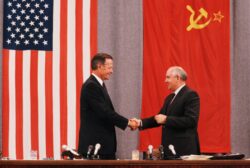
Also affecting the American decision to press for expansion were developments in Russia during and after 1993: the attempted “second coup” and assault on parliament, the electoral victories by Communists and nationalists, the war in Chechnya, and US-Russian disputes over Bosnia. These left few American officials confident that Russia would evolve into a truly reliable and stable ally — at least, not on its own. And if one thread has linked both the Bush and Clinton policies toward Russia it has been the decision to leave Russia “on its own,” twisting in the wind. Both administrations voiced high hopes for post-Communist Russia, while doing very little materially to aid Russian stability and democratic transition.
Nonetheless, the Clinton team did not conceive and pursue NATO expansion as an anti-Russian maneuver. It was not fear of Russia’s potential strength that gripped them, but recognition of Russia’s current weakness. Put simply: The Clinton administration knew that there was little Russia could do about expansion. Yes, that condition may change — given 15 or 20 years — but by then, the Administration hopes, Russia will have accepted the new strategic landscape. And if it has not, and a new cold war ensues, at least the West will be in a much better position strategically than it was during the first go around.
For other pro-expansion advocates, represented by the Republican leadership in Congress, anti-Russian sentiments are central. In this there may be an element of “settling scores” and also the notion, espoused by Henry Kissinger and Zbigniew Brzezinski, that Russia is somehow culturally programmed for expansion. At any rate, this part of the policy bloc tends to favor accelerating NATO outreach to the Baltic states and possibly the Ukraine. But they will not pay even lip-service to the idea of eventually including Russia too.
One sentiment shared across the spectrum of expansion advocates is that Russia has no legitimate reason to be concerned about NATO expansion. Strobe Talbot, who should know better, says Russian opposition to NATO “will only intensify the darkest suspicions about Russia’s intentions and future.” Senate Republican leader Trent Lott echoes these sentiments: “Whether Russia is ready to accept an enlarged NATO will be an important sign of Russia’s departure from its imperial past.” For them, Russian opposition to NATO is itself an argument for expansion. From this perspective there are no legitimate Russian concerns.
This remarkable assertion asks us to set aside all that history teaches about the behavior of states and the workings of power. We might begin to understand Russia’s concerns by asking “What is NATO?” Edward Luttwak, an American strategic analyst, answers that “NATO is not a security-talking shop but a veritable military force…temporarily at peace.” NATO offers its members participation in not only an alliance but a unified military command whose primary mission is to prepare for war on a continental scale. Even today, after significant reductions, NATO’s members together boast military power several times as great as that demonstrated (but underutilized) in the Gulf War.
It is the stock in trade of military professionals to look first at strategic capabilities and trends, rather than declarations of intent. So it should not surprise anyone that the creep of a great and exclusive military organization toward Russia’s borders is of concern to the Russian military. It would also seem unavoidable that any Russian politician hoping to keep his or her position would express concern. This concern need not focus principally on the unlikely prospect that NATO might someday take an aggressive turn. More to the point is the effect military power has on politics every day. Nations routinely have differences of interest and perspective. The settlement of these differences need not involve conflict but they always involve calculations of power and position. NATO expansion diminishes Russia politically and does so at a time when Russia is already weakened, fairly accommodating, and facing great instability at home and on its southern borders. Moreover, third parties are watching, and some of these directly and immediately engage important Russian interests.
Russia is naturally concerned about the tens of millions of Russians living outside Russia as minorities in other former-Soviet republics. These republics are sensitive to Russia’s concern — but how will the image and reality of an expanding NATO affect their behavior? For that matter, how will the march of NATO affect the calculations of separatist forces within Russia?
Another concern: The former-Soviet republics seemed able to divide the assets and resources of the Soviet Union with relatively little acrimony — partly because they have continued to function cooperatively in the economic realm. This division — the question of who should get what — takes on an entirely different valence if some republics, but not others, move into an exclusive economic and military bloc.
To limit these concerns Russia has and will continue to take steps to improve its European military posture — but these steps can only take away from defense efforts on its southern flank, where even border control poses a daunting challenge. So NATO expansion effectively squeezes Russia between a rock and a hard place. Most damaging to relations between Russia and NATO is the fact that what has inspired NATO expansion is not necessity, but opportunity. NATO is expanding not because it must, but because it can.
Did NATO expansion prompt the Russian attack on Ukraine?
The short answer is “no” – but there is more to the issue than that. A closer look at the road to war illuminates paths to a negotiated end
by Carl Conetta, 10 June 2022
With no end in sight, the Russia-Ukraine conflict is an unfolding catastrophe for Ukraine, the region, and the world. Besides increasing battlefield death and destruction, the war and how it is being fought promise global economic recession, severe food crisis, a surging flow of refugees, pandemic revival, and a transnational flood of illicit military weapons and munitions.
This essay looks at the policies that shaped the contention leading to war, and that increased the likelihood of conflict. It looks at the effects of NATO expansion and military activism, the “color revolutions” in Ukraine, the disposition of Crimea, the rebellions in Ukraine’s east, the Minsk process, Putin’s revisionism, Russia’s security concerns, and how the USA and Europe responded to the intensifying friction between Moscow and Kyiv. Through closely examining the policies conditioning the conflict, this analysis aims to identify potential “exit ramps” for all involved.
Did NATO expansion prompt the Russian attack on Ukraine?
The short answer is “no” – but there is more to the issue than that. A closer look at the road to war also illuminates paths to a negotiated end.
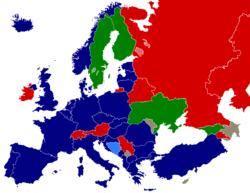 Carl Conetta, Project on Defense Alternatives, 09 June 2022
In early May, Politico reported Pope Francis suggesting that “NATO may have caused” the Russian invasion.[1] What the Pope actually said was more cautious and useful in understanding the road to this war. As clarified by Religion News Service, the Pope had suggested that:
“NATO barking at Russia’s doors” may have raised alarms in the Kremlin about the Western European alliance’s intentions in Ukraine. “I can’t say if (Russia’s) anger was provoked,” he continued, “but facilitated, maybe yes.”[2]
Neither NATO nor US policy caused the Ukraine war. The invasion was Moscow’s unforced choice. But that doesn’t settle the issue of provocation. Although neither provocation nor “facilitation” amount to “cause,” such dynamics might have played a role in moving us toward this war. And knowing what role US or NATO policy may have played in bringing the world to this juncture can help illuminate ways to end the conflict (short of prosecuting it to its bitter end – however long that might take and at whatever cost it might entail).[3]
Ivo Daalder, a long-time national security manager for Democratic presidential administrations,[4] rejects outright the idea that NATO expansion had anything at all to do with the February 2022 invasion. He asserts that
“Moscow’s unprovoked aggression is proof that its long-standing complaint about NATO moving too close to its borders was little more than a convenient excuse for its revisionist aims.” [5]
This dismisses the NATO expansion complaint too cavalierly. The author might as well have asserted that because NATO expansion is not provocative, Moscow was not provoked. This argument assumes its conclusion. It doesn’t settle questions about provocation, it elides them.
Does the invasion of Ukraine reflect “revisionist aims” in whole or part? Moscow certainly has sought to inhibit or block Ukraine’s approach to NATO, which became a Ukrainian constitutional imperative in 2019.[6] Restoring Ukraine to the status of a neutral buffer state counts as a revisionist aim, although this instance of revisionism directly reflects concerns about NATO expansion. It’s not a counter-point.
The comparative roles of NATO expansion and independent “revisionist aims” in effecting Moscow’s aggression is a pivotal issue. It bears on the prospect of negotiating an end to this war any time soon. Are we in fact witnessing a first or major step in a dedicated Russian effort to re-establish an empire in the post-Soviet space and overturn Europe’s post-Cold War order by force or coercion?[7] Such ambitions would seem almost Hitler-ite or Napoleonic in character. If so, it might require a protracted war and total strategic defeat to quell Moscow’s will to conquest, regardless of how costly such a war might be. Conversely, if Russian actions have been significantly shaped by an accumulation of more specific issues, incidents, and complaints then the room for productive negotiation is greater.
Although efforts toward a negotiated settlement are presently stalled, this could soon change should a costly stalemate take hold, as seems likely. Also, the regional and global costs of the conflict are mounting, and this will increase pressure for a diplomatic resolution.[8] Already some European NATO members are working independently to advance diplomatic solutions. [9]
Options for compromise have already been ventilated. Earlier in the war, Kyiv had proposed some measures, including formal neutrality, a return to the status quo 2014, and a 15-year pause in deciding the disposition of Crimea and the Donbas.[10] (On 23 May 2022, Henry Kissinger proposed that Ukraine simply cede the same territory to Russia and be done with it; The proposal mostly sparked strong objections in Ukraine and in the West.)[11] Presently, Pres. Zelensky seems to disfavor negotiations, but also recognizes that these are essential to war termination.[12] He must certainly understand that should Moscow face failure in the east, it will impose even greater, more far reaching destruction on all of Ukraine.
For its part, Moscow had suggested horizontal negotiations in mid-December 2021 when it advanced a series of proposals to revise Russia-NATO security arrangements.[13] Although these were too grand, one-sided, and late in the game to win a serious hearing, they suggested the possibility of pursuing broader Russia-NATO negotiations to facilitate compromise on Ukraine. Even portions of the Minsk agreements could be modified and revisited. (Minsk I, for instance, suggests the prospect of a post-war demilitarized “security zone” extending on both sides of the Russia-Ukraine border monitored by the OSCE.)[14]
Some NATO members are presently pursuing more ambitious war goals having less to do with simply defending Ukraine than with punishing Russia and imposing a strategic defeat on it.[15] Some may have already acted to constrain Kyiv’s efforts toward a negotiated ceasefire.[16]
US Sec of Defense Austin has clarified that America’s ultimate goal is to weaken Russia “to the degree that it can’t do the kinds of things that it has done in invading Ukraine.”[17] It’s hard to imagine what Sec Austin has in mind given that Russia has 900,000 active military personnel and 4,500 ready nuclear warheads, and that the case at hand involves an attack on a contiguous nation rather than some distant target such as Iraq or Syria. Any broad assent in the West to this audacious and risky goal depends on the characterization of Russia as a constitutionally expansionist power, posed to possibly sweep to the Atlantic. Weighing against this interpretation would be any conditional circumstances particular to this conflict that helped shape its occurrence and that might be addressed to truncate it.
Putin’s “grand ambition”
Putin’s ambitions are supposed to be revealed in the long July 2021 article written under his name, “On the Historical Unity of Russians and Ukrainians.”[18] This offers a biased re-imagining of the historical relationship between Russia and Ukraine.[19] Essentially, it concludes that the citizens of both belong to a broader community that has been torn asunder politically by treachery and error. And he argues that, due to historical and cultural ties, “true sovereignty of Ukraine is possible only in partnership with Russia.” This seems an exceptionally covetous conclusion, even an imperial one[20]. But his policy prescriptions are more modest. He observes:
“Some part of a people…can become aware of itself as a separate nation… How should we treat that? There is only one answer: with respect!” [21]
Still, he asserts that seceding groups have an unquestioned right only to that which they originally brought to the union. “All other territorial acquisitions are subject to discussion, negotiations.” The relevant referent here is Crimea. (Of course, the appropriate time for negotiating the disposition of Crimea was 30-years ago).[22]
The article extends Moscow’s interests to Donbas as well. Putin writes that he increasingly believes that “Kiev simply does not need Donbas.” His reasoning is that Kyiv has refused to proceed with the Minsk accord which promised the only way to peacefully restore the area to Ukraine. Here Putin is being sarcastic. Of course, Kyiv seeks to re-integrate the rebel areas – but only on its own terms, not the rebels’.
With regard to both Crimea and Donbas, the article also re-asserts a Russian responsibility to protect the rights of ethnic Russian communities.[23] This issue is especially salient for Moscow because it reflects on the legitimacy of a state espousing a nationalist ideology. Indeed, the article principally stands as an appeal to Russian nationalism, including that allegedly felt by Ukraine’s ethnic Russian community. All of the article’s historical bias is bent to this purpose – a rationalization to build support for the war.[24] On the positive side, however, it also suggests a strict limit to Moscow’s European ambitions.
Moscow’s threat to Ukraine is over-determined
Obviously there’s more to the Russian invasion and occupation than simply an effort to preempt NATO membership, although it certainly does that. The seizure of Crimea, for one, is partly motivated by other critical security concerns due to the basing there of Russia’s Black Sea Fleet.[25]
Russian basing rights were challenged in 2008 when following the “Orange Revolution” (2004) the Ukrainian government under Pres. Viktor Yushchenko (2005-2010) declared that Russia’s lease would not be renewed once it expired in 2017. The next president, Viktor Yanukovych, reversed that decision after taking office in 2010.[26] He negotiated a new agreement extending the lease to 2042 in exchange for lower gas prices. (Notably, the presence of a Russian base on Ukrainian territory would have precluded NATO membership.)[27] The decision would probably have been abrogated after Yanukovych was deposed in 2014 and the new Maidan government began to look decisively West.
In March 2022, Russian Col. Gen. Sergei Rudskoi, deputy head of the General Staff, argued that Donbas was key to the entire 2021 invasion. He said that all of Ukraine was targeted (rather than just Donbas) to prevent Kyiv from continuously threatening Donbass.[28] But this is not credible. The Russian operation far exceeded in risk and cost both the requirement and the value of securing Donbas. More likely the aims were to ensure that Ukraine would remain a reliable Russia-NATO buffer of 1000+ km and to keep at least some of Ukraine in Moscow’s orbit given the close economic relationship between Russia and (especially) Ukraine’s east.
In sum, Moscow’s threat to post-Maidan Ukraine was over-determined, partly due to the extent and nature of the change that occurred in 2014 – the ouster of a democratically-elected pro-Russian leader by a western-supported protest movement. Moscow’s threat to Ukraine is exceptional, however. Apart from Ukraine, Moscow’s unilateral Eurasian military interventions over the past 30 years have not much expanded its writ.[29] The Kremlin did gain and still retains virtual control over small slices of Moldova and Georgia (begun as putative peace operations but now sustained supposedly as a matter of protecting ethnic rights.) On balance, however, and measured over 30 years, Russia is a conservative regional hegemon invested in stasis not revisionism. And central to its military activity along its perimeter have been security concerns. [30]
The Issue of “Provocation”
Did US/NATO policy provoke the Russian attack on Ukraine? If by “provoke” one means “cause” as in a chemical reaction, then the answer is “no.” But the actions of one state that affect another can cause sentiments – alarm, fear, suspicion, outrage, disaffection – among the other’s political authorities that shape their perceptions and predispose them to belligerent responses.
Violent responses are allowed by international law in very few and select circumstances, notably: self-defense against armed attack. Russia’s actions in Ukraine fall far short of this standard. And the notion of “preventive attack” – action to preclude a possible future attack – has no standing in international law, although some (including the United States) have advanced this rationale for war.[31]
While most types of provocative actions do not justify an offensive response, all types make them more likely. Even lawful actions bearing on the security of other states can raise the probability of a belligerent response, lawful or not. And the cascading consequences for the global community of a subsequent war may outweigh the immediate issues at stake. Thus, wise leadership would be careful about reducing or crowding the critical security concerns of other powerful nations, especially nuclear ones.[32] Failing to do so is irresponsible – and perhaps fatally so. At minimum, efforts at mitigation or compensatory steps are required. Sometimes peace, stability, and prosperity are best served by seeking alternative approaches.
Two questions can help assess the possible role of Western policy in the slide toward this war. And both may illuminate a road out – short of fighting to the bitter end. First, does NATO expansion in any sense “threaten” Russia? And second, apart from NATO’s 30-year march eastward, what does Moscow see as more immediate provocations – that is, Why act now?
The NATO “threat”
NATO’s eastward expansion “threatens” Russia in the same general sense that the 1962 Soviet deployment of nuclear missiles to Cuba “threatened” the USA. Although the missile deployment didn’t itself constitute an act of violence, nor even announce an intent to do violence, it did involve an immediate and objective decrement in US security by complicating the nation’s strategic calculus.[33] Security managers and analysts often use the word “threat” in this way, meaning an act or development that increases vulnerability to possible acts of violence or coercion. Such “threats”can be said to be potential, indirect, or incipient. (Notably, security managers typically use “threat” in this way to refer to the vulnerabilities of their own homelands or “interests” exclusively.)[34]
Washington and Moscow have had a long history of contentious relations, never fully repaired. Indeed, NATO was born in opposition to Moscow. It outlasted Soviet collapse, growing from 16 members to 30, incorporating most former members of the Soviets’ “Warsaw Treaty Organization” as well as several former republics of the Soviet Union itself. This Cold War and post-Cold War history is the substrate of present Russian state manger sentiments, perceptions, and assessments.[35]
Since the end of the Cold War, NATO or its leading members have conducted multiple regime-change operations using both non-military and military, covert and open means in Europe and elsewhere.[36] In this light, there is no national leader on earth now or in history who wouldn’t be concerned should a comparable contending military power set-up “shop” next door, especially if done as the nth step in a military “march” of decades.
The close presence of a powerful adversary or strategic competitor constitutes a potential “threat in being,” even though this doesn’t rationalize a violent response.[37]. To compensate in the present case, Russia would have to substantially increase surveillance and defenses along a ~2300-km border. It also would have to attempt compensating for the loss of 1,000-km of defensive depth. Even still, it would be vulnerable to increased cross-border surveillance, espionage, and covert action.
Given that the two sides of the Russia-US/NATO divide hold about 15,000 nuclear weapons between them, it’s wise to keep them separated while developing cooperative means to help ensure the safety of non-aligned buffer states. Ukraine puts 1,000 kilometers between NATO and Russia along its 2,300 kilometer border with Russia. That separation has been a good thing for Europe and the world, although Ukraine has lacked sufficient security guarantees.
Moscow’s complaint
Moscow has been consistently warning and complaining about NATO expansion since Yeltsin’s time [38], having perceived multiple vows that it would not occur [39]. Those complaints grew more urgent in 2004 when former Soviet republics Estonia, Latvia, and Lithuania were incorporated. But their borders with Russia extend only 500 kilometers. They are sandwiched between Russian Kaliningrad and Belarus, and connected to NATO via Poland by a narrow corridor of 100 kilometers. The Baltic states have more reason for concern in this case than does Russia.
The next initiative drawing Moscow’s ire was the declaration at NATO’s 2008 Bucharest Summit that Georgia and Ukraine would one day join NATO. Putin, speaking at the summit, immediately warned against admitting Ukraine and moving NATO’s military infrastructure closer to the Russian border.[40] He had offered similar complaints the year before at the 2007 Munich Conference.[41]
By contrast with the summer 2021 article, these presentations focused mostly on security issues – not only NATO expansion, but also NATO’s eastward troop deployments, the collapse of negotiations on adapting the CFE Treaty to new conditions, the unilateral declaration of Kosovo independence, the US withdrawal from the ABM treaty, and America’s increased practice of military intervention. (At the time, the United States had 180,000 troops deployed in Iraq and Afghanistan.)[42] Of course, not long after the 2008 NATO summit, Russia and Georgia went to war with the latter hopelessly outgunned.
In his presentations, Putin’s suggestion of “debts owed Moscow” continued to undergird his appeals for reciprocity. But in this case the putative “debts” relate to Moscow’s “tear down” of the Berlin Wall, its 1989 unilateral reduction of conventional forces in Europe, the release of the east and central European captive nations, and the dissolution of the Soviet Union itself. Outside Moscow these moves were not viewed as “gifts” but as forced choices. Nonetheless, Gorbachev and Yeltsin had risked and won internal disputes on the hope of achieving a common European home.
The long contest over Ukraine
Russia and US/NATO have seriously contended for influence over Ukraine since the early 2000s,[43] but the 2014 Maidan revolution and regime change in Kyiv was a turning point. The Maidan mass movement, supported by the West and representing Western-leaning segments of Ukrainian society, deposed pro-Russia Pres. Viktor Yanukovych, who had won office in a 2010 election (declared fair by OSCE observers).[44] A Feb 2014 peace settlement brokered by the EU between the government and opposition leaders was summarily cast aside on the insistence of Ukrainian Right Sector leaders and some grassroots fighting groups in Kyiv.[45] Weeks later, Moscow seized Crimea.
Moscow rationalized its 2014 seizure of Crimea partially on the basis of a new draft Ukrainian language law limiting the official use of Russian language (later rescinded)[46], the presence of extreme Ukrainian nationalists in the new government [47], and the fact that Crimea’s population was two-thirds ethnic Russian. (The peninsula also heavily favored the deposed President Yanukovych, and a 2014 Pew Center poll found a slim majority favoring the right of regions to secede.)[48] As suggested earlier, Moscow’s principal motivation may have been its strong security interest in maintaining the Black Sea Fleet there.
Earlier in the Maidan revolution, US political support for it had been graphically communicated by photos of Assistant US Secretary of State Victoria Nuland and US Amb Geoffrey Pyatt socializing with the protestors and handing out sandwiches to them.[49] Also, a leaked phone conversation between Nuland and Pyatt revealed them planning to push for the selection of Arseniy Yatsenyuk as next Ukrainian Prime Minister – a position he did attain.[50] As for the EU, the USA was contemptuous of its efforts – or as Nuland put it to Pyatt, “Fuck the EU.” Reasonable people can disagree about what these actions prove about US influence on the events leading to the Feb 2014 revolution, but it is indisputable that such actions would feed suspicions and fears of an improper US role. (Notably, US political and financial support for pro-Western revolutions in Ukraine and elsewhere do not violate international law although they may contravene the non-binding 1981 UN General Assembly “Declaration on the Inadmissibility of Intervention and Interference in the Internal Affairs of States.”)[51]
Donbas and the Minsk protocol
Separatist sentiment in Ukraine’s east grew rapidly in response to the ouster of Viktor Yanukovych, who had strong majority support there, and the rise to power of ethnic-Ukrainian nationalists.[52] When anti-Maidan rebels in the east (who were supported by Moscow) seized portions of the Donbas area in March and April 2014 [53], Kyiv quickly launched an “anti-terrorist” campaign against them.[54] Compromise should have been possible, but from a different perspective, the legitimacy of one rebellion could be viewed as inversely related to the legitimacy of the other. Post-Maidan Kyiv was strongly disinclined to tip its hat in any way to the Donbas rebels.
The Kyiv offensive slowly ground down the rebels until mid-August 2014 when Russian artillery, equipment, and “volunteers” more substantially joined the fight.[55] (Ukraine’s security service estimated rebel strength as 40,000 fighters plus 6,000 Russians.)[56]
Nearly 10,000 Ukrainians died in the first two years of the Donbass fighting (as well as perhaps 400-500 Russians, according to the US State Department).[57] Those first two years of the Donbass fight claimed 75% of the total fatalities through to 2022. The bloodshed slowed from a flood to trickle due to the 2015 Minsk II agreement, mediated by France, Germany, and the OSCE.[58] Average annual fatalities during 2016-2022 were only 10% as great as during 2014-2015.
The agreement provided for a ceasefire; It also entailed granting the rebel areas autonomy within Ukraine. However, while the cease-fire was significantly effective over the next six years, saving thousands of lives, the agreement was never fulfilled. Essential constitutional change never occurred. And autonomy was never implemented.[59]
This was partly due to stiff opposition from ultra-nationalist groups, whose militias had also been vital to the fight in the east. Their fight extended to Kyiv as well. A deadly anti-Minsk II protest by these groups in Sep 2015 involved a grenade assault that left three Ukrainian soldiers dead. (This led Prime Minister Yatsenyuk to say the rightists were “worse” than the eastern separatists.)[60] But the Rada’s governing majority also would not abide by the sequencing of steps set out in the agreement [61] that would have had Donbas elections occur before Kyiv had regained control of the border. The United States among other NATO and EU nations gave vocal support to the Minsk II process, but none applied their ample leverage to compel closure. Their general support for Ukraine vs Russia had put them in a position of moral hazard.
Ukraine’s ultra-nationalist parties and militias have an outsized influence over Ukrainian policy despite their weak electoral showing (seldom as high as ten percent). This is due to their very active memberships (probably exceeding 50,000) and their reliance on mass protest and direct action – sometimes violent.[62]
Relevant to the eastern conflict, their strength was made evident in early 2017 when they blockaded east-west trade routes. During the first few years of the eastern standoff, the rebel and western areas continued a degree of commerce. However, within weeks of the vigilante blockade’s start, government opposition to it melted away and an official blockade was implemented.[63] One predictable result was that the rebel areas integrated more closely with the Russian economy.
Beyond Minsk, Toward NATO
In early 2018, the Ukrainian parliament passed a controversial bill prioritizing the full reintegration of the rebel areas, now defined simply as territory temporarily occupied by Russia as an aggressor state.[64] This supplanted the notion of the struggle as an internal conflict. Soon after, Ukraine replaced the four-year Anti-Terrorism Operation (ATO), which had been led by the state’s security forces, with a Joint Forces Operation (JFO) led by the regular military.[65] On the face of it, these efforts were incompatible with the Minsk agreement. Finally, in early 2021, the Zelensky government openly called for revising the agreement as well as the negotiating body, adding the USA, Canada, and the UK to existing members Germany, France, Russia, and Ukraine.[66] In effect, this was an abrogation of the Minsk agreement and process, although Kyiv said not.
While Minsk II hung in abeyance, the USA and other NATO members began and then redoubled their arming and training of the Ukranian military.[67] NATO and Ukrainian troops also conducted numerous joint exercises both inside Ukraine and elsewhere.[68] As each year passed, Ukraine’s capacity to retake Donbas by force increased.
As for the post-Maidan government’s NATO aspirations: Kyiv had abandoned neutrality and declared for NATO as early as Dec 2014.)[69] In early 2019, it passed a constitutional amendment formally committing the country to becoming a member of both NATO and the European Union.[70]
In 2018, NATO had granted Ukraine official aspiring member status.[71] Finally, in June 2020, it recognized Ukraine as an Enhanced Opportunities Partner.[72]
The view from Moscow
From Moscow’s perspective the progression of events and their meanings would have been clear. An extra-constitutional change of Ukraine’s government in 2014, conspicuously supported by the USA and other Western powers, deposed a democratically-elected Russia-friendly president who was also strongly favored in Ukraine’s east. For Moscow, this could only have redefined the nature of contention over Ukraine.
The change also posed a multifaceted security challenge for Russia involving the disposition of its Black Sea Fleet and the expansion of an exclusionary and competitive military alliance to its borders. When portions of Ukraine’s eastern oblasts rebelled against the change, the Maidan government attempted to forcefully suppress them. Multiple opportunities to achieve compromise in the Ukraine disputes were cast aside (2014 EU sponsored agreement) or held in abeyance (Minsk II) while the country muscled up, deepened its NATO partnership, increased NATO presence, and crept steadily closer to official membership.
None of the above justifies Russia’s illegal actions but it should be clear how these developments might prompt sentiments, perceptions, and assessments that made an aggressive Russian response more likely. Notably, it is not NATO expansion alone that had this effect, but expansion together with the other developments summarized above.
The above analysis reveals multiple opportunities and options for avoiding war by giving some credence to Moscow’s concerns, even though there was no legal compulsion to do so. The draft US-Russia security agreements that Moscow advanced in mid-December 2021 also provided some last-minute opportunity to avert war. Although these served more as a litmus to rationalize war, a positive US response could have forestalled that outcome. None was forthcoming, however.[73]
Principles and Prospects
Moscow frames its case against ongoing NATO expansion in terms of a principle of “indivisible security,” which was most recently set out in the 1999 OSCE Charter for European Security.[74] For Moscow, the relevant guideline is “States will not strengthen their security at the expense of other States.”[75] By its reading, both NATO and its prospective members are aiming to improve their security in ways that diminishes Moscow’s. There is no objective measure by which to determine this, however – and no formal means for adjudicating it. Resolution depends on strategic empathy.
For its part, the United States has repeatedly asserted NATO’s so-called “open door” policy as a reason for standing firm regarding Ukraine’s candidacy. Nonetheless, NATO’s charter and practice reveal several relevant conditions that might shut the door on some aspirants. Notably, aspiring members need first to resolve ongoing conflicts, and their joining the alliance should bring greater security to the whole (and presumably not greater security challenges).[76] Regardless of talk about inviolable principles, no one should doubt that the United States together with other leading members could close the door should they decide that doing so best serves their security, alliance functionality, and/or regional stability.[77] Article 10 of the 1949 North Atlantic Treaty is clearly conditional – and not solely with reference to the character and strength of aspiring members.[78] So why act as though the USA and other NATO members have no choice?
Kyiv has based its plea for defensive support on “the sovereign equality of nations” – a principle enshrined in the UN charter and foundational to all international law.[79] There’s no question that Russia’s assault on Ukraine is a grave violation of its sovereignty. How to productively address this is the present challenge. What if restoration of the status quo ante bellum (pre-2014) is judged unattainable? Or, what if the costs of attaining it are judged too steep – considering not only battlefield costs, but also global costs in multiple registers?
As noted above, various options for compromise have already been ventilated. All would involve a concession to power, however – which is presently the price of stabilization. But as part of any compromise package, Russia could be made to pay substantial reparations (by whatever name) to Ukraine, which would help dissuade future Russian aggression. And embedding compromise on the war within some new and broader Russia-NATO security arrangement could incentivize adherence. Indeed, opening a dialog on an improved European security architecture would encourage Moscow to abandon maximalist aims regarding Ukraine.
Diplomatic progress toward ending the war requires a recognition that Russia’s security concerns have been at least partially legitimate, even though its invasion of Ukraine is not. As NATO leader, the United States is best positioned to encourage and initiate effective East-West dialog on the war and broader security issues. This is not likely to occur, however, because US leaders seem strongly committed to the ultimate aim of “weakening” Russia. Realistically, initiative for compromise will have to be independent, coming first from the UN, EU, OSCE, or all three.
NOTES
1. “Pope says NATO may have caused Russia’s invasion of Ukraine,” Politico, 03 May 2022.
2.“Pope Francis says NATO, ‘barking at Russia’s door,’ shares blame for Ukraine,” Religion News Service, 03 May 2022.
3. Weighing NATO expansion
- “NATO and the Road Not Taken,” Boston Review, 16 Mar 2022.
- “Was NATO Enlargement a Mistake?” Foreign Affairs (19 Apr 2022)
4. Daalder served on President Clinton’s National Security Council. He also served the Obama administration as US Permanent Representative to NATO from May 2009 to July 2013.
5. Ivo Daalder, “Let Ukraine In,” The Atlantic, Apr 2022.
6. “Ukraine President Signs Constitutional Amendment On NATO, EU Membership,”
RFE/RL, 19 Feb 2019.
7. Elias Götz, “Russia, the West, and the Ukraine crisis: three contending perspectives,” Contemporary Politics Vol. 22, No. 3 (2016)
8. Regional and global costs of the Russia-Ukraine war
- “War in Ukraine: Twelve disruptions changing the world,” McKinsey & Company, 9 May 2022
- “Ukraine war to cause biggest price shock in 50 years – World Bank,” BBC, 26 Apr 2022.
- “Ukraine’s Reconstruction To Require Sums ‘Beyond Imagination,’ Says EIB Head,” Eurasia Review, 24 Apr 2022.
- “From soaring food prices to social unrest, the fallout from the Russia-Ukraine war could be immense,” CNBC, 21 Apr 2022.
- “Crisis in Ukraine could slash global trade growth by half in 2022: WTO,” Business Standard, 01 Apr 2022.
- “Ukraine War to Compound Hunger, Poverty in Africa, Experts Say,” VOA, 19 Mar 2022.
9. “Europe’s leaders fall out of key on Ukraine. Germany, France and Italy are making overtures to Moscow,” Politico.eu, 16 May 2022.
10. Kyiv proposed compromises
- “Zelensky floats possible Putin compromises,” Axios, 22 Mar 2022.
- “Ukraine is willing to compromise on Donbass to end war: Zelensky,” NY Post, 27 Mar 2022.
11. Kissinger Davos speech and proposal
- “Kissinger: These are the main geopolitical challenges facing the world right now,” full text, World Economic Forum, 23 May 2022.
- “The War in Ukraine Can Be Over If the US Wants It,” New York Magazine Intelligencer, 1 June 2022.
- Daniel R. DePetris, “Does Henry Kissinger Have a Point on Ukraine?” Newsweek, 27 May 2022.
12. Kyiv takes firmer stance
- “With Ukraine Taking Firmer Stance, Peace Talks Grind to a Halt,” NYT, 17 May 2022.
- “Ukraine peace deal: Kyiv rules out ceding land to Russia,” BBC, 22 May 2022.
13. Moscow security proposals
The two Russian documents proposed (among other things) that:
– NATO expansion end,
– NATO and Russia rollback their European military deployments to the status quo 27 May 1997,
– Neither side deploy land-based intermediate- or short-range missiles in areas that put them in reach of the other’s territory,
– NATO conduct no exercise in Ukraine and none in the other states of Eastern Europe, the South Caucasus, or Central Asia,
– Both sides agree to limit the size of their military exercises,
– Neither the USA nor Russia will operate heavy bombers or surface warship in areas from which they can attack the other party,
– Neither the USA nor Russia will deploy nuclear weapons outside their own territory, and
– Neither will conduct nuclear weapons training of personnel from non-nuclear countries.
- Ministry of Foreign Affairs of the Russian Federation, Treaty between The United States of America and the Russian Federation on Security Guarantees (Moscow: 17 Dec 2021).
- Ministry of Foreign Affairs of the Russian Federation, Agreement on measures to ensure the security of The Russian Federation and member States of the North Atlantic Treaty Organization (Moscow: 17 Dec 2021).
- “Russia’s draft agreements with NATO and the United States: Intended for rejection?” Brookings Institution, 21 Dec 2021.
14. Peace Agreements Database, Minsk I (Minsk Protocol), University of Edinburgh, 09 May 2014.
15. US/NATO war goals
- “Western allies ramp up rhetoric against Russia, want ‘defeat’ of Moscow,” Politico.eu, 20 May 2022.
- “The Utter Necessity of a Russian Defeat,” The Hill, 20 May 2022.
- “The War Won’t End Until Putin Loses,” The Atlantic, 23 May 2022.
16. Western dissent over Kyiv peace proposals
- “NATO says Ukraine to decide on peace deal with Russia — within limits,” Washington Post, 05 Apr 2022
- Paul Pillar, “The Coming Dissent Over Ukraine’s Peace Terms,” National Interest, 05 Apr 2022.
17. “Pentagon chief’s Russia remarks show shift in US’s declared aims in Ukraine,” Guardian, 25 Apr 2022.
18. Vladimir Putin, “On the Historical Unity of Russians and Ukrainians,” (Moscow: The Kremlin, 12 Jul 2021)
19. Putin’s revision of Russia-Ukrain history
- “Fact-checking Putin’s claims that Ukraine and Russia are ‘one people’,” U.Rochester Newscenter, 03 Mar 2022.
- “Putin’s one-sided history of Ukraine’s relationship with Russia,” Politifact, 23 Feb 2022.
20. “Putin’s new Ukraine essay reveals imperial ambitions,” Atlantic Council Ukraine Alert, 15 Jul 2021.
21. Putin, “On the Historical Unity of Russians and Ukrainians,” op cit.
22. “Analysis: Why Russia’s Crimea move fails legal test,” BBC, 07 Mar 2014.
23. “Putin Pledges To Protect All Ethnic Russians Anywhere. So, Where Are They?” RFE/RL, 10 Apr 2014.
24. “Contextualizing Putin’s ‘On the Historical Unity of Russians and Ukrainians’,” Ukrainian Research Institute, Harvard University, 2 Aug 2021.
25. Crimea background
- “Analysts: Black Sea port in Ukraine still key to Russia’s naval interests,” Stars & Stripes, 03 Mar 2014.
- “Why Did Russia Give Away Crimea Sixty Years Ago?” Wilson Center, 22 Mar 2014
26. “Ukraine extends lease for Russia’s Black Sea Fleet,” The Guardian, 21Apr 2010.
27. “Russia’s Black Sea fleet in Sevastopol beyond,” Diploweb – La Revue Geopolitique, 23 May 2010.
28. “Russian Military Official Shifts Rhetoric, Says Army Now Focusing On ‘Liberation’ Of Eastern Ukrainian Regions,” RFE/RL, 25 Mar 2022.
29. Russia’s Military Interventions (Santa Monica CA: RAND. 2021)
30. Alexander Thalis, “Threat or Threatened? Russian Foreign Policy in the Era of NATO Expansion,” Australian Institute of International Affairs, 03 May 2018.
31. On “preventative war”
- “Iraq War lesson. ‘preventative wars’ are illegal wars, period,” Responsible Statecraft, 18 Mar 2022.
- “Beating Them To the Prewar,” New York Times, 28 Sep 2002.
- Mary Ellen O’Connell, “The Myth of Preemptive Self-Defense,” American Society of International Law, Aug 2002.
32. Russian nuclear use?
The probability of Moscow resorting to nuclear weapons remains very low because the likely consequences of such action is widely seen as catastrophic for all sides. However, the character of the war as an increasingly Russia-NATO proxy conflict and its proximity to Moscow increases the likelihood of desperate action should Russian failure loom. This is a conflict that Putin cannot afford to lose strategically or politically. So, should Russia face a categorical defeat in the field, the likelihood of intentional nuclear use will rise – and probably to a degree greater than that during the 1962 Cuban missile crisis. Even in this case it will remain low, although higher readiness levels and signalling on both sides will increase the likelihood of accidental use.
- “Putin could use nuclear weapon if he felt war being lost – US intelligence chief,” Guardian, 10 May 2022.
- “Russia Insists It Won’t Use Nuclear Weapons in Ukraine,” Newsweek, 19 Apr 2022.
- “CIA Chief Says Threat Russia Could Use Nuclear Weapons Is Something US Cannot ‘Take Lightly’,” RFE/RL, 15 Apr 2022.
- Lawrence Korb, “Why the War in Ukraine Poses a Greater Nuclear Risk than the Cuban Missile Crisis,” Just Security, 12 Apr 2022.
- “‘Battlefield nukes’ in Ukraine? A low but complex threat,” CSM, 11 Apr 2022.
- “Would Russia Use a Tactical Nuclear Weapon in Ukraine?” Modern War Institute, 16 Mar 2022.
- “Putin Orders Russian Nuclear Weapons on Higher Alert,” Arms Control Association, Mar 2022)
33. “The Soviet Union could not right the nuclear imbalance by deploying new ICBMs on its own soil. In order to meet the threat it faced in 1962, 1963, and 1964, it had very few options. Moving existing nuclear weapons to locations from which they could reach American targets was one.” Graham Allison and Philip Zelikow, Essence of Decision: Explaining the Cuban Missile Crisis (New York: Addison Wesley Longman, 1999), pp. 94–95.
At the time, the USA had 203 ICBMs able to reach anywhere in the Soviet Union. The Soviets by contrast had 36 ICBMs able to hit anywhere in the USA. The planned Cuban deployment when finished would have comprised more than 80 intermediate- and medium-range missiles sitting just 90-miles off the US coast and thus able to function as proxy ICBMs. Also available would have been 90 shorter range nuclear missiles for defense of the island.
- “Last Nuclear Weapons Left Cuba in December 1962,” National Security Archive, 11 Dec 2013.
- “The Cuban Missile Crisis: A nuclear order of battle.” Bulletin of the Atomic Scientists (20 Oct 2012)
- “What Was at Stake in 1962?” Foreign Policy (10 Jul 2012).
34. “The Geopolitics of Empathy,” Foreign Policy (27 Jun 2021).
35. Why Moscow fears NATO
- “The sources of Russia’s fear of NATO,” Communist and Post-Communist Studies (Apr 2018)
- Assessing Russian Reactions to US and NATO Posture Enhancements (Santa Monica CA: RAND 2017)
36. US practice of regime-change
- Template Revolutions: Marketing US Regime Change in Eastern Europe, Westminister Papers, 2017
- “American Covert Regime Change Operations: From the Cold War to the War on Terror,” Journal of International Affairs (23 Jul 2018)
- “The USA tried to change other countries’ governments 72 times during the Cold,” Washington Post. 23 Dec 2016.
- “Mapped: The 7 Governments the USA Has Overthrown,” Foreign Policy (20 Aug 2013)
- “Regime Change Doesn’t Work,” Boston Review (26 Jun 2012).
37. see ft. 31.
38. Moscow’s complaints about NATO expansion
- “Ukraine war follows decades of warnings that NATO expansion into Eastern Europe could provoke Russia,” The Conversation (28 Feb 2022).
- Peter Beinart, “Biden’s CIA Director Doesn’t Believe Biden’s Story about Ukraine,” peterbeinart.substack.com (07 Feb 2022).
- “NATO Expansion – The Budapest Blow Up 1994,” National Security Archive, 24 Nov 2021.
39. NATO Expansion: “What Gorbachev Heard,” National Security Archive, 12 Dec 2017.
40. Full text available in PISM, Documents Talk: NATO-RUSSIA Relations after the Cold War, The Polish Institute of International Affairs, 08 Dec 2020.
Also see: “Putin warns NATO over expansion,” Guardian, 04 Apr 2008.
41. “Transcript: Putin Speech and the Following Discussion at the 2007 Munich Conference on Security Policy,” Johnson’s Russia List, 27 Mar 2014.
42. Congressional Research Service, “The Cost of Iraq, Afghanistan, and Other Global War on Terror Operations Since 9/11″ (Washington DC: CRS, 08 Dec 2014)
43. US-Russia contention over Ukraine
- Short critical assessment of US efforts before and leading up to the original 2004 Ukrainian “Orange Revolution”: “US campaign behind the turmoil in Kiev,” Guardian, 25 Nov 2004.
- Critical assessment of recent Russian efforts to shape political developments in Ukraine: “The logic of competitive influence-seeking: Russia, Ukraine, and the conflict in Donbas,” Post-Soviet Affairs Vol. 34, No.4 (2018)
44. “Yanukovych set to become president as observers say Ukraine election was fair,” Guardian, 08 Feb 2010.
45. EU 2014 peace deal discarded
- “Ukraine Has Deal, but Both Russia and Protesters Appear Wary,” NYT, 22 Feb 2014.
- “Ukraine opposition signs crisis deal, but streets resist,” NY Post, 21 Feb 2014.
- “Agreement on the Settlement of Crisis in Ukraine – full text,” Guardian, 21 Feb 2014.
46 “Ukraine passes language law, irritating president-elect and Russia, Reuters, 25 Apr 2019.
47. “In Ukraine, nationalists gain influence – and scrutiny, Reuters, 07 Mar 2014.
48. Crimea voting trends and popular opinion
- “Percentage of Ukraine’s Population (by region) that voted for Tymoshenko or Yanukovych in the 2010 Presidential Election,” Central Election Commission Ukraine, Brookings Institution, 21 May 2015.
- “Despite Concerns about Governance, Ukrainians Want to Remain One Country,” Pew Research Center, 08 May 2014.
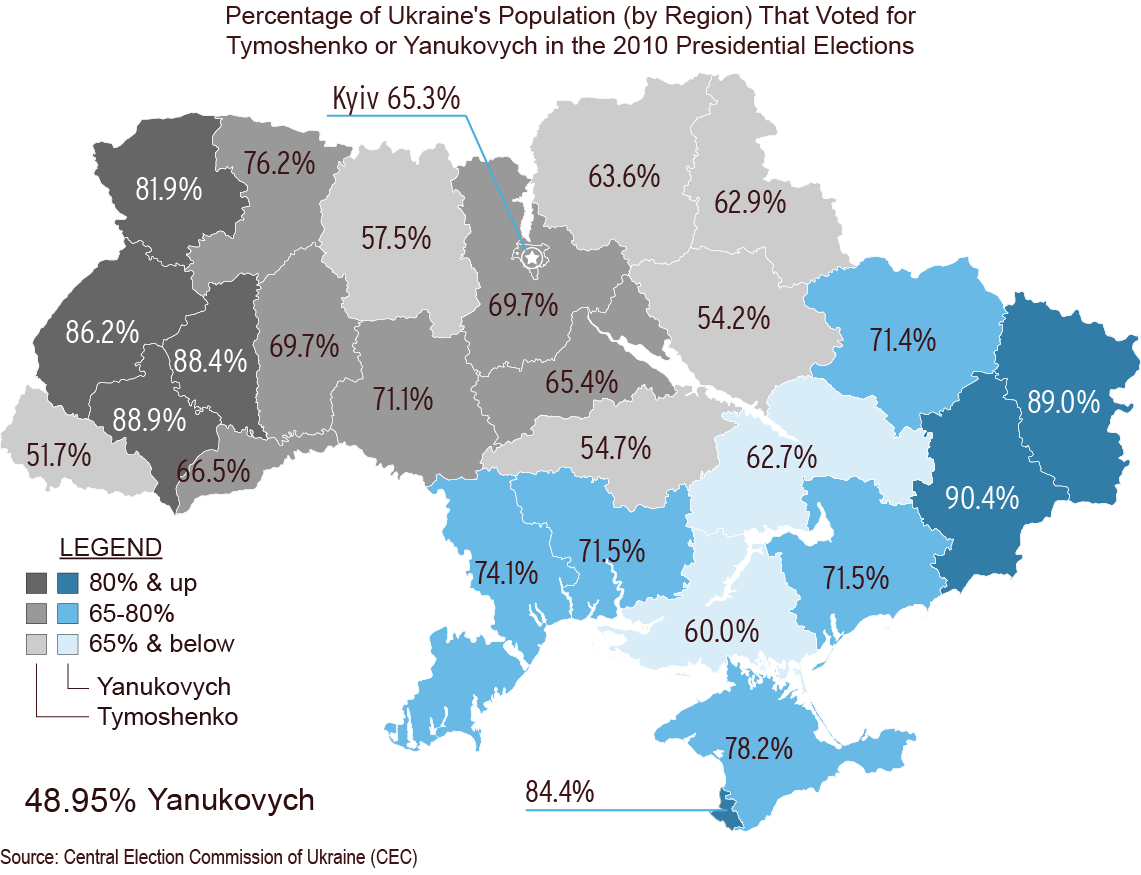
49. US officials supporting Maidan protestors
- “Russia cries foul over Western embrace of Ukraine’s demonstrators,” CSM, 13 Dec 2013.
- “Top US official visits protesters in Kiev as Obama administration ups pressure on Ukraine president Yanukovich,” CBS News, 11 Dec 2013.
50. “Ukraine crisis: Transcript of leaked Nuland-Pyatt call,” BBC, 07 Feb 2014.
51. UN General Assembly, Declaration on the Inadmissibility of Intervention and Interference in the Internal Affairs of States, 09 Dec 1981.
52. Separatist sentiment in Ukraine’s east
- “The Origins of Separatism: Popular Grievances in Donetsk and Luhansk,” Ponars Eurasia, 15 Oct 2015.
- “In Ukraine, nationalists gain influence – and scrutiny,” Reuters, 07 Mar 2014.
- “Percentage of Ukraine’s Population (by region) that voted for Tymoshenko or Yanukovych in the 2010 Presidential Election,” Central Election Commission Ukraine, Brookings Institution, 21 May 2015.
53. Donbas anti-Maidan rebels
- “A new, pro-Russia ‘Maidan’ in Ukraine’s east?” CSM, 08 Apr 2014.
- “Pro-Russian Protesters in Eastern Ukraine Seize Weapons,” VOA, 06 Apr 2014.
- “Pro-Russia protesters occupy regional government in Ukraine’s Donetsk,” Reuters, 03 Mar 2014.
54. Kyiv takes military action against Donbas rebels
- “Ukraine says Donetsk ‘anti-terror operation’ under way,” BBC, 16 Apr 2014.
- “Kiev government to deploy troops in Ukraine’s east,” AP, 13 Apr 2014.
55. Russian 2014 intervention
- “Ukrainian army closes in on Donetsk as rebel fighters call on Russia for help,” Guardian, 03 Aug 2014.
- “Ukraine Reports Russian Invasion on a New Front,” NYT, 28 Aug 2014.
56. “Security Service of Ukraine: Today 6,000 Russian military personnel and 40,000 militants fight in Donbas,” Ukraine Media Crisis Center, 15 Mar 2015.
57. Death toll during Ukraine civil conflict
- “Death Toll in Ukraine Conflict Hits 9,160, UN Says,” NYT, 03 Mar 2016.
- “US says about 500 Russian soldiers killed in eastern Ukraine,” Anadolu Agency News Broadcasting System (Turkey), 10 Mar 2015.
58. Minsk II agreement
- “Factbox: Minsk agreement on Ukraine,” Reuters, 12 Feb 2015.
- “Package of measures for the Implementation of the Minsk agreements,” UN Peacemaker, 19 Feb 2015.
59. “Ukraine unlikely to advance Minsk II despite talks,” Economist Intelligence Unit, 11 Jan 2022.
60. Far-right deadly revolt against Minsk agreement
- “Death Toll Rises To Three From Grenade Attack Near Ukrainian Parliament,” RFE/RL, 01 Sep 2015.
- “Far-Right Riot at Ukraine’s Parliament,” Institute for the Study of War, 01 Sep 2015.
61. “Ukraine parliament offers special status for rebel east, Russia criticizes,” Reuters, 17 Mar 2015.
Note: The 2015 special status law was provisional and, contrary to the Minsk agreement, it was not to come into effect until Donetsk and Luhansk held elections under Ukrainian law.
62. Outsize influence of Ukrainian extreme nationalists
- “Nationalist Radicalization Trends in Post-Euromaidan Ukraine,” Ponars Eurasia, May 2018.
- “Commentary: Ukraine’s neo-Nazi problem,” Reuters, 19 Mar 2018.
- “In Ukraine, Ultra-nationalist Militia Strikes Fear In Some Quarters,” RFE/RL, 30 Jan 2018.
63. Blockade of rebel areas
- “Cut Off: What Does the Economic Blockade of the Separatist Territories Mean for Ukraine?” Focus Ukraine, Wilson Center, 9 Jan 2018.
- “Ukraine orders blockade on rebel-held east,” Deutsche Welle, 15 Mar 2017.
- “In Ukraine, blockade threatens to force issue at heart of civil war,” CSM, 28 Feb 2017.
- “Donbas Blockade Exposes Political Fault Lines in Ukraine, Eurasia Daily Monitor 14:24 (24 Feb 2017).
64. Donbas Reintegration Law
- “Ukraine Moves To Restore Control Over Separatist-Held Areas, “ RFE/RL, 18 Jan 2018.
- “Donbas Reintegration Law: What Impact on the Minsk Agreements?” Strike, 09 Mar 2018.
65. Kyiv’s new military policy on Donbas
- “Ukraine’s New Military Engagement in the Donbas,” Strategic Europe, Carnegie Europe, 03 May 2018.
- “Ukraine Declares ‘Anti-Terrorist Operation in the Donbas’ Officially Over: What Does That Mean?” RUSI, 16 May 2018.
- “Old war, new rules: what comes next as ATO ends and a new operation starts in Donbas?” Ukraine Crisis Media Center, 04 May 2018.
- “What Does Ukraine’s New Military Approach Toward the Donbas Mean?” Atlantic Council, 15 May 2018.
66. Ukraine seeks to revise Minsk agreement and process
- “President of Ukraine calls for revamp of peace process to end Donbas war,” President of Ukraine Official Website, 26 April 2021.
- “Zelensky offers to involve U.S., UK, Canada in Normandy talks,” UNIAN (Ukrainian Independent Information Agency), 26 Apr 2021.
67. NATO Security Assistance to Ukraine: Arms and Training
- Congressional Research Service, US Security Assistance to Ukraine (Washington DC: CRS, 29 Apr 2022)
- “Lethal Weapons to Ukraine: A Primer,” Atlantic Council, 26 Jan 2018.
- “The Secret of Ukraine’s Military Success: Years of NATO Training,” WSJ, 3 Apr 2022.
- “As the Russian threat grew, US intelligence ties to Ukraine deepened,” Yahoo News, 02 Feb 2022.
- “CIA-trained Ukrainian paramilitaries may take central role if Russia invades,” Yahoo News, 13 Jan 2022.
- “Mission Ukraine: US Army Leads Multinational Training Group to Counter Russian Threat,” Association of the United States Army, 19 May 2020.
- “Ukrainian Special Forces Getting Western Help, Training,” SOFREP, 08 Mar 2019.
- “In Ukraine, the US Trains an Army in the West to Fight in the East,” Defense One, 05 Oct 2017.
- “US, allies give Ukrainians a boost in building modern army,” Stars & Stripes, 06 Jul 2017.
- “The USA and Ukraine have started military training exercises despite Russian objections,” Insider, 20 Apr 2015.
68. Joint Exercises
- “Ukraine holds military drills with US forces, NATO allies,” Reuters, 20 Sep 2021.
- “The US-Ukraine Sea Breeze naval exercises, explained,” Washington Post, 02 Jul 2021.
- “Military from 5 NATO states to take part in Ukrainian-British drills,” Kyiv Post, 04 Apr 2021.
- “US Air Force’s huge exercise in Ukraine fuels growing partnership and that country’s NATO ambitions,” Air Force Times, 13 Nov 2018.
- “Ukraine-NATO Joint Military Exercises Begin In Lviv Region,” RFE/RL, 03 Sep 2018.
- “US and NATO troops begin Ukraine military exercise,” BBC, 15 Sep 2014.
69. “Ukraine Votes To Abandon Neutrality, Set Sights On NATO,” RFE/RL, 23 Dec 2014.
70. “Ukraine President Signs Constitutional Amendment On NATO, EU Membership,” RFE/RL, 19 feb 2022.
71. “NATO officially gives Ukraine aspiring member status; membership action plan is next ambition,” Euromaidan Press, 10 Mar 2018.
72. “NATO recognises Ukraine as Enhanced Opportunities Partner,” NATO News, 12 Jun 2020.
73. US rejects Russian security proposals
- “US refuses to budge on Ukraine in response to Russian demands,” LA Times, 26 Jan 2022.
- “Putin accuses US, allies of ignoring Russian security needs,” AP, 1 Feb 2022.
74. “The Indivisibility of Euro-Atlantic Security,” presentation by OSCE Secretary General Marc Perrin de Brichambaut, 18th Partnership for Peace Research Seminar, Vienna Diplomatic Academy, 4 Feb 2010.
75. Organization for Security and Cooperation in Europe, “Charter for European Security,” Istanbul Document 1999 (Vienna, Austria: OSCE, 1999)
76. NATO, Study on NATO Enlargement (Brussels: NATO, 03 Sep 1995)
77. NATO’s “Open Door”
- “Article X is conditional. New members can join NATO only if their membership would enhance regional security.” Michael O’Hanlon and Stephen Van Evera, “There is no NATO open-door policy,” The Hill, 27 Jan 2022.
- Amb. James Dobbins, “Should NATO Close Its Doors?” RAND Blog, 02 Feb 2022.
- Daniel DePetris, “NATO should shut the door, but not because Russia said so,” Defense News, 19 Jan 2022.
78. NATO, The North Atlantic Treaty (Brussels, 4 Apr 1949)
79. See Article 2(1). United Nations Charter (New York: UN, 26 Jun 1945)
Russia-Ukraine War: Estimating Casualties & Military Equipment Losses
⇒ see full post: HTML
by Carl Conetta, updated 02 April 2022
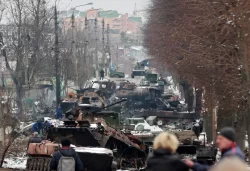 How do the two sides in the Russia-Ukraine conflict compare in terms of personnel and equipment losses? These seemingly objective measures are subject to an intensive propaganda war. This brief analysis examines multiple sources of data to find that the combatants are actually not far apart in the percentage of equipment attrition they have suffered. And Russian personnel fatalities are likely in the range of 3,500 (April 2). Contrary to the messaging of the two sides, both would seem able to sustain combat for a considerable time longer. Unfortunately, as Russian forces have transitioned to a heavier, more firepower-dominant mode of warfare, Ukrainian civilians and civilian infrastructure are suffering more death and destruction. While this might argue for increased emphasis on war containment and diplomatic efforts, the most evocative messaging on the western side emphasizes Russian miscalculation and fumbling, Ukraine’s adept resistance, and the promise of war termination via increased investment in the war.
Russia-Ukraine War: Estimating Casualties & Military Equipment Losses
Carl Conetta, Project on Defense Alternatives, updated 03 Apr 2022
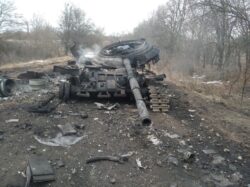 Within days of the Russian invasion, it became clear that Moscow’s effort to seize Ukraine had stumbled badly. The Russian military had expected a quick win, but found itself facing a hard slog instead. But why? And how to measure the conflict now?
The “whys” are multiple and intersecting:
- First, the operation reflected an exceptionally ambitious goal: complete seizure and “demilitarization” of the largest European country apart from Russia itself. The operational plan supporting this goal was complex, dividing the effort along several axes. It aimed to overtax and section Ukraine’s defenses, isolate the capital, and envelop Ukraine’s main force in the east. But a plan this grand and complex tempts collapse.
- Second, the size and complexity of the operation required a deep draw on Russia’s military. The invading force could not be limited to Moscow’s best and most experienced units. And many of the selected units seemed incapable of managing the fog and friction of war.
- Third, the Russian military came expecting to fight the weak force it had faced and badly mauled in 2014 and 2015. It planned, organized, and provisioned accordingly. Moscow also expected the Ukrainian populace to be as divided now as it was in 2010. One result was that Russian units initially moved forward in small, light units, hoping to seize the prize with minimal combat and destruction. But both assumptions about Ukraine proved wrong. And as the Russian advance slowed and stalled, logistical problems set in.
Ukraine had begun a process of military reform and revitalization following establishment of the Minsk II cease fire in 2015. The cease fire mostly held for seven years during which time several NATO countries afforded Ukraine increasing levels of military assistance – material, training, and intelligence support. The country’s special operations forces gained special attention. Ukraine’s progress in military reform has been modest, but sufficient to enable it to exploit the weaknesses in Russia’s initial assault, attacking its vulnerable supply lines, relying on portable anti-armor weapons and small unit tactics to ambush armored vehicle, and fighting pitched battles in urban settings as the war progressed.
Within a week of invading, the Russian military was struggling to revise its approach. Earlier errors impeded any quick reorganization and resupply, but Russia has progressively transitioned to a heavier, more balanced mode of warfare, with greater reliance on artillery and siege tactics. Paradoxically, as Russian artillery and air attack now bear down, Ukraine may suffer the most from its relative early success in stalling Russian forces. That is, success called forth the current onslaught, which was always implicit in the lopsided Russia-Ukraine balance of forces.
The contest over measuring gains and losses
How do the two sides compare in terms of personnel and equipment losses? That’s a matter of dispute, of course. These seemingly objective measures are subject to a rather intensive propaganda war, as both sides try to shape the opinion and morale of both fighters and publics, their own and their opponents’.
In fact, the information war is not two sided – Russia vs Ukraine – but multi-sided. The types and degree of risk that US and European governments are willing to bear, and the types and extent of support they are willing to offer Ukraine are influenced by public perception of the war and its progress, which in turn is subject to shaping. And this helps explain the wide divergence in estimates of loss.
What’s at issue is not simply an accurate accounting of the war’s costs, but policy choices – such as declaration of a “no fly” zone or cross-border flights of substitute fighter aircraft – that might tempt a much broader and more destructive conflict. Where the trigger for escalation sits is a policy decision. This post looks at some of the information dynamics that are shaping such decisions.
Personnel losses
Consider that on March 15 official Ukrainian sources claimed that more than 13,500 Russians had been killed. By contrast, Moscow has claimed 1,500 fatalities on March 25. The Conflict Intelligence Team (CIT), an independent monitoring group based in Russia, estimated Russia’s military dead as ~700 as of early March based on their investigations, but also speculated that a complete number might fall between 1,000 and 2,000.
During the week of March 6, one US official put the number of Russian fatalities as high as 6,000, but thought the number could be closer to 3,500. Also that week in testimony before members of the US House of Representatives, the director of the US Defense Intelligence Agency said the best estimate of Russian fatalities was between 2,000 and 4,000, although he also admitted low confidence in the estimate “because it relied on both intelligence sources and ‘open source’ information.” Clearly these US estimates of Russian fatalities range widely. One certainty, however, is that none comport with the estimates offered by either Moscow or Kyiv.
On March 13, President Zelensky claimed that the Ukrainian military had suffered around 1,300 fatalities. Earlier in March Russia estimated that its military operation had killed 2,870 Ukrainian troops. US officials have estimated that between 2,000 and 4,000 Ukrainian soldiers have been killed.
Confirmed civilian fatalities as of April 3 have been less: 1,413 dead, according to the UN High Commissioner for Human Rights. However, the UN office also asserts that the number is surely an under count. (And with Russia having commenced heavier urban assaults in mid-March, the number might climb rapidly.)
Russian equipment losses
Turning to Russian equipment losses: In a March 15 report, the Ukrainian military claimed to have destroyed 81 Russian fixed-wing aircraft and 95 helicopters. It also claimed to have captured or destroyed 404 tanks and 1,279 armored personnel vehicles. Reports verified via online photographs tell a different story.
Independently documented Russian equipment losses amount to only half the number claimed four days earlier by the Ukrainian military for armored combat vehicles and only one-fourth the claimed aircraft losses. As of April 2, independent researchers logged the following Russian military losses:
- 179 tanks destroyed. Another 209 otherwise damaged, abandoned or captured;
- 365 fighting vehicles, APCs*, and MRAP** vehicles destroyed. Another 370 otherwise removed from Russian service;
- 16 aircraft destroyed, 1 damaged; 15 of these were combat aircraft;
- 33 helicopters destroyed, 5 otherwise out of commission.
[*Armored Personnel Carriers, ** MRAP: Mine-Resistant Ambush Protected vehicle]
How reliable are these figures? All claims derive from readily available photographic evidence exhaustively linked on the report’s website, which is commendable. The researchers claim efforts to ensure that the photographs are current, related to the Ukraine conflict, and correctly assigned to the appropriate party. And the photos can be reverse searched to aid in their verification.
Under-counting is more likely than over-counting. Although thousands of citizens and soldiers are deluging social media with photo documentation of the war, it’s likely that some disabled or abandoned Russian equipment has not been recorded due to the lingering presence of Russian troops. Also, Russian troops may have carted some away.
A summary of the combat vehicle and aircraft assets that Russia and Belarus brought to the theater can help put estimated losses in context:
- 1800-2000 tanks by various estimates (links are below)
- Up to 8000 other armored combat vehicles (links are below)
- 300-500 combat aircraft at hand by varying estimates
The source of these baseline estimates are western military and intelligence agencies, diplomatic institutions, security policy centers, and trade and other media. Based on these sources, final ground equipment totals were extrapolated from the Pentagon assessed presence of 117 Russian Battalion Tactical Groups (BTGs) as well as other unit types and higher levels of organization.
Viewing the observed losses in light of these figures suggests a Russian armored vehicle loss rate of 11.2% over five weeks. Armored vehicles (including tanks) actually destroyed in combat or otherwise destroyed had constituted about 5.4% of the total deployed. (The rest of those counted as “lost” were simply disabled, captured, or abandoned.)
Russian combat aircraft losses were somewhat less. They have been within the 3-4 percent range. which corresponds with the sense that Russian air power has been underutilized.
It’s difficult to estimate ground combat activity based on such losses, which include armored vehicles destroyed, disabled, abandoned, and captured. We know that the Russian effort has been plagued by severe logistical problems involving equipment repair and the provision of food and fuel. This might prompt soldiers to not only abandon equipment – which is occurring, in fact – but also to disable or destroy it to prevent its appropriation by Ukrainian forces. (The United States armed forces often did the same when leaving behind equipment in Afghanistan and Iraq.)
What might Russian material losses say about personnel attrition?
Even taken as an approximate accounting, 11% of Russian armored vehicles equipment destroyed, disabled, or otherwise lost within a period of five weeks is a great deal. Equipment losses do not necessarily correlate with personnel losses, however. Ukrainian operations prioritized the destruction of vehicles by remote action or ambush using portable missiles. Nor were all the losses the result of combat. As noted above, some portion of the 5.4% of vehicles actually destroyed were destroyed by Russian personnel as they abandoned them to prevent their appropriation by Ukrainian units.
In light of the level and type of equipment loss, an associated 10% Russian casualty rate would be considerable. Routinely, a third of casualties are fatalities. This might suggest about 3,500 Russian fatalities and 6,500 injured. This assumes that 100,000 troops were deployed forward in 100+ Battalion Tactical Groups (BTGs) and other formations with the remainder in support or reserve.
The estimated number of Russian combat casualties is more-or-less consistent with Ukrainian claims of as many as 1,000 POWs – again assuming that Ukrainian units mostly depleted adversary units, rather than enveloping them. (On March 12, the Ukrainian armed forces claimed to be holding 500-600 Russian POWs. President Zelensky was later reported to claim “almost” 1,000 POWs.)
For historical context, units suffering logistics, morale, or leadership problems can disintegrate if they suddenly suffer as little as 15% serious casualties. In the 1990-1991 Gulf War, Iraqi ground units, disintegrated after suffering as little as 2.5% fatalities. And this would generate large amounts of destroyed, disabled, abandoned, and captured equipment.
Ukrainian equipment losses
Drawing on the same source for a verified accounting of Ukrainian equipment losses shows, as of 20 March:
- 33 tanks destroyed, 53 otherwise abandoned or captured;
- 64 armored fighting vehicles and APCs destroyed. 103 otherwise abandoned or captured;
- 11 aircraft destroyed; 10 of these are combat aircraft. 1 other aircraft destroyed.
As in the case of counting Russian losses, an undercount is more likely than an over count, both because lost equipment may lie in Russian controlled areas and because Ukrainian photographers and web masters may self-censor.
As best can be determined from other sources, the prewar Ukrainian arsenal included:
- ~850 usable tanks of varying age and capability
- ~2,400 infantry fighting vehicles and APCs
- ~80 combat aircraft – presumably not all of these are usable
Based on these estimates, the war has consumed about eight percent of Ukraine’s available tanks and other armored combat vehicles. This rate is 70% as high as that calculated for Russian forces, which is not so much less. The percentage of Ukrainian aircraft losses has been significantly greater – 12% compared with 3-4 % on the Russian side. Also, keep in mind that the percentage of Ukrainian aircraft holdings that are actually functional is uncertain. One recent report asserts that Ukraine now holds only 56 functional fighter aircraft. This and combat attrition may explain Kyiv’s insistent requests for replacement aircraft.
Conclusion
Unsurprisingly, Moscow and Kyiv are far apart in their estimation of own and other losses. This testifies to the information or propaganda aspects of the current conflict. Independent sources of equipment losses show the two sides much closer in their levels of attrition than most media coverage would suggest. And this implies lower levels of personnel attrition. Interestingly, the levels of verifiable equipment loss are within the range of US official estimates for Russian personnel losses.
Ukrainian resistance is more intense than Moscow anticipated, but Russia’s principal problems are logistical and the impact of logistical shortcomings on morale. Although Russia’s home-based material stores are great, its forces are operating at the end of ever longer and more vulnerable supply lines. By contrast, Ukrainian forces are heavily dependent on uncertain outside support, but when its units are forced back they fall back on their supply lines.
The utter dependence of Ukraine on outside support drives its investment in the propaganda war, whose target is the West. By contrast, Russia’s propaganda efforts are oriented toward maintaining troop morale and Russian public support.
The key conclusion of our analysis is that, contrary to the propaganda messaging of the two sides, both would seem able to sustain combat for a considerable time longer. And this implies unrelenting destruction in Ukraine, with ever mounting civilian losses. While this might argue for increased emphasis on war containment and diplomatic efforts, the most evocative messaging on the western side emphasizes Russian miscalculation and fumbling, Ukraine’s adept resistance, and the promise of war termination via increased investment in the war.
And so now… It’s war?
⇒ see full post: HTML
by Carl Conetta, 21 Feb 2022
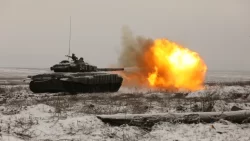 The battle within Ukraine and the USA-Russia contest over it has returned Europe to the darkest, most ominous period of the 1947-1989 Cold War. That this should happen with both the United States and Russia barreling grimly forward reflects a singular failure of diplomacy and common sense. There were two recent points in time when positive leadership might have turned us away from the path of disaster. Fortunately, one of these is not yet foreclosed. The short essay examines them both, asking how did we get here? It concludes with the question: Is it harder to live with autonomy for the Ukrainian rebel areas than it is to face regional war?
And So Now… It’s War?
Carl Conetta, Project on Defense Alternatives, 21 Feb 2022
The battle within Ukraine and the USA-Russia contest over it has returned Europe to the darkest, most ominous period of the 1947-1989 Cold War. That this should happen with both the United States and Russia barreling grimly forward reflects a singular failure of diplomacy and common sense. There were two recent points in time when positive leadership might have turned us away from the path of disaster. Fortunately, one of these is not yet foreclosed.
Movement toward resolution begins with recognizing that all sides, all stakeholders share fault for the current crisis. And no side has told the whole truth of it.
Without question, Russian intervention in Ukraine’s civil conflict violates international law. Although Russia has the right to defend itself from attack, this proviso does not apply in the current situation. The annexation of Crimea was illegal, as is Russian intervention in the Donbass. This is indisputable.
Also indisputable is the civil nature of the conflict between Kyiv and the Donbass rebels. Russian intervention on the rebel’s side does not change this. Similarly, the 2014 Euromaidan revolution and regime change has real, indigenous roots – despite the role of Western powers in encouraging it and supporting it politically and financially. This external interference tarnishes but does not de-legitimize the uprising. US and allied interference probably contravened the UN Declaration on the Inadmissibility of Intervention in the Domestic Affairs of States (1965). But the interference was not strictly illegal. And such interference happens all the time. Also, the Ukraine regime change was not a “coup” as some contend – except in the sense that many revolutions end in coup-like transfers of power. The story does not end here, however.
What should also be clear is that the Euromaidan revolution (or regime change) did not represent the whole of the country, which was divided linguistically, politically, and geographically. Moreover, the new regime attempted to revise language laws in ways prejudicial to ethnic Russians and Russian speakers, who constitute almost 1/3 of Ukraine’s population. Finally, the role of extreme ethnic-Ukrainian nationalists in the new order was and is indisputable. Although small in number, they have had an outsized influence on policy and action regarding ethnic Russians and the Donbass conflict. Put simply, the Euromaidan revolution and the new regime are not “pure as the driven snow.”
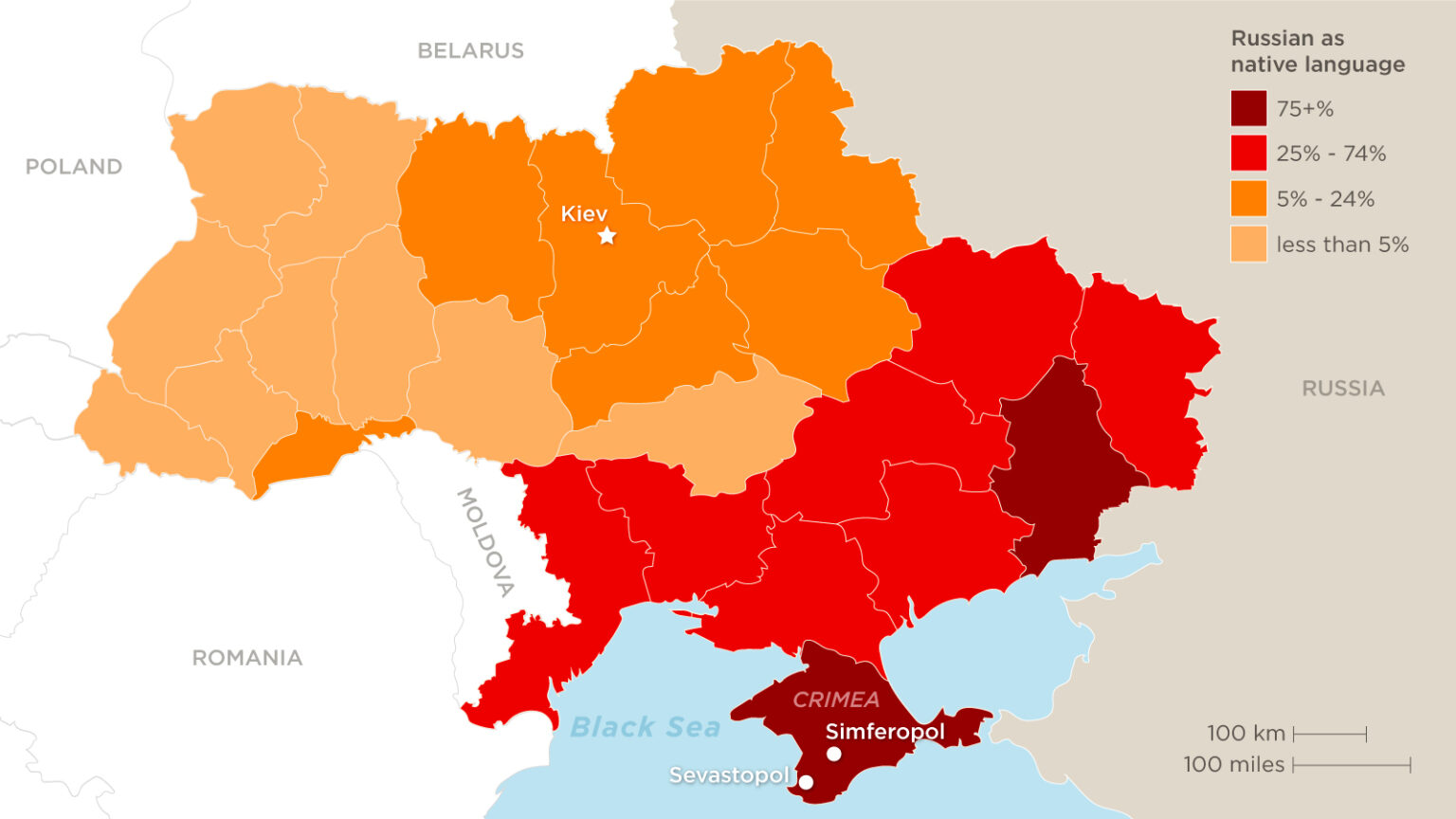
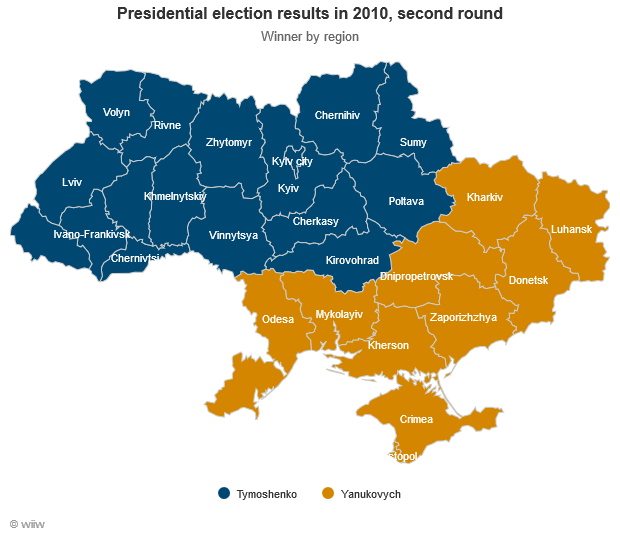
All things considered, it is not surprising that anti-Euromaidan protests sprang up in the east soon after the Feb 2014 regime change. The eastern oblasts is where ethnic Russians, Russian speakers, and electoral supporters of the deposed president were concentrated. With Moscow’s encouragement, the eastern protests evolved by April 2014 into the self-styled Donetsk and Luhansk “People’s Republics”. Almost immediately, acting Ukrainian President Oleksandr Turchynov launched an “Anti-Terrorist Operation” (ATO) against the eastern rebels. What should have happened was negotiation.
Kyiv’s operation made halting progress for awhile, but the front stabilized after a summer flood of Russian equipment and Russian “volunteers.” (Total rebel strength has been approximately 40,000 fighters plus up to 6,000 Russians.) In April 2018, Kyiv redefined the conflict as one between Ukraine and Russia, essentially rejecting the indigenous roots of the eastern rebellion and claiming the fight to be wholly international in character.
In the 12-15 months following the April onset of the civil conflict 11,000 Ukrainians were killed in fighting. This death toll represents more than 80% of the total 13,000 killed between 2014 and 2021. The very substantial reduction in carnage after mid-2015 was due to the so-called Minsk agreements and the control regime that followed.
As noted above, there were two recent points when positive leadership might have turned the region away from the path of disaster. The first was on February 21, 2014, when negotiations led by European Union mediators and the foreign ministers of Poland, France, Germany succeeded in bringing both opposition leaders and President Yanukovych to sign the “21 February Agreement” (formally “Agreement on Settlement of Crisis in Ukraine“).
Among its provisions, the 21 February Agreement included restoration of the 2004 constitution (which weakened the power of the presidency), formation of a government of national unity, early elections, a new Election Commission and reformed election laws, a block on declaring a state of emergency, and amnesty for the Euromaidan protestors. However, the deal was abruptly cast aside by Euromaidan activists, being vocally opposed by street-level leaders and some nationalist groups (including Right Sector). Subsequently, President Yanukovych fled the country, many of his government and parliamentary supporters recused themselves (to put it mildly), and the Verkhovna Rada (Ukraine’s parliament) quickly reshuffled itself. The revised body almost immediately voted to abolish language policies that had given Russian and other minority languages official status in some areas. This was a serious misstep, only blocked a few days later by Ukraine’s acting president, Oleksandr Turchynov.
The second opportunity to avert disaster was the signing of the Minsk II Protocol in Feb 2015, which pledges autonomy for the rebel areas and also requires the “withdrawal of all foreign armed formations, military equipment, as well as mercenaries from the territory of Ukraine” and the “disarmament of all illegal groups.” Its provisions were soon affirmed and reinforced by UN Security Council Resolution 2202 (The Resolution here also appends the provisions confirmed by the Security Council).
As already noted, the protocol’s cease-fire provisions had the effect of very substantially reducing violence. For this reason, it continues to earn verbal praise from all-sides, even while some stall or seek to exit other provisions of the agreement. Unfortunately, over the course of six years, there has been little progress fulfilling the political aspects of the agreement. And now the rebel forces seem to be intent on exiting the deal’s cease-fire provisions. (Moscow and the rebel leaders insist that Ukrainian government forces started the recent escalation, but such a provocation seems unlikely given the massive Russian force arrayed along Ukraine’s borders ready to strike.)
Current Ukrainian President Volodymyr Zelenskyy has sought to rewrite the agreement since early last year. The critical provisions now refused by Kyiv are those granting rebel areas a significant degree of autonomy; This is the reason the rebels fight. And, as it turns out, none of the western sponsors of the agreement (France and Germany), nor the Organization for Security and Co-operation in Europe (OSCE) that oversaw it, nor those western nations sitting on the UN Security Council (which had affirmed it), seem willing to push hard for the agreement’s full implementation. These powers certainly have the leverage needed to ensure implementation. Of course, this reality has not been lost on Moscow, which sees key provisions of the agreement hanging in abeyance while Kyiv stumps for fast-tracking NATO membership and Ukraine receives arms and training from the USA and other NATO countries.
What has changed since 2014 is the willingness of the USA and some other NATO countries to tempt war in order to undo those aspects of Minsk II that might inhibit the full and uncompromised incorporation of Ukraine into western institutions and the US/NATO sphere. Zelenskyy appreciates this and is acting accordingly. Both he and the Biden administration hope that Moscow will back down in the face of Washington’s threats. Apart from this, Ukrainian state and military leaders may hope to gain increasing support from the west, even if NATO membership remains a distant prospect.
What Zelenskyy may not appreciate is that the United States can gain strategically even if Russia further occupies Ukraine in whole or part. Such a move would cost Russia dearly, revive NATO, increase European dependence on American military power, and gain broader adherence to the foreign policy framework that Washington currently advances: “strategic competition” or “great power competition.” Of course, this would be cold comfort for a devastated, occupied Ukraine.
For its part, Moscow’s willingness to tempt war over Ukraine has been clear ever since it annexed Crimea. It lost out to the USA in the contest to shape Ukraine’s governance, purportedly worries about the fate of Ukraine’s Russian communities, and resists the loss of both economic and military connections. But central to its concern has been the 25-year march of NATO toward its borders. The absorption of Ukraine would be the culminating point of NATO expansion. It would give the alliance a 1400 mile border with Russia.

Washington insists that NATO poses no threat to Russia, even should it press up against its borders. But such assertions are themselves disquieting. They evince a not credible ignorance of the inherent nature of military power and alliances, the long and continuing history of tense US-Russia relations, the permeability of borders to all sorts of unwanted influences, and the proclivity of several NATO alliance members for regime change efforts.
While Moscow insists that the USA and NATO take its security interests into account, Washington says there is no room in a “rule-based” world order for considerations of Realpolitik. True, there is nothing in international law, formal or customary, that flatly prohibits the expansion of military alliances. Of course, this view underrates the persistence of power politics in the practice of nations, including America’s. There is wisdom and usefulness in taking a Realist reading of conflict situations and their broader ramifications.
Practically, what does the United States hope to gain by pushing NATO up to Russia’s borders when the effort risks sparking conflict between nuclear great powers and is certain to deepen and perpetuate East-West contention? Consider: It may be that stability, cooperation, and the rule of law all depend on reaching some sort of underlying condominium among great powers with regard to their core security interests.
Fortunately, the second opportunity to avert disaster mentioned above has not yet been foreclosed – and it accords with the “rule of law.” In the recent exchange of US-Russia security proposals a minimum Russian requirement is evident. While Russia has raised a broad variety of security concerns and demands, its Feb 17 statement emphasizes the importance of Minsk II implementation to de-escalating the Ukraine standoff. And implementation of the agreement in accord with UN Security Council Resolution 2202 (2015) would in no sense upset the rule of law. Quite the contrary. But the pivotal question may be less legalistic than practical:
Is it harder to live with autonomy for the Ukrainian rebel areas than it is to face regional war?
Putin’s Next, Best Move – The Logic and Limits of Russian Action on Ukraine
⇒ see full post: HTML
Carl Conetta, 14 Feb 2022
 Moscow will act when and if it declares that the West has escalated contention rather than responding positively to its entreaties – principally those regarding NATO expansion and implementation of the Minsk II agreement. Recent US/NATO troop deployments and weapon transfers to Ukraine may already count as relevant escalation. Russian forces surrounding Ukraine stand at an exceptionally high level of readiness and significantly exceed the scale of previous deployments. A full-scale invasion aiming to seize the whole of Ukraine seems unlikely. Indeed, Russian action may involve no more than large-scale conveyance of weapons and munitions to the rebel areas, possibly along with an influx of “volunteers.” Several other options ranging between these two are discussed in the essay.
Putin’s Next, Best Move – The Logic and Limits of Russian Action on Ukraine
Carl Conetta, Project on Defense Alternatives, 14 Feb 2022
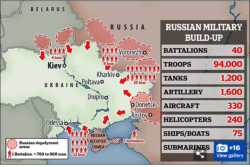 Summary: Moscow will act when and if it declares that the West has escalated contention rather than responding positively to its entreaties – principally those regarding NATO expansion and implementation of the Minsk II agreement. Recent, new US/NATO troop deployments and weapon transfers to Ukraine may already count as relevant escalation. Russian forces surrounding Ukraine stand at an exceptionally high level of readiness and significantly exceed the scale of previous deployments. Nonetheless, a full-scale invasion aiming to seize the whole of Ukraine is highly unlikely. Indeed, Russian action may involve no more than large-scale conveyance of weapons and munitions to the rebel areas, possibly along with an influx of “volunteers.” Several other options ranging between these two are discussed below.
Given the forecasts, premonitions, and warnings emanating from Washington regarding a prospective Russian invasion of Ukraine, one would think it a foregone conclusion. And maybe, it is – even though seizing the country and subjugating its 44 million people would be an unparalleled nightmare for Moscow. And that’s true regardless of threatened sanctions. (By comparison, the 2014 seizure of Crimea was easy; It is small region (pop. 2.4 million) that had been positively inclined toward Russia and was already hosting thousands of Russian military personnel on the eve of annexation.)
Has Washington been hoping to deter a Russian invasion by forecasting it, threatening punishment, bolstering Ukraine’s weapon stocks, and redoubling the type of European military deployments about which Moscow incessantly complains? A curious feature of the recent NATO military preparations and enhancements is that, while sure to irritate Moscow, they fall far short of what might deter invasion. Perhaps these, like Washington’s warnings and prognostications, are meant mostly to rally NATO and burnish the image of American leadership. Another distinctive feature of US pronouncements is that they comprise mostly threats and little in the way of positive inducements. In some respects, America’s framing of the crisis cannot fail: If Russia invades, then America is proved insightful; If it does not invade, then America can claim effective deterrence. And yet, there are options for Moscow to spoil both expectations.
The road to current options
Weighing what Moscow might do now or soon requires a look back at the recent evolution of the crisis. Russia’s attempted intimidation of Ukraine by massing troops on its border has occurred frequently since Jan 2015, always linked to (i) Ukrainian action concerning the eastern rebels or Ukraine’s Russian-speaking citizens, (ii) Ukranian steps toward NATO, or (iii) weapon deliveries from the USA or NATO.
Since early 2020, Russian military pressure has been linked to the lack of progress toward fully implementing the Minsk II agreement, President Zelenskyy’s desire to revise provisions of the accord regarding autonomy for rebel areas, his pronounced campaigning for NATO membership, NATO’s June 2020 grant to Ukraine of “enhanced opportunities partner” status, the transfer of lethal weapons from NATO countries (beginning in 2017), and joint Ukraine-NATO training and exercises. From Moscow’s perspective, the likelihood of full Minsk II implementation is progressively diminishing, while Ukraine’s approach to NATO advances, and its capacity to retake the eastern rebel areas improves. This argues against patience, especially given the failure of western capitals to incentivize Ukrainian acceptance of key Minsk II provisions.
Upping the ante
In Dec 2021, Moscow seemed to broaden the scope of prospective negotiations by offering a draft “Treaty between The United States of America and the Russian Federation” regarding security guarantees. This document outlined rather ambitious proposals to mutually limit behavior that Moscow perceived as undermining the core security interests of the signatories, especially itself. These included ending the eastward expansion of NATO and, indeed, denying ascension to any former member state of the USSR (presumably meaning Georgia). The treaty would also forbid deployment of nuclear weapons outside national territory, and forbid the dispatch of heavy bombers, warships, or missiles to areas outside national territory from which they can attack the other’s home territory.
The document seems to be more a public enumeration of security complaints than a practical foundation for near-term negotiations. It’s too ambitious. However, while it does not mention the ongoing dispute regarding Ukraine’s civil conflict, it may have been meant to put that dispute into the context of Russia’s overall and long-standing security complaints. In this context, a western push to fully and soon implement the Minsk II agreement would seem a modest concession to Moscow’s concerns. Now, in the opinion of many western leaders and commentators, grants of autonomy for the rebel areas would also scuttle Ukraine’s hopes for NATO membership – as Moscow desires. But such an exclusion is speculative and proffered mostly as additional argumentation against granting the eastern rebel zones true autonomy. (A number of NATO members have nettlesome regions, population segments, political tendencies, or even state leaders.)
In any event, neither the USA nor NATO have responded favorably to Moscow’s avowed security interests on either the large or small scale. The US rejoinder to Moscow’s draft treaty (inclds English translation) did offer renewed dialog on some issues and the possibility of negotiating some relevant arms control agreements and confidence building measures. However, the response deferred such discussion to a Russia-NATO format, thus delaying it, and also asserted that negotiations should occur within the framework of 1990s East-West agreements and forums that Moscow now considers long-surpassed and rendered moot by Western actions over the past two decades.
With regard to NATO enlargement, the US document simply reiterates disingenuous cant about NATO’s “open door.” Additionally, the United States offered its own list of complaints to be discussed, covering inter alia Russian troop presence in Crimea, Moldava, and Georgia. This is fair enough, but the document’s closing sentence undercuts the prospect for negotiation: “It is the position of the United States government that progress can only be achieved on these issues in an environment of de-escalation with respect to Russia’s threatening actions towards Ukraine.” In other words, you stand down and then we can discuss your concerns and ours.
This offers Moscow no easy or respectable exit from the current standoff, no “golden bridge” out. The United States is offering Moscow the sole option of empty-handed and humiliating retreat. This is all that Washington thinks Moscow deserves. Of course, at this point, Moscow might find useful America’s very public presentation of “an offer they cannot accept.” How might this be viewed outside US-allied capitals (and even within some)? Might it inadvertently afford Moscow some greater political freedom to take direct action? The same might be true of perspectives on Ukranian President Zelenskyy’s hardline insistence on vacating the Minsk II promise of true autonomy for the rebel regions. (The agreement continues to enjoy strong declaratory support on all sides because it dramatically reduced the carnage of Ukraine’s civil conflict – most died prior to Minsk agreement – in the first years of the fighting.)
Moscow’s Options for Action
As stated at the outset, there’s no good reason for Moscow to seek or attempt the conquest of all Ukraine. The least demanding option suggested above would involve the transfer of very substantial amounts of armament to the rebel areas, possibly together with additional Russian “volunteers.” This would undergird a “porcupine defense”.
Most of the Russian units currently arrayed along Ukraine’s borders might then gradually withdraw, leaving behind some rapid intervention forces and a considerable number of artillery, air defense, and reconnaissance assets to buttress rebel defenses, if need be. This degree of intervention might come as a considerable relief to those led for months to expect a massive invasion – thus weakening western support for severe sanctions. Indeed, subsequent efforts to stymy the Nord Stream 2 pipeline might fracture NATO.
Complimentary Russian political steps might include a formal pledge to help defend the rebel areas against military offensives. Not likely would be recognition of these areas as independent states, as was the case with Abkhazia and South Ossetia in Georgia. Such might foreclose their reintegration with Ukraine, which Moscow prefers (although the rebel leadership might not).
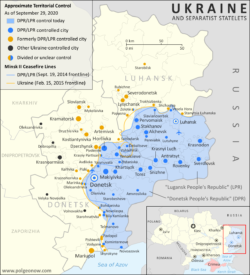 A more ambitious and less likely objective would be to help recover areas lost by the rebels since 2015 or even to extend control to the whole of Donetsk and Luhansk Oblasts. (The lost areas are depicted in the map “Ukraine and Separatist Statelets,” which also shows the full extent of the related Oblasts). This larger area might prove more defensible because it would be less vulnerable to flank attack. The resulting rebel “republics” would face the rest of Ukraine on only one side. But this assumes that the rebel forces could confidently hold this expanse without a long-term large-scale influx and stationing of Russian troops (which would support the narrative of “Russian occupation.”) Obviously, this larger-scale option for Russian action would be much more demanding and costly for Moscow’s forces, and it would likely prompt US-promised sanctions.
The farthest plausible limit of Russian advance would aim to occupy all of those areas of Ukraine that have a higher concentration of ethnic Russians, Russian speakers, and citizens who voted for the former president Viktor Yanukovych (who was deposed by the Euromaidan revolutionaries). (See maps below) This is not to assume that Russian invaders would be welcome in these areas, only that Moscow might hope to face less resistance there. And why might Moscow attempt such a risky gambit? To substantially increase its defensive depth – an objective that speaks directly to concerns about the advance of NATO.
Map ⇓ indicates the geographic distribution of native Russian-language speakers
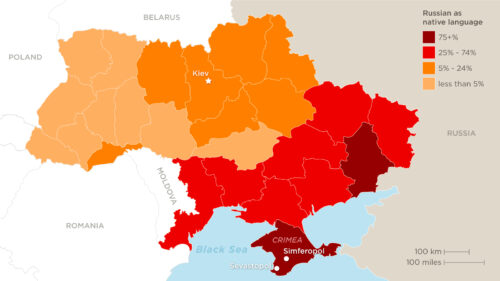
Map ⇓ indicates distribution of support in the 2010 election for Viktor Yanukovych, the president deposed by the Euromaidan revolutionaries in 2014.
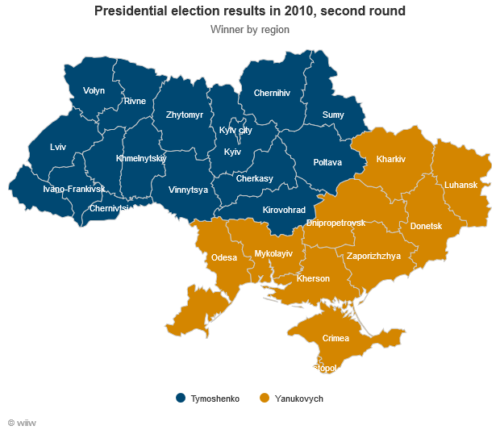
Pentagon Fact Sheet on February 2022 Troop Deployment to Europe
 Pentagon Fact Sheet: Posture Update in Support of Allies in Europe (PDF), 02 Feb 2022. Noted by Carl Conetta.
Resolving the Ukraine Crisis
War? Only If We Want It
Carl Conetta, Project on Defense Alternatives, 26 Jan 2022.
 Anatol Lieven offers a way out of the current impasse in Ukraine: The Most Dangerous Problem in the World. Essentially, he reviews the 2015 Minsk II agreement, how implementation might have averted the current crisis, and the roadblocks to its implementation. But it remains relevant and it points to an exit from the crisis. Drawing on Lieven’s analysis, here is my view and prescription:
The current crisis began with disagreement on how to proceed with the Minsk II Protocol. The issue was the sequencing of its steps and how this affected reversibility. Of course, the 2018 adoption by the Ukrainian parliament of a law on “Ensuring Ukraine’s State Sovereignty over Temporarily Occupied Territories in Donetsk and Luhansk Regions” didn’t help. It sidestepped the Minsk agreement, redefined the conflict as one purely between Ukraine and Russia, and it privileged a military solution. More than sidestepping the agreement, Ukrainian President Volodymyr Zelensky has sought to exit and revise the hard won agreement since late 2019 – and, more recently, in April 2021. And why?
The “problem” generally was that the Protocol lends some legitimacy to both sides. Quarrelsome, perhaps, to both sides, but a modicum of mutual respect and the practice of quid pro quo is the essence of diplomacy. (So, the “problem” is actually the formula for a solution – that is, diplomacy.) Now, practically or politically the problem is the Ukrainian parliament’s refusal to go forward with a change to the constitution allowing autonomy for the Donbass region – at least, not until after Kiev has regained control of the region and of the border with Russia. However, on the Russian and rebel side, this approach makes the promised autonomy too easily reversible. Tuesday’s vote can undo Monday’s.
How to move forward? The first step is for benefactors on all sides to motivate progress. The United States, EU, and Russia should initiate a joint effort making all aid to Kiev and to the eastern rebels contingent on near-term compliance with Minsk II.
Some provisions of Minsk II are easily reversible, others less so. Begin with the easily reversible provisions which at least can serve as confidence-building measures. Pivotal among these is a change to the Ukrainian constitution allowing for the autonomy of the Donbass region within a federated Ukraine. While this could be quickly undone, the involvement of outside sponsors should give some confidence that the measure will not be reversed unless other elements of the Protocol are violated. The next steps would be to demilitarize the Donbass and supplant both Russian and Ukrainian troops with a large contingent of European peacekeepers. These also would gain control of the region’s borders. Subsequently, local elections could be held under the supervision of outside monitors.
Here’s the hitch:
Allowing for true Donbass autonomy within a future federated Ukraine accepts that the 2014 regime-change did not represent a large portion of the country and that the way forward grants both sides legitimacy. It might also imply, although not necessarily, that the international community accepts that if the division of the country resulted from outside intervention, the intervention came from *both* east and west. Finally, this solution might preclude NATO membership for Ukraine – and not because Moscow would object. Also, a stable solution would probably necessitate some sort of EU-Russia accommodation on economic relations with Ukraine. Overall, the result could advance cooperation between east and west rather than war, hot or cold.
Afghanistan: What Just Happened? What Comes Next?
Can the United States escape the vortex of its 20-year war?
 Carl Conetta, Project on Defense Alternatives, 09 Sept 2021
15 August 2021- in short order, a 20-year $1.2 trillion US effort at nation-building evaporated, disintegrated, went up in smoke. And while unreconstructed interventionists pummel President Biden for surrendering Afghanistan, the truth is that we never had it. What we held instead was a hollow construct of our own imagination and creation – a client pseudo-state. And when it was finally and fully tested, it (for the most part) threw down its arms and ran away.
In a sense, the sudden collapse of Kabul’s government and security services provides the surest litmus test of America’s 20-year enterprise in Afghanistan. It tells us that coercive nation-building by a foreign power – indeed, an alien power – is an impossible mission. Outsiders lack the knowledge, indigenous roots, legitimacy, and degree of interest to succeed against local resistance. Their very presence is provocative, especially given differences of language, religion, and culture. It’s as likely to spur resistance as it is to quell it. At the same time, such interventions risk becoming intractable given domestic political dynamics and Washington’s fixation on preserving its superpower reputation, its claim to being the “indispensable power”.
America’s interventionists have had only one answer to the persistence of failure: Stay the Course (with minor adjustments and occasional troop surges). They commonly aver that “Will” is the ingredient lacking in US adventures abroad. Public support or tolerance for this view steadily declined after the completion of the Obama troop surge in 2012; By April 2021 less than one-quarter of Americans would affirm it. However, the deadly mid-August disorder at the Kabul airport has given interventionists a fresh opportunity to assail withdrawal, if only obliquely.
While most Americans have come to accept the need and wisdom of withdrawal, the bloody mess at the airport casts a shadow over its practical implementation. US hawks and interventionists mobilized this impression to challenge the goal of withdrawal itself and to rally opinion to support interventionism – presumably by smarter means. Ostensibly the criticisms concerned the manner of withdrawal, not the fact of it. However, during August, the one type of complaint morphed seamlessly into the other, with interventionists decrying the “abandonment” of the Kabul regime, blaming the collapse of Kabul’s forces on the USA, demanding that American forces secure Kabul province, and ultimately insisting that Biden renege again on a withdrawal pledge and keep troops in Afghanistan until “every American is brought home.”
In recent complaints, there was no proposed new course that credibly promised to deliver the type of Afghanistan that Washington’s nation-builders had sought. And there was little recognition or expressed concern that the proposed action – defer withdrawal – would have involved returning to war with the Taliban. There’s not even much attention to the fact that the Taliban had recently been helping to protect US forces, safely escorting US nationals to the airport, and fighting off ISIS. This degree of cooperation was limited and conditional, but also essential. It should not have been summarily dismissed – especially given that Kabul’s military, such that it was, offered no alternative.
The Biden administration did err seriously in failing to fully appreciate what little progress had been made over 20 years toward building a functional Afghan government and military. How much progress was there? Next to nothing lasting or reliable. Failing to see this is an astonishing omission, but the omission has been endemic among US security policy officials. And it has kept the USA stuck in an impossible mission for 20 years. To be fair, the Biden administration appreciated the short-fall more than most officials, although not nearly enough – hence, the airport fiasco.
Did America’s covey of intelligence agencies “see it coming,” as some critics assert. No. Not usefully. The intelligence estimates that were supposed to guide the withdrawal repeatedly proved to be “an hour late and a dollar short” – that is, not usefully accurate, timely, or detailed:
- In mid-2020, the intelligence consensus had been that the Taliban might triumph within two or three years.
- By 27 April 2021, when President Biden announced the prospective withdrawal date, the intelligence estimate had been revised to 18 months – which, actually, was not much different than the 2020 estimate in terms of the possible end date. Rather reassuring, it would seem, but wrong.
- By 23 June, a possible collapse date was further revised to be as close as 6 months away. US retrograde operations had somehow lost a year of leeway over a period of just 2 months. Still, the projected horizon was still far enough away to allow smooth completion of the planned evacuation. Had it been correct. But it too was wrong.
- A mid-July estimate argued that despite Taliban gains, “the capital is not at imminent risk of a takeover, thanks in part to the threat of US airstrikes.”
- In early August, DOD disseminated a new, foreshortened estimate of possible Taliban victory: 90 days.
- Soon after – around Aug 12 – less than a week before the regime’s collapse – a new intelligence assessment concluded that the Taliban could isolate Kabul within the next 30-to-60 days. Still, room enough to complete withdrawal – but wrong.
Only in late June 2021 did intelligence services begin seeing a possible collapse before the end of the year. And at no point did intelligence services see a potential collapse before mid-September. Rather than aid the administration, this cluster of mistaken estimates may have contributed to the administration’s faulty calculus.
Still, outside the intelligence establishment, there were sufficient sources indicating that the Afghanistan effort was rotten at the core – a patient perpetually on life-support. The Special Inspector General for Afghanistan Reconstruction (SIGAR) saw it, the federal government separately recorded it, the news media widely reported it, and various non-governmental organizations chronicled it. The sorry condition of the effort might also have been gleaned from President Ghani’s January 2018 assessment that the Afghan National Army would not last more than six months without US support and that the Afghan government would also collapse. Thirty months hence, nothing had changed to improve this situation. In fact, Ghani‘s assessment has been shown to be overly optimistic.
The administration’s endgame plan envisioned the Kabul regime minimally securing Kabul Province while holding much of the center and northeast of the country long enough for an orderly US troop withdrawal to occur. Civilian evacuations would continue after the troops’ departure. The long-term survival of the regime was thought to be problematic, but not hopeless. And the Biden administration intended to continue supporting Kabul’s military effort with funds, training, equipment, force planning, munitions, logistics, and intelligence. Direct US military action would occur from “over the horizon,” but only to blunt explicit terrorist threats.
This administration’s program was not much different than how both the Obama and Trump administrations had come to see a possible future end game and post-deployment relationship. What should be the centerpiece of discussion now is that all these expectations stretching back a decade and more were delusional. In that light, Biden’s misjudgments about the near-term reliability of the Kabul regime were just a lesser instance of those guiding US policy for 20 years. This shows the danger of narrowing critical attention to the airport debacle: It produces no caution against the impossible missions, the torrent of hubristic error that culminates in last acts such as this one. Of course, for some critics, preserving the interventionist prerogative takes precedence.
Did Biden’s decision to proceed with withdrawal actually contribute to the collapse of the Kabul government and military, as some critics say? Yes, certainly – how could it not? America’s “Afghanistan” was a client-state, a desperate dependency. A fiction. The USA was its paymaster and superpower partner in war. Once fully tested on its own, it quickly crumbled. That should not be surprising – although much of Washington has acted as blind to this reality for years or tried to suppress it. As the collapse actually unfolded, each local loss or setback suffered by the Afghan National Security Forces added to the momentum of collapse (calling to mind the effect of the German blitzkrieg on the French military in 1940). The rapid desertion of soldiers and politicians from their posts was the impetus for the Kabul airport chaos. But the essential precondition for chaos and collapse was the inherent decrepitude of this foreign-imposed state. Yes, by his action, Biden pulled the curtain back on this fragile corrupted entity. It was weaker than he or the intelligence establishment or most US state managers had expected.
Diplomacy as War by Other Means
Having lost the war, the United States and its allies are now coordinating to win the peace by other coercive means: stopping aid, reviving and stiffening sanctions, blocking recognition, freezing financial assets, and denying the Taliban government access to the global commons. Of course, a wide range of covert means is also available.
The leaders of the G7 countries have warned the Taliban not to revert to the strict Islamic form of government that they ran when they last held power. And the G7 has asserted “that the Taliban will be held accountable for their actions on preventing terrorism, on human rights, in particular, those of women, girls and minorities, and on pursuing an inclusive political settlement in Afghanistan.”
While compromise on some of the G7 demands seems possible, those regarding the form and composition of the Taliban government are unlikely to find any acceptance. The Western alliance straight-out dictating the contours of an Islamic government is a non-starter, to stay the least. The Taliban will not soon or easily surrender the commanding position or core principles for which 50,000 of its members died. While punitive measures might compel a degree of shaky compliance in some areas, the greater effect of tightening the screws on Afghanistan will be instability, hostility, realignment, and missed opportunities for cooperation – in other words, more pain and loss on all sides. The cost-benefit ratio for this campaign of punitive diplomacy is not encouraging, but other dynamics can drive the confrontational approach, nonetheless.
Sanctions, as an assertion of power after losing a war, may speak to the domestic politics and public opinion of the losing states. Punitive measures may also aim to restore some of the reputational heft lost by the United States due to the Afghan war outcome, saying in effect: our destructive power does not end at the edge of the battlefield. Some argue that the reputational fallout of such losses doesn’t matter. That’s wrong, judging from the geopolitics of the immediate post-Vietnam War years. There is a reputational price to pay for imprudent and/or unnecessary military adventures, although the United States obviously recovered its hegemonic prerogatives within 15 years of North Vietnam’s victory.
Finally, the temptation to enact severe sanctions and other punitive measures after a war loss may be intentionally aimed to destabilize Taliban rule and help feed resistance, perhaps reviving war on a proxy basis. In this example, punition would not simply serve as a tool of coercion; It would be meant to actually achieve destabilization and perhaps collapse.
Regardless of motive, the punitive approach undermines rather than enhances regional and national stability. And it feeds contention rather than cooperation. It continues to view Afghanistan and the surrounding region principally through the lens of 9/11 and America’s 20-year war. It literally revives that war and continues it by other means. And it minimizes the regional reality of new actors, new challenges, and new opportunities. A different approach might build on the precedent of selective US-Taliban cooperation achieved over the last two years – transactional for sure, but real nonetheless.
Stabilize Afghanistan: Make Peace with the Taliban Now
As an alternative to pursuing a peremptory approach to the Taliban, Washington should immediately establish a civil, diplomatic modus. It should pursue a non-coercive transactional relationship. This seemingly audacious turn in policy offers the only realistic prospect for moving soon toward a more stable country and region, which will be achieved together or not at all.
A more cooperative relationship might quickly begin to address and advance a variety of important goals:
■ Ensure the return home of all foreign nationals who care to depart Afghanistan as well as releasing all Afghans with travel authorization from another country (as the Taliban have pledged).
■ Preventing or interdicting the export of terrorist influence and activity. Especially, work jointly against ISIS-K.
■ Containing or reducing other transnational criminal activity, especially the drug and arms trades.
■ The development of regional confidence and security-building mechanisms, such as conflict resolution and arms control protocols.
■ The advance of equitable, sustainable economic development.
Other important subjects of cooperation that might begin soon include migration control, environmental protection, and transnational health concerns.
Full and formal normalization of relations will take time, but many aspects of normalization (affecting, for instance, trade and aid) should go forward quickly on a provisional basis. This should have a stabilizing effect on the country and advance cooperation in all spheres.
As suggested above, any attempt to compel Taliban adherence to outside political and social ideals and practices will prove very contentious. But more can be accomplished within a context of cooperative relations than without. And, of course, in the final resort, no nation is compelled to trade with or aid others whose policies it considers abhorrent. (WTO rules give leeway for trade sanctions on a number of non-economic pretexts.) The prospect of limited restrictions argued explicitly on the basis of adhering to one’s own national laws may be a way of favoring change without giving the impression of a united front against the Taliban or an opening shot in a “clash of civilizations.” Neither of these stances would be productive, although possibly gratifying to some.
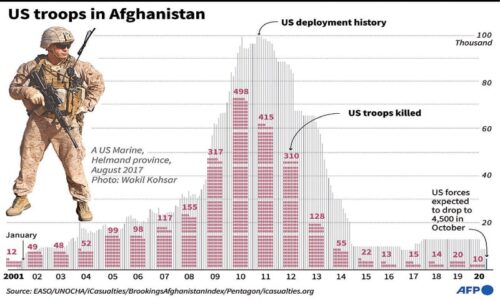
Afghanistan: What Just Happened? What Comes Next?
Can the United States escape the vortex of its 20-year war?
➪ see full-post: HTML
by Carl Conetta, 09 Sept 2021.
This article assesses the calamitous end of America’s 20-year war and the effort of US interventionists to use public distress about the airport chaos to blunt and distract from an adequate appraisal of the war that produced it.
The war was defined from the start by an impossible mission shrouded in misinformation. Intelligence agencies failed to give useful intelligence over a span of not just 4 months, but 20 years. And the article asks, Can we escape the political and strategic dynamics that produce and sustain such wars?
It concludes by examining how some Western powers are now looking to continue the conflict via other means. Against this, the author proposes a stability-oriented approach that would energetically explore areas of possible US-Taliban cooperation, a new positive context in which areas of difference might be productively addressed.