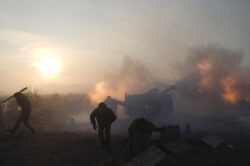
Afghanistan: The Fog at the End of the Tunnel


see full-text: HTML or PDF   

by Carl Conetta, 19 June 2021

What is causing the uncertainty about when US ground forces will exit Afghanistan?

The Biden administration insists that logistical factors explain its breach of the 2020 US-Taliban agreement, which reset the exit date from May to September. Logistical factors were also used to explain why the date may be moved back to July. Actually, logistical issues explain neither. Using current data and historical precedent, this short analysis shows why.

An alternative explanation for the delay is that it gave Washington more time to pursue some of its unfinished goals regarding Afghanistan. In this, the lingering troop presence serves as leverage.

What goals? Improve Kabul’s military posture, polish plans and preparations for US forces to “fight from afar,” and pursue dramatic new international initiatives aiming to lock the Taliban into a cease-fire, peace settlement, and government reform plan substantially defined by the USA. This high risk-gambit won’t succeed, but it might prolong the conflict and America’s involvement in it.

Afghanistan: The Fog at the End of the Tunnel*

When will US troops leave Afghanistan? Why the uncertainty?
And how the logistics of withdrawal has little to do with it.

Carl Conetta, 19 June 2021 – PDF version here

(Note: Reference numbers in text link directly to relevant documents)

The date for US troop withdrawal from Afghanistan is subject to change once again. (1)  The Feb 2020 agreement between the USA and the Taliban had originally set May 1, 2021 as the deadline for ending US ground presence.(2) However, on April 17 President Biden announced his intention to breach the agreement by setting a new date almost 6 months in the future: September 11.(3)  Now, the NYT reports that more than a dozen officials in the USA, Afghanistan, and Europe are confirming a possible new departure date in mid-July 2021.(4)  Given the opportunity to deny the leaks, Pentagon Press Spokesman John Kirby instead demurred, saying, “I’m not going to speculate about what the exact time frame is going to end up being.” (5)

In US discussion of these changes, the logistics of withdrawal have been emphasized as initially requiring the delay and then, unexpectedly, allowing some mitigation of it.(6) According to the Times, upon supposedly beginning withdrawal in April “military officials quickly realized that they could be out by early to mid-July.”(7) But these explanations for the delay and then its partial retraction fall short, as this post will show.

First, previous troop drawdowns in Afghanistan (and elsewhere) strongly imply that the task could have been completed by May 1, if there had  been a will to do so.(8)  (see Appendix 1: The Logistics Dodge, below )

Second, arguing that ignorance of conditions on the ground led to overestimating the time needed for withdrawal begs credulity. Active planning for the move has been underway for more than a year.(9) (10) So has the process of withdrawal. Already 10,000 troops had withdrawn by early 2021 (counting from January of 2020).(11) The task facing the new administration was not a new one, nor was the ground unknown.

An alternative (or complimentary) explanation for breaching the US-Taliban agreement is that it gave Washington more time to pursue some of its unfinished business concerning Afghanistan’s future. In this, the lingering troop presence would serve as a type of leverage. As a Reuters reporter found, “Some U.S. officials and many experts fear that if US-led international forces depart before a peace deal is reached, Afghanistan could plunge into a new civil war, giving al Qaeda a new sanctuary.”(12) Motivating and managing that prospective peace deal was part of Washington’s unfinished agenda.

Clearly, the ~10,000 US troops and contractors serving in Afghanistan could not counter-balance the Taliban, but they could stiffen Kabul’s forces and resolve, hold NATO’s attention and concern, add to the effectiveness of US air power, keep access points open, and anchor the possibility of a revived US ground presence. Put simply, they could represent the fact that the ground game isn’t over until it’s over. And that’s the foundation of the leverage those troops provide.

The USA has been using the time it’s gained not only to ease the pace of withdrawal, but also to improve Afghan defenses, polish plans and preparations for “fighting from afar,” and pursue dramatic new political initiatives aiming to lock the Taliban into a cease-fire, peace settlement, and nation-building plan substantially defined by the USA. (See Appendix 2. Unfinished Business: Shaping Afghanistan’s Future, below.) An illustrative goal briefed to Afghan President Ghani and Chairman Abdullah by US Special Representative Zalmay Khalilzad was “a revised 90-day Reduction-in Violence…intended to prevent a Spring Offensive by the Taliban.”(13)

Biden’s decision to breach the agreement was a high-risk gamble. This was partly because the existing Taliban cease-fire on US forces was associated with the 2020 US-Taliban deal – now breached. That cease-fire allowed the United States more than a year without a combat casualty – a sharp drop from previous years.(14) Should the cease-fire break down and US forces suffer fatalities under Taliban attack, near-term withdrawal could become politically impossible. However, with the prospect of US withdrawal still dangling in the near future, Biden gambled that the Taliban would hold their fire and wait.

For Every Action…

The Taliban responded to Biden’s contravention by threatening a return to unrestricted attacks on US troops.(15) But Biden had already issued a preemptive threat on April 14 when he warned that, should the Taliban lift the cease-fire linked to the deal and resume attacks on US troops, the latter would respond with “all the tools at (their) disposal.”(16) The Taliban reiterated their threats as the May 1 deadline passes.(17) And US Army General Austin Scott Miller, commander of the NATO Resolute Support Mission in Afghanistan, repeated Biden’s.(18)

In this exchange the potential for an escalation spiral is obvious. And should fighting once again flare, it would not admit an easy or quick resolution. Even apart from the friction generated by the breach, any delay in withdrawing troops from the Afghan imbroglio presents an opportunity for renewed conflict, which could easily add years to US ground troop combat in a conflict several US presidents had hoped to end or curb.

Taliban offensive action surged after May 1, (19) although little or none of it was intentionally directed at US forces. When attacks did seem to target US troops or their positions, US forces struck back ferociously.(20) Generally, the role of US air power in supporting Kabul’s forces against the Taliban grew along with the fighting.(21) And with the increasing extent and intensity of fighting,(22) Washington increasingly worried about what NYT’s informants called a “nightmare scenario”: The eventuality of a US combat-related death in Afghanistan.(23) That occurrence might reconfigure US policy on withdrawal and would certainly be politically disruptive at home. The NYT informants connected these concerns to the administration’s consideration of a mid-July exit.

Blinken’s diplomatic and government-shaping program made little progress during the period April to June even though it was arguably the main reason for extending America’s ground force presence beyond the agreed May deadline. Obviously, Blinken’s cease-fire proposal did not take hold. Also failing to gain traction (at least initially) were efforts to draw the Taliban into an Istanbul-based international meeting that might formulate an Afghan settlement with features favored by Washington. (See Appendix 2. Unfinished Business: Shaping Afghanistan’s Future)

Throughout April, the Taliban steadfastly refused to participate in any meetings that addressed substantive settlement issues before foreign troops left Afghan soil. This prompted Turkey, Pakistan, and the Kabul government to issue joint statements accusing the Taliban of failing in its responsibility to seek an inclusive negotiated settlement. Not wishing to be portrayed internationally as a spoiler, the Taliban responded in early May with a counter-offer: It would participate in the US arranged meetings if the United States would agree to a July exit date. Reportedly, the USA and Taliban subsequently conferred over the option. More recently, as rumors of a possible July exit circulated, the Taliban agreed in principle to participate in the US proposed meeting, although the terms of the meeting are still under discussion. (For more detail see Appendix 2)

Indicative of the remaining distance between the two parties and the emphasis the Taliban place on indigenous authority is their response to the Biden proposal to have a NATO country – presumably Turkey – assume responsibility for keeping the Kabul International Airport open and secure.(24) The Taliban’s response was categorical:

“Every inch of Afghan soil, its airports and security of foreign embassies and diplomatic offices is the responsibility of the Afghans, consequently no one should hold out hope of keeping military or security presence in our country.”(25)

In a net assessment, Biden’s gambit has involved more risk than gain. The Taliban have continued their rapid advance, refused to renew a cease-fire with Kabul, and so-far rebuffed efforts to draw them into substantive settlement negotiations prior to the withdrawal of foreign troops.  This outcome should not be surprising. It corresponds to Afghanistan’s internal balance of power and to the limit on what outside players can accomplish by means of force and funding. The commitment of outside powers, now twenty years along, has substantially receded in recent years, as is obvious to all the contestants

In the United States, public support for withdrawal now stands above 2:1, not surprisingly.(26) What has twenty-years, $2 trillion, and as many as 6,000 US military and contractor lives gained? A dysfunctional kleptocratic warlord state that cannot stand on its own against ill-equipped insurgents. (27)

Without substantial permanent foreign military support the Kabul government will soon crumble and a Taliban coalition will become the predominant political force in Afghanistan. (28) (29) (30) Appreciating this, the Taliban will not be co-opted by Washington’s recent raft of peace and governance meetings and proposals. Why cannot Washington see this? Why pursue a policy that risks prolonging the war and US ground force intervention with little hope of gain?

Hubris, voluntarism, institutional interests, and partisan politics all play a role in shaping Washington’s appreciation of strategic realities and in limiting the range of options thought feasible. The recent debate over withdrawal shows that, contrary to the evidence of 20 years, confidence in progress if not victory remains alive in some corners.(31) (32) Given this, building a leadership coalition supportive of a given policy can require compromise on specifics. Thus, past efforts to reduce deployments in Afghanistan and Iraq have come wrapped paradoxically in troop surges or “one last shot,” often extending rather than ending commitments. Paradoxical action is often the price of “consensus.” (33)

Today, in Afghanistan, “mission accomplished” turns out not to have meant exiting ASAP. Nor did it exclude a sudden surge of new policy initiatives, anchored by military presence and action. This suggests that the administration was divided among itself. Certainly, the broader Democratic Party leadership was divided on the wisdom of straight-forward “withdrawal.” (34) (35) And some key military leaders made no secret of their disapproval while nonetheless retaining their positions.(36)

What remains to be seen is how the principal players respond to each other’s initiatives during this tense interregnum between ground combat and withdrawal. To be sure, every day the USA prolongs its ground presence involves new opportunities for US troops to be killed. Every day presents an opportunity to re-enter a cycle of violence, making it more difficult to exit. Similarly, every new US plan, every new or renewed commitment is an anchor, a snare, increasing America’s political investment in advancing its vision(s) of Afghanistan’s future. And when we take into consideration air power, special operations raids, military aid, diplomatic support, and financial assistance, it’s clear that US withdrawal from this conflict, in any full sense, is not on the horizon.

Appendix 1: The Logistics Dodge

Among the broad public the most persuasive reason to delay the long-awaited, majority-supported troop withdrawal involves safety and logistical limits. However, taking historical precedent into account, neither of these concerns makes much sense given the size of the US and allied contingent: about 17,000 troops and contractors. Relatively speaking, the United States has managed much greater logistical challenges in a more timely fashion in the recent past – including in Afghanistan: (37) (38)

Without doubt there are a variety of tough transportation problems in the current Afghanistan case – such as the rugged terrain and poor transportation net.(39) Some of the challenges have been exaggerated, however. For instance, the number of sites hosting US personnel numbered in the hundreds some few years ago, but only dozens more recently.(40) More relevant than enumerating the types of obstacle possibly facing Afghanistan withdrawal is weighing this case against other US withdrawal efforts. How do different cases and experiences stack up?

The 1990-1991 Gulf War offers one standard for judging the challenge now facing America in Afghanistan.(41) Operation Desert Storm (ODS) involved more than 500,000 US troops “in theater”. This posed a redeployment challenge orders of magnitude greater than what Washington today faces in Afghanistan. Nevertheless, following the ODS cease-fire, troops were exiting the war zone at rates up to 5,000 personnel per day. Assets took longer, of course. All told, redeployment of people and materiel from the theater took 10 month.

Applied to the present Afghanistan case, this standard might suggest that withdrawal could be accomplished in less than a few weeks! That calculation is faulty, of course. The relationship between the two cases – the Gulf and Afghanistan wars – is not linear.(42) The Gulf states offer an exceptional infrastructure and environment for deployment and redeployment. In the case of Afghanistan, countervailing factors include an especially poor transportation network, limited airport capacity, lack of nearby seaports, severe weather, mountainous terrain, and possible harassing attacks by violent actors.(43) On the other hand, facilitating the current effort is that planning has been already underway for a year.(44) (45) Also expeditious was the consolidation of US personnel and assets in fewer, more secure locations, which similarly had been underway for a year.

Another – and perhaps more relevant – standard was set during the 2013-2015 US military drawdown in Afghanistan.(46) (47) This followed the 2009 Obama surge. In the space of two years, 60,000 troops were redeployed. The lion’s share of their equipment was removed, destroyed, or transferred to the Afghan Armed Forces.(48) And, unlike today, that was a period of active combat. Indeed, during 2013 and 2014, over 120 US soldiers were killed in action.(49)

Looking forward from February 2021, in light of the above, could the United States have withdrawn all its troops and assets by May 1. Personnel, yes; Assets, probably not. Despite almost a year of specific planning, the delay in execution had precluded it. However, while the administration might reasonably argue that logistical challenges impose some delay in full withdrawal, the planned five months exceeds what’s reasonable. Supporting this conclusion is not only the example of the 1990-1991 Gulf War (adjusted for size), but the adjusted examples of the Vietnam War, the 1983 Grenada intervention, the 1999 Kosovo War, and the multiple surges and recessions in US troop levels during both the Iraq and Afghanistan wars to date.(50) (These comparisons assume the need to evacuate a total of ~20,000 US and allied troops, civilian government personnel, and contractors from Afghanistan.)

The Taliban would certainly have negotiated a short delay in America’s exit. Indeed, some sources report they are now in the process of belatedly negotiating a possible July 2021 exit date.(51) Looking back to April, the key to having effectively met the terms of the 2020 agreement would have been negotiating a short delay, declaring an end to the operation on May 1, making substantial withdrawals within weeks of April 14, and completing withdrawal by mid-June. That’s a practicable option that would not have risked disrupting the process of disengagement and withdrawal.

Appendix 2. Unfinished Business: Shaping Afghanistan’s Future

In early March 2021 US Secretary of State Antony Blinken summarized ambitious new US proposals for Afghanistan’s near future in letters (52) and documents (53) shared with Afghanistan’s President Ghani and Chairman Abdullah. (54) (55) These documents outline in some detail (i) a possible roadmap to a permanent cease-fire, (ii) the structure of a temporary unity government, (iii) the principles of a new constitution, and (iv) a future permanent government structure.(56) In essence, they constituted a “shake-and-bake” peace settlement confected in Washington DC and reflecting its ongoing vision for Afghanistan. There’s little doubt that this eleventh-hour effort to gain substantial influence over the Kabul-Taliban negotiations would shape the Taliban’s reaction (57) to Biden’s eleventh-hour breach of the 2020 US-Taliban “Agreement for Bringing Peace to Afghanistan.”(58)

For the immediate future the United States had prepared “a revised 90-day Reduction-in Violence, which is intended to prevent a Spring Offensive by the Taliban.”(59) Blinken also asked the UN to convene a meeting of representatives from Russia, China, Pakistan, Iran, India, and the United States to discuss a joint approach to shaping a new order in Afghanistan.(60) Similarly, the USA has pushed to accelerate settlement negotiations between the Kabul and the Taliban. To this end, the UN, USA, Turkey, and Qatar proposed a session to be held April 24 in Istanbul, but this had to be postponed due to the Taliban’s refusal to attend such summits until foreign troops leave the country, as promised. (61) (62)

The Taliban see these machinations as an effort to overturn the 2020 agreement, strengthen the political and military position of Kabul, and revive some elements of earlier Western nation-building plans. Washington had hoped to significantly advance this program before the end of the revised troop withdrawal schedule. Should the Kabul government and a varied assembly of world powers coalesce around Blinken’s proposals, international pressure on the Taliban might intensify. But there is no good reason to believe that this imperious approach would succeed now anymore than before. It could, however, prolong the conflict and America’s involvement in it.

* “The Fog at the End or the Tunnel” is a paraphrase of “Light at the End of the Tunnel,” which was a statement commonly used by US government officials during the Vietnam War era to argue that the end of the war or a turning point in the war was coming into sight, even if not immediately obvious.

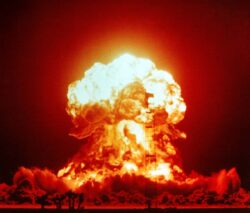
 

Noted: Destroyer of Worlds*

By Carl Conetta, 14 March 2021

Between 1945 and 1962, the United States conducted 210 atmospheric nuclear tests. Many of these can viewed online in the nuclear test video archive maintained by the Lawrence Livermore National Laboratory. (A fuller assessment of the films and their use is found here: “LLNL releases newly declassified test videos.“)

By some estimates, the US and other (mostly Soviet) tests produced in excess of 400,000 additional cancer deaths worldwide (Comprehensive Nuclear-Test-Ban Treaty, “General overview of the effects of nuclear testing“). But this represents only part of the risks and costs of premising security on these weapons. The cost of actually using them, intentionally or by accident, would be much much greater.

In 2019, Princeton University’s Program on Science and Global Security simulated the impact of a full-scale nuclear war between Russia and USA/NATO based on the 2019 US nuclear war planning  guidance, Joint Publication 3-72: Nuclear Operations. The analysts estimated that the immediate impact of the exchanges would be 34 million dead and 57.5 million injured. Of course, the longer-term impact would be much greater due to terminal injuries, radiation effects, pandemic disease, climate effects, and the failure of medical systems and other essential services and infrastructure.

(One tool used in the study was the  “Nuke Map” produced by Alex Wellerstein, Director of Science and Technology Studies at the Stevens Institute of Technology. The map is an interactive tool allowing estimates of the destructive effects of different types and yields of nuclear blasts.)

Our present circumstance: Today the USA and Russia still each hold more than 6,000 nuclear warheads. Other nations hold 1,200 cumulatively: China, France, India, Israel, North Korea, Pakistan, and the UK. (Arms Control Association, “Nuclear Weapons: Who Has What at a Glance“).

Most weapons in the US arsenal currently range in yield between 150-kilotons (thousands of tons of TNT equivalent) and 600-kilotons, although some can dial up to 1.2 megatons. The US bombs that destroyed Hiroshima and Nagasaki in 1945 are estimated to have had 15-kiloton and 21-kiloton yields respectively. The largest test ever conducted by the USA was Castle Bravo in 1954, yielding approximately 15 megatons. The largest test yield ever resulted from the Soviet “Tsar Bomba” test: 50 megatons.

Today, while most efforts at nuclear arms control and reduction have stalled or been rescinded, nuclear weapon modernization programs are surging.  While Barack Obama began his presidency pledging progress toward a world without nuclear weapons, and did win congressional support for the New Start treaty, this came at the price of a nuclear weapon sustainment and modernization program now estimated to cost more than $1.5 trillion over the next 30 years.

Currently a new qualitative arms race is underway, commensurate with “big power competition,” as both the United States and Russia seek to neutralize or surmount the advantages each perceives in the other’s global position and posture. In this sense, we have turned the clock back 30 years to a period when international competition involved existential threats.

If one believes that the awful power of nuclear weapons can reliably deter their use while also serving to limit war generally, then it might seem reasonable to accept the moral and financial burden they impose. However, these weapons incur additional costs that serve to countervail their deterrence effects.

Framing the world in terms of nations that permanently hold each other at threat of near-instantaneous extinction gravely distorts all international relations, shrouding them in persistent fear and distrust. This undermines global cooperation and provides no sure foundation for stability, much less security and peace. Indeed, fear and distrust are principal drivers of contention and war. In this sense, nuclear arsenals contribute to the conflict potentials that they are supposed to contain.

Whether one believes in the deterrent power of these weapons or not, their other longer-term risks and negative effects makes essential a determined commitment to increase international cooperation, confidence-building measures, and progress in nuclear arms reduction. Looking forward, the hope for a reliable peace depends not on the bulwark of mutual assured destruction, but on lowering levels of international threat and building accord among nations, whenever and however we can.

* The title of this post derives from J. Robert Oppenheimer’s reflection on witnessing the first atomic bomb explosion in July 1945. He shared this brief reflection on a TV broadcast in 1965: https://youtu.be/ZardNuQ_fE0

Noted: Peace & Security via Hegemony?

“The idea of international law presupposes the separate existence of many independent but neighboring states. Although this condition is itself a state of war (unless a united federation of these states prevents the outbreak of hostilities), this is preferable to the amalgamation of states under one superior power, as this would end in one universal monarchy, and laws always lose in vigor what government gains in extent; hence a soulless despotism falls into anarchy after stifling the seeds of the good. Nevertheless, every state (or its ruling power) desires to establish a lasting condition of peace in this way, aspiring if possible to rule the whole world. But nature wills otherwise.”
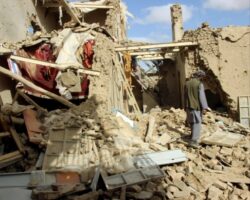

– Immanuel Kant, Concerning the Guarantee of Perpetual Peace (1795)

They made a desolation and called it “A Good War”


➪ see full-text: HTML

By Carl Conetta, Reset Defense Blog, 04 February 2021.

This article (with extensive bibliography) surveys, at the 20-year mark, the consequences of the US regime change, occupation, and nation-building exercise in Afghanistan. Drawing on US DOD and congressional research agency reports, media investigations, and NGO analyses it anchors the broad public impression of full-spectrum failure. It reviews the human and financial costs of the war, the failures of reconstruction, and the ongoing dysfunction of Afghan governance.

America’s debacle in Afghanistan, which echoes the Soviet failure during the 1980s, indicates that nations are not the type of thing that can be built according to a foreign blueprint, and especially not at the point of a gun. Outsiders lack the knowledge, indigenous roots, legitimacy, and degree of interest to prevail. Indeed, their very presence is provocative, especially given differences in language, religion, and culture.

Why is withdrawal so difficult? The article concludes that domestic political and institutional considerations are more important than any strategic rationale or cost-benefit analysis. Once committed, no political or military leader, nor the Pentagon cares to own responsibility for failure. And hubris generates an endless succession of imagined “new paths” to success. But as success proves forever elusive, so does withdrawal. In a perverse sense, it is persistent failure that keeps America mired for decades in this and other desultory wars.

Noted: George Kennan on NATO Expansion

Excerpt from George F. Kennan, “A Fateful Error,” New York Times, 05 Feb 1997

“Why, with all the hopeful possibilities engendered by the end of the Cold War, should East-West relations become centered on the question of who would be allied with whom and, by implication, against whom in some fanciful, totally unforeseeable and most improbable future military conflict?”

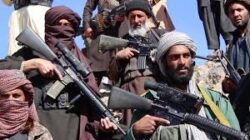
“[B]luntly stated…expanding NATO would be the most fateful error of American policy in the entire post-Cold War era. Such a decision may be expected to inflame the nationalistic, anti-Western and militaristic tendencies in Russian opinion; to have an adverse effect on the development of Russian democracy; to restore the atmosphere of the cold war to East-West relations, and to impel Russian foreign policy in directions decidedly not to our liking … ”

Re-purposing the Tale of Russian Kill Bounties on US Troops in Afghanistan

By Carl Conetta, 13 Jan 2021.  (Extensive Background Bibliography at Bottom)

Mid-year 2020, anonymous leaks to the New York Times revealed that several US intelligence agencies believed that Russia had been paying the Taliban to hunt down and kill US troops in Afghanistan. More recently, China has been presumed culpable for this supposed assassination-by-proxy effort. Some other authorities point to Iran instead. This seems a rather promiscuous “intelligence finding.” Notably, the adversary deemed most culpable at any one time seems to depend on who’s sitting in the White House or hoping to occupy it.  The policy and political impact of such allegations is certain. But what about the truth of the allegations themselves?

This blog post focuses on the version of the bounty story that indicts Russia. Although not the most current example, the Russia story has been the one most vigorously pursued and exercised. Its elements are clear.

Questionable Strategic Logic

One salient feature is that the Afghan intelligence agencies who sourced the tale of a Russian bounty program (principally the National Directorate of Security or NDS) want the United States to continue its troop presence in Afghanistan – an objective not likely shared by the Russian government.

Purveyors of the story mostly insist that the program’s aim has been to compel US withdrawal. One such assessment sees Russia “pursuing a ‘bloodletting’ strategy, a cruel type of limited proxy conflict, with the intent of accelerating a US withdrawal, and the strategic goal of projecting greater Russian influence in Afghanistan.” There are two principal objections to this view, which pertain to the story’s wobbly strategic logic:

  • The number of Americans killed in recent years remains far far less than would be needed to compel withdrawal. Over the entire six-year period that Moscow has allegedly been providing arms or funding assassinations, US casualties have remained quite low – less than 4% of all US military fatalities in Afghanistan since 2001. There’s not much gain in this for Russia while the chance and ramifications of being discovered would be quite significant. In other words, the balance between putative risk and gain should discourage the effort.
  • Rather than accelerate withdrawal, a Russian-sponsored assassinations program would add to the difficulty of US military disengagement because it would refigure Afghanistan as a key site of big-power military contention. Also, any significant increase in Taliban attacks on US troops would imperil peace negotiations by undermining goodwill and faith in achieving a sustainable peace. For many in the US defense establishment, favorable prospects for a sustainable peace is a prerequisite for withdrawal.

For these reasons the NYT journalists who broke the story opine that Russia’s presumed motivation “remains murky”,  and so they call attention to an alternative explanation: “Some officials have theorized that the Russians may be seeking revenge on NATO forces for a 2018 battle in Syria in which the American military killed numerous Russian mercenaries.” Possible, but it’s a stretch. (Note: while some media reported that 200 Russians had been killed, a more careful investigation concludes that the true number of Russian fatalities was probably no more than a dozen.)

There’s a discernible difference between incidentally killing mercenaries in a shared battlefield and opening a new theater of direct conflict by having a nation’s military personnel murdered. This would constitute escalation, both horizontal and vertical, that would invite retaliation which could only impede Russia’s political advance in Afghanistan. This explanation cannot remedy the story’s logical problems. But it’s a mistake to assume that all forceful international engagement is a logical extension of national interest.

Not every act ascribed to nation-state agencies, personnel, or their auxiliaries reflects official state policy, much less a rational calculus. Rogue and reckless acts are too common. This might serve as the last redoubt for advocates of the Russian Bounty story: It was a rogue or irrational act. Obviously, this position does little to clear the murk that encumbers this story. And it increases the evidential weight that the “intelligence finding” must bear. To compensate for the wobbly logic of the tale, the supporting evidence for the purported action needs to be empirically strong – impeachable – and clear for everyone to see. But in this case, it is not.

Shaky Empirical Foundation

Both the CIA and National Counter-terrorism Center expressed “moderate confidence” in the claim that Russia’s military intelligence agency (GRU – Glavnoje Razvedyvatel’noje Upravlenije) had offered bounties to the Taliban for killing Americans. Within the intelligence community “moderate confidence” means that authorities believe that “the information is plausible and comes from credible sources” but lacks sufficient corroboration.  It implies that “moderate potential for deception exists; and/or the body of reporting leaves open the possibility of a plausible alternative explanation of events.”

By comparison, the NSA expressed “low confidence” in the story. This means that NSA analysts “question the credibility or plausibility of the information, or that they’re concerned about the sources.” Low-confidence “generally indicates that key assumptions have been used to fill critical gaps; significant inconsistencies or questions exist regarding the evidence; the information is fragmented or uncorroborated or is of questionable credibility and/or plausibility; high potential for deception exists; and/or the body of reporting supports an alternative explanation of events.”

All this hardly amounts to a ringing endorsement of the story. Even less so was the view of the chief of US Central Command, Gen. Frank McKenzie, who in Sep 2020 said: “It just has not been proved to a level of certainty that satisfies me.” No matter. In this case, concerns about a false negative seemed to outweigh concerns about a false positive. As for the media, the sensationalist appeal of the story proved irresistible. And so it quickly became an important issue in the presidential campaign and in discussions about withdrawal from Afghanistan.

What is Known and Not Known

The irreducible factual basis for the story is the existence of a family-led Afghan drug, smuggling, graft, reconstruction contracting, and currency exchange network whose activities crossed Afghanistan’s borders. In early 2020, Afghanistan’s National Directorate of Security (NDS) arrested more than a dozen members of the network. A raid on one residence turned up a large money cache – reputedly, 500,000 (USD). The notion that this network was also running a Russian-sponsored assassination program was based principally on the subsequent interrogation of those arrested. Was the testimony freely given and not led or coerced? We don’t know. But the NDS has a reputation for abuse and torture of its detainees.

Independent of the raids, the National Security Agency (NSA) claimed evidence of multi-year electronic cash flows between Russia and Afghanistan, some purportedly involving transfers between accounts “linked” to Russian intelligence agencies and Afghan accounts “linked” to the Taliban. Reports of these flows have been construed by some agencies and journalists as supporting evidence for the bounty story.  But the NSA says it lacks evidence that these transfers have anything to do with the network or a bounty program. What else might these transfers have involved?

The funds flowing between Russia and Afghanistan can serve many purposes – some suspect, some not. Russian investment in the country has grown substantially since 2012. Among other things, between 2014 and 2018 Moscow supplied 18% of Kabul’s arms imports. As for criminal exchanges, bribes and kickbacks may attend any type of commercial exchange between these two kleptocracies. And then there is the drug trade: In 2014, the UN estimated that the street value of Afghan heroin flowing into Russia was $16-$18 billion annually. This might have generated $3 billion income for Afghan criminal and Taliban networks. The business is surely much larger today, as is the Afghan opium crop.

Russia’s Game

Russian political involvement in Afghanistan has also grown significantly since 2012, to the consternation of Washington’s foreign and security policy establishment. In recent years, Russia has independently convened nation-state “stake-holder” meetings and talks putatively aiming to advance Afghan stability (and also Russian influence). These confabs have gone forward sometimes with and sometimes without the involvement of the United States and the Kabul government.

At the sub-national level, Russia also has hosted several “inter-Afghan” talks in Moscow involving the Taliban and above-ground non-governmental Afghan groups (the latter led by former Afghan President Hamid Karzai). The aspect most irritating to the NATO mission and Ghani government is the ongoing contact between Moscow and the Taliban, minimally including intelligence sharing between them about their common enemy, the Islamic State (IS-Khorasan Province, IS-K).

Russian involvement certainly complicates NATO’s mission, but that’s a far cry from explicitly seeking to have American troops assassinated. At the same time, Russia’s objectives do extend beyond aiming to impede the drug trade, blunt transnational terrorism, and help ensure the stability of Central Asia.

Russia is leveraging Taliban antipathy for NATO’s intervention in order to increase its own influence in Afghanistan and undercut the prospects for a future NATO bastion to Russia’s south. Given this, why not incentivize a rapid American withdrawal by paying proxies to boost the US body count? The answer is four-fold:

  • The Taliban have needed no encouragement to kill Americans when it suits their strategy
  • The Taliban do not need additional funds
  • The body count has played little role in deciding America’s presence in Afghanistan, and
  • The assertion that Russia is running a program to assassinate Americans has had the opposite effect of hastening withdrawal, as was the case with the 2017 story of Russia giving arms to the Taliban.

Indeed, the bounty story has been most vigorously advanced by those seeking to slow withdrawal; this, because the story refigures Afghanistan and America’s presence there as a vital part of a multi-regional strategic contest with Russia.

Arming the Taliban

The claims of Russian-sponsored hit squads in Afghanistan resemble earlier assertions that Russia was supplying weapons to the Taliban. These stories began to circulate in earnest in April 2017, just as the Trump administration was contemplating its Afghanistan strategy. As in the present case of supposed Russian bounties, the NATO coalition would have seen any substantial Russian military aid to the Taliban as a serious transgression. However, the evidential basis for Russian arms transfers was weak – mostly second-hand reports by aggrieved parties showing piles of old Russian, Chinese, and East European light-arms (which are ubiquitous in the region).

What remains plausible (while lacking factual support) were very small-scale transfers attending Russia’s efforts to build goodwill with the Taliban. But any such transfers would not be remotely comparable to the tens of thousands of Kalashnikov rifles and millions of rounds of ammunition transferred by Russia to Kabul. Regardless of the ground truth in Afghanistan, the buzz and concern spurred by these reports in 2017 may have played a role in President Trump’s revising his earlier inclination to reduce the US presence and deciding instead to follow the Pentagon’s lead in increasing and prolonging it.

Conclusion

To summarize, the arms transfer and bounty stories share some identifying characteristics, a common signature, regardless of who is named as culprit:

  • First, they lack a strong and obvious evidential basis.
  • Second, what evidence is proffered admits multiple interpretations, but its presentation by authorities is tendentious.
  • Third, the purported evidence often depends on secret or occluded sources and methods.
  • Fourth, the strategic logic of the stories seems convoluted or unsound.
  • Fifth, and most serious, the purported transgressions invite decisive, often forceful responses that would have strategic ramifications.
  • And finally, the stories often figure in broader US policy and political debates.

Put simply: While the stories’ foundations are shaky, their ramifications could be profound.

What best impeaches the reports of bounty programs is that they transmute so easily and quickly, featuring one then another and then another of America’s presumptive adversaries. Also suspicious is how they rise and fall in accord with political and policy debates in Washington. This should prompt caution in supporting consequential policy responses based on secret, obscure, or foreign-sourced intelligence. The road to counter-productive policy, unnecessary wars, and quagmires is paved with tendentious “intelligence.”

SOURCES & BACKGROUND

Lead Stories

Horizontal Escalation by Russia for Syria Deaths?

Reactions & Ramifications

Background Analysis & Critical Views

Russian-Taliban Relations

Russia in Afghanistan

US-Russia Contention Over Afghanistan

2017 Claims of Russian Arm Sale to the Taliban & Political Repercussions

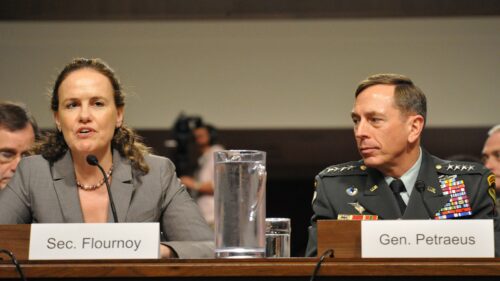
Michèle Flournoy reveals why US troops may stay in Afghanistan – indefinitely

by Carl Conetta, Reset Defense Blog, 3 December 2020

-> HTML

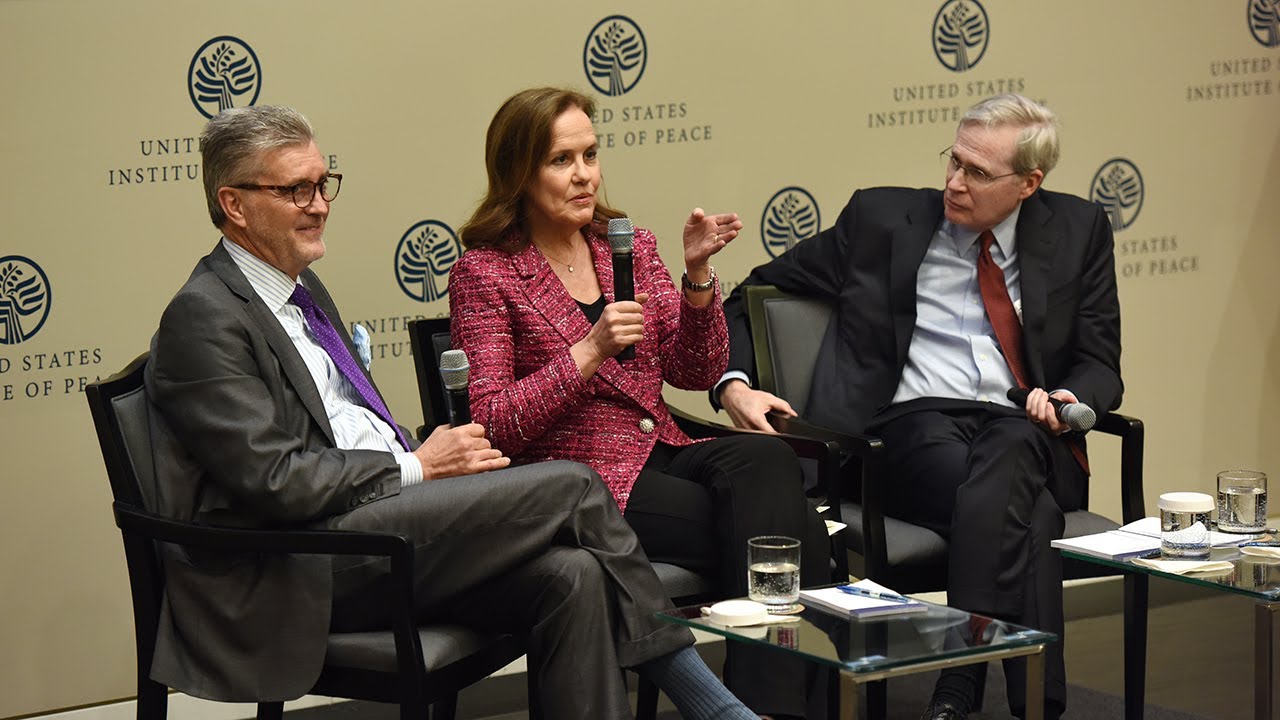
“Ending Our Endless War in Afghanistan,” USIP panel w/ Michèle Flournoy & Stephen Hadley. 18 Feb 2020

Commentary on “Ending Our Endless War in Afghanistan: Washington Perspectives on a US-Taliban Agreement” – A US Institute of Peace panel w/ Michèle Flournoy and Stephen Hadley, February 18, 2020

Michèle Flournoy reveals why US troops may stay in Afghanistan – indefinitely

by Carl Conetta, 3 December 2020

Commentary on “Ending Our Endless War in Afghanistan: Washington Perspectives on a US-Taliban Agreement” – A US Institute of Peace panel w/ Michèle Flournoy and Stephen Hadley, February 18, 2020

“Ending Our Endless War in Afghanistan,” USIP panel w/ Michèle Flournoy & Stephen Hadley. 18 Feb 2020

In this Feb 2020 panel on the US-Taliban agreement, prospective Biden SecDef Michèle Flournoy emphasizes the “phased, conditional” nature of the negotiated US troop withdrawal, while herself suggesting some conditions that would essentially preserve the nation-building goals long advanced by the United States. And she avers that she “would certainly not advocate a NATO or US departure short of a political settlement being in place. That would be a disaster for everyone.”(46:03)

However, Flournoy’s conditions, including implementation of a finalized intra-Afghan peace agreement, significantly exceed those conditions set out in the Feb 2020 US-Taliban Agreement for Bringing Peace to Afghanistan.  In other words, her putative support for the agreement is nothing of the sort. What’s more, her enhanced conditions might actually serve as poison pills. Her co-panelist, Stephen Hadley (who served as GW Bush’s National Security Advisor 2005-2009) concurs in advancing new conditions. He argues that the Taliban need to accept the current Afghanistan constitution and state institutions.

None of this over-reach is surprising, given that both Hadley and Flournoy helped shape the policies that kept this war burning during their successive tenures, 2005-2012. The USA has long demanded that the Taliban simply fold itself into the political order crafted by the US occupation. But none (or not much) of this figures in the current US-Taliban agreement – which is why the Taliban are playing ball and we are moving toward ending US involvement in this conflict.

What does the hard-fought, long-sought agreement actually say? In order to trigger the full withdrawal of US and coalition forces by May 2021, the agreement only requires that (i) cease-fires are in place, (ii) the Taliban work to suppress Al Qaeda and other terrorist groups within their areas of control, and (iii) intra-Afghan negotiations on the country’s political future get underway. The agreement does not make withdrawal contingent on completion of an intra-Afghan agreement.

Both Flournoy and Hadley repeatedly stress that actually sealing a final an intra-Afghan settlement will require a long, hard slog. That may be correct – but also irrelevant to the US-Taliban agreement and US troop withdrawal, as long as the Taliban enact the conditions listed above. Apparently that’s not how either Hadley or Flournoy see it.

According to Flournoy and Hadley, what should happen if no final intra-Afghan settlement is reached? “What is Plan B?” – as one perspicacious audience member asked. Hadley says that Plan B is to make Plan A work – a weak joke that inadvertently reveals why the USA has been stuck in Afghanistan for 19 years: No Plan B except to surge Plan A. Flournoy, by contrast, picked up the gauntlet and inadvertently revealed why we’re likely to remain there indefintely: “Plan B is [to] revert to where we are now and try to convince the Taliban and their supporters… to be more serious about moving forward.” Plan B is to replay Plan A. (Flournoy’s support for the 2009-2012 troop surge in Afghanistan is a point of contention with Biden, who opposed the surge. The surge more than doubled US troop presence. It nearly tripled annual US troop fatalities.)

Apart from demanding a final political settlement, which is more than the current withdrawal agreement requires, Flournoy also puts the onus of progress solely on the Taliban. This grants Kabul considerable freedom to demand more from the final settlement than conditions on the ground and the Kabul-Taliban power balance would imply. Kabul can simply refuse to move forward to a final settlement on any basis other than its preferred one. What would happen then? Presumably Flournoy’s “Plan B” – a reversion “to where we are now” – would occur. And to be clear, “where we are now” is US military presence, operations, and support. Put simply, “where we are now” is war.

The Flournoy-Hadley position seems to be that Washington either wins considerably more than what the US-Taliban agreement promises or it “stay the course” – a course now 19-years old. This view may lead the United States deeper into a position of “moral hazard” because Kabul is certainly listening and hoping to keep US dollars and troops fully engaged.  The US presence, yes or no, may become Kabul’s choice if all it takes is for President Ashraf Ghani or the Afghan National Assembly to stonewall the intra-Afghan negotiations.

The unspoken truth is that the Kabul government, its institutions and security forces, its basic functionality, are nowhere without US power and support. Of course, no US policymaker wants, intends, or foresees “staying the course” forever. None expect or desire an endless series of resets, surges, or “do-overs.” But US policy regarding its costly regime-change, nation-building, and regional reform efforts is immured by denial and delusion about what can be accomplished by forceful US intervention. In their discussion of the Afghan prospect, Flournoy and Hadley seem unaware and unaffected by the numerous reports of Afghan government dysfunction, reconstruction failures, and security force depredations.

Similarly, Hadley makes the remarkable claim that (circa early 2020) Afghan security forces were “in the lead” combating the Taliban. Well, apart from the fact that they are losing, they remain wholly dependent on US intelligence, logistical support, and air power. Indeed, US fixed-wing aircraft dispensed more munitions in the 2018-2019 period than in the previous five years. And, until recently, there were approximately 25,000 US and allied troops in the country. Additionally, the United States employed 25,000 contractors. And US financial and material aid to Afghanistan has in recent years exceeded 25% of the nation’s GDP. This does not suggest a government that can stand on its own. It does not suggest that reliable stability is within reach, given just a wee bit of additional US intervention.

If the next administration hopes to end this seemingly endless conflict and bring US troops home, it needs to face facts about the character of the Kabul government, the balance of power on the ground, and the limits of outside intervention. These realities should be abundantly clear by now, albeit hard to swallow.

In light of current painful realities, Washington should council Kabul to seek a compromise settlement that it can have some hope of defending on its own. Beyond this, the coalition can increase Kabul’s leverage by offering diplomatic support and pledges of substantial reconstruction aid. Pakistan and the Gulf States might use similar means to moderate the Taliban’s position. Ruled out, however, should be any extension of US troop presence or other applications of US military power to decide Afghanistan’s future.

US expectations of Afghanistan’s future also need a strong dose of realism. America’s long and costly Vietnam intervention is instructive. In 1968, 13 years and 30,000 US deaths after President Eisenhower launched significant US military involvement, peace talks began. Five years and 30,000 US deaths later, the Paris Peace Accords were signed. A little more than two years after that, the US allied government in the south was overrun by Northern and Viet Minh forces. This much might have been expected given the balance of power and the dysfunction of the South Vietnamese government, which had been largely a creature of US power. Now, what about Afghanistan?

It is more likely than not that the Taliban will come to be the dominant actor in Afghanistan’s future. To this eventuality, outside states should be ready to adapt. Should the Taliban gain predominant sway, this need not and will not imply a replay of the period 1996-2001. The Taliban will grow their influence and moderate it by finding allies among players in the current governing order. There were in the past, are now, and will be in the future areas and opportunities for US-Taliban cooperation – such as stemming ISIS and limiting the drug trade.

What will be most difficult for the Biden administration is to face and admit the error of the Afghanistan regime-change, counter-insurgency, and nation-building efforts. As demonstrated by the USIP panel, there is a powerful temptation to deny past missteps and instead “stay the course.” And this temptation is especially strong among the architects of this foreign policy disaster.

They made a desolation and called it “A Good War”*

by Carl Conetta, 14 Mar 2020; Updated 5 Nov 2020

How to assess America’s adventure in Afghanistan? It’s a costly hopeless debacle – “a travesty” writes Ben Armbuster, managing editor of the Quincy Institute’s Responsible Statecraft. Libertarian icon and former congressman Ron Paul concurs – and more, calling it “the crime of the century.” Yes, it is both these things and also a lie in all essential details, as the reports summarized and linked below show. Yet we cannot manage to withdraw. Principal historical sources on the US troop presence in Afghanistan are here (PDF) and here (PDF). To review the US troop level seesaw:
In 19 years of war, 70,000 bombs have been dropped (sources in Notes) and more than 150,000 people killed. Among the 150,000 dead are more than 40,000 civilians. Most of these dead were not killed by US hands, directly, but all resulted from a war sustained for 19 years by the USA.

The cost to the United States includes 2,400 military personnel fatalities (PDF) and ~$900 billion in direct DOD expenditures. (Financial data in End Notes.) And what has this expenditure of blood and treasure gained? All the relevant detail can be found in the DOD Inspector General reports and the Washington Post‘s “Afghanistan Papers” linked below.  But to offer a summary conclusion:

What’s been gained is a dysfunctional kleptocracy, a narco-state, a warlord state, a Potemkin village on a grand scale (and existing mostly in the imagination of war proponents). Pentagon chieftains, neo-cons, neo-liberal interventionists, and standard-issue hawks share and promote various vacuous rationales for staying, including routine assertions that victory is in sight, dire warnings about the loss of American credibility, and concerns regarding “sunk costs.”

Most galling are so-called “humanitarian” rationales, which in this case ring cynical and cruel. The problem is not humanitarian goals, per se, but the conceit that these can be advanced by foreign occupation and coercive means –   bombs, bullets, and bayonets.

Given the grim death toll, “humanitarianism” as a rationale for persisting in the effort calls to mind the (possibly apocryphal) statement of a US officer during the Vietnam War about the battle for Ben Tre: “It became necessary to destroy the town in order to save it.

It’s not just the avalanche of bombs that belie the humanitarian facade, nor the mountain of the dead. Also telling are the particulars, such as the accidental destruction of hospitals, the killing of farmers at work, the slaughter of families at home,  and repeated attacks on wedding parties and processions. These were not intentional killings, but they are the predictable collateral of war.

Even the more routine practices of “nation-building” – such as building schools – impugn the integrity of the effort. Worse has been the delegation of law enforcement to brutal warlords and militias outside Kabul. Given the centrality of concern about women and children in humanitarian efforts, the often grotesque abuse of the vulnerable by these militias is especially disconcerting.

America’s chronic, full-spectrum failure in Afghanistan, which echoes the Soviet failure during the 1980s, suggests that nations are not the type of thing that can be built according to a foreign blueprint, and especially not at the point of a gun. Outsiders lack the knowledge, indigenous roots, legitimacy, and degree of interest to prevail. And their very presence is provocative, especially given differences of language, religion, and culture. This should be abundantly clear by now, so what freezes US troops in place?

More important than any strategic rationale or cost-benefit analysis are domestic political and institutional considerations.

Once committed, no political or military leader, nor the Pentagon cares to own responsibility for failure, much less surrender; this, because of the price it would incur in votes, budgets, and legacy. So plans and promises of withdrawal are typically tied to claims of progress or intimations of pending success. But as victory proves forever elusive or ephemeral, so does withdrawal. Only crises at home or disaster overseas will bring this cycle to an end. So, in a perverse sense, it is persistent failure that keeps America mired in desultory wars.

NOTES

Additional Background on the Conduct of the War and Reconstruction:

US Bombing Data: Afghanistan, 2001-2020:

Financial Cost of War

* [Title of this post derives from the Roman historian Tacitus’ quotation of Calgacus, a Caledonian (Pictland) chieftain, who said of the Roman conquest of his realm: “They make a desolation [or ‘desert’] and call it peace.” The title also borrows from the title of Studs Terkel’s The Good War: An Oral History of WW II.]

‘Precision warfare’ – A 2,000-lb Scalpel?

By Carl Conetta, 7 Nov 2017; updated 25 Oct 2020

Expanded excerpt from “Disappearing the Dead: Iraq, Afghanistan, and the Idea of a ‘New Warfare,’ 18 February 2004 (pdf).

Even given perfect intelligence and accuracy, most guided weapons in the 500- to 2000-lb range are sufficiently powerful to routinely cause some degree of collateral damage. This, because they carry hundreds of pounds of enhanced high-explosives wrapped in hundreds of pounds of steel – an obvious point, but one that has been too often occluded or overlooked.

A 2,000-lb bomb typically contains 945 pounds of tritonal, a TNT derivative that is about 20 percent more powerful than TNT. By comparison, the bomb that destroyed the Murrah Federal Building in Oklahoma City on 19 April 1995, comprised approximately 5,000 pounds of ammonia nitrate mixed with fuel oil — the equivalent of nearly 4,000 pounds of TNT. The portable devices used by suicide bombers typically weigh between 10 and 35 pounds; these can carry a punch equivalent to 40 pounds of TNT if a plastic explosive (C-4) is used.

Most everything will be severely damaged, injured, destroyed, or killed within 20 meters of a 500-lb bomb blast and 35 meters of a 2000-lb blast. This lethal radius can be partly mitigated by detonation inside a large, compartmentalized building – however, as a Rand study points out: “While structures surely have some shielding effect, building collapse and spalling are secondary yet major causes of injury.” (pdf)

Averaged across different types of surfaces, a 2000-lb bomb will carve a crater 50 feet across and 16 feet deep; a 500-lb bomb will carve one 25 feet across and 8.5 feet deep. The probability of incapacitating injury to unprotected troops within 100 meters of a 2000-lb bomb blast in the open is 83 percent; for those between 100 and 200 meters it is 55 percent. (pdf)

Safe distances for unprotected troops are approximately 1,000 meters for 2000-lb bombs and 500 meters for 500-lb ones. Even protected troops are not entirely safe within 240 meters of a 2,000-lb bomb or 220 meters of a 500-lb bomb. [For sources and more information on blast effects see the note at bottom.]

It is considered bold for a combat controller to bring down a strike within 800 meters of his/her position, and the 2001 Afghan strike that killed eight coalition troops and injured Hamid Karzai and 20 others is attributed to a JDAM hit within 100 meters of their position.  Commenting on the Karzai incident Rear Adm. John Stufflebeem of the Joint Staff rightly described the 2000-lb JDAM as a “devastating weapon”, adding that, “As a pilot, when I would drop a 2,000-lb weapon, I wanted at least 4,000 feet of separation from that weapon when it went off.” This distance would put an aircraft just beyond the reach of shrapnel and flying debris.

The brute destructive power of these weapons is not ancillary to the recent success of so-called precision attack, but central to it. A critical threshold in the development of US capabilities was passed when improvements in accuracy and precision helped insure that 50% or more of the weapons dropped would hit close enough to their targets so that the latter would be encompassed by the weapon’s destructive footprint. Of course, the area of deadly destruction is not small, but large – more than a acre for 2000-lb bomb. And this big footprint is pivotal to the success of “precision weapons.” An appropriate analogy is not a sharpshooter’s rifle shot, but a well-aimed double-barreled scatter gun firing a hail of slugs. In a sense, “precision” depends on which end of the weapon’s trajectory one sits.

Also relevant to the impact of “precision warfare” is the sheer number of bombs used since 2001: more than 70,000 in Afghanistan and more than 150,000 in Iraq and Syria (US munitions only). (See note at bottom for sources of bombing totals.)

It is certainly true that improvements in the accuracy and precision of air-dropped munitions has greatly reduced the numbers of aircraft and weapons required to destroy targets. Compared to bombing efforts during the Vietnam war era, it might take only 1/8 as many aircraft and 2% as many weapons to destroy a target today. A corollary of this is a capacity to significantly reduce the extent of death and destruction collateral to a bombing run. But capacity doesn’t necessarily determine actual outcomes, measured broadly. Several other variables weigh in:

(1) Does improved targeting lower the threshold for going to war and, thus, increase the frequency of wars and aggregate war fatalities?

(2) Does improved targeting encourage attacks on targets that carry a greater inherent or baseline risk of substantial collateral death and destruction? That is, do advanced air forces spend down “improved safety” by attacking less safe targets? And,

(3) Does improved targeting better enable attackers to comprehensively collapse an enemy nation’s government and critical infrastructure, producing fatal chaos on a wide scale.

The answer to all three queries is “yes” – and this upends the mystique of so-called “precision warfare.” America’s post-9/11 wars have not been low casualty events. To address the questions posed above in turn:

(1) Since the end of the Cold War, the USA has conduced air campaigns, some protracted, in a dozen nations – all outside the context of superpower contention, none involving existential threats, and most with only tenuous, remote, or indirect connection (if any) to attacks on US assets. Counter-terrorism efforts, once the province of discrete Special Operations units, have become a major employer of guided bombs in large quantities.

(2) Hubris, complex environments, and the fog of war have led to numerous, deadly “precision strikes” on wrong targets including attacks in residential neighborhoods, city centers, crowded towns, and government complexes resulting in many hundreds of civilian dead. Also mistakenly hit were mosques, hospital complexes, refugee encampments, farm workers, wedding parties, and even a neutral foreign embassy – this latter with potential strategic consequences. None of these strikes might have been attempted except for undue confidence in the promise of “precision warfare.”

(3) By any measure, US forces in Iraq and Afghanistan relied more on guided-weapons than ever before, quickly disintegrating governments in both places. And yet the product of these rapid victories was humanitarian crisis and chronic chaos. The same is true for operations in Libya, which have fed conflict across the Sahel. Indeed, with the partial exception of the mid-1990s intervention in the Bosnia-Herzegovina conflict, none of America’s post-Cold War military operations produced conditions of reliable stability or security. As for the cost in lives of the war and chaos unleashed by “precision” victory: 160,000 dead in Afghanistan and 300,000 dead in Iraq – and still counting. This is the standard by which precision warfare should be judged.

Sources on blast effects and safe distances:

On blast effects also see:

US Bombing Data, Afghanistan, Iraq, Syria – 2001-2020:

Sustainable Defense: More Security, Less Spending

Final Report of the Sustainable Defense Task Force of The Center for International Policy, June 2019. ➪ full report  PDF

Carl Conetta contributed analysis of the economic and climate change challenges, details of the threat assessment, the strategy, and the calculation of savings from recommended changes to force structure.

The United States must partner with other nations in addressing challenges like climate change, epidemics of disease, nuclear proliferation, and human rights and humanitarian crises. None of these challenges are best dealt with by military force. Rather, they will depend on building non-military capacities for diplomacy, economic assistance, and scientific and cultural cooperation and exchange which have been allowed to languish in an era in which the military has been treated as the primary tool of U.S. security policy.

2018 US Defense Strategy: All the World Our Battlefield

By Carl Conetta, 19 Jan 2018

It’s no surprise that, given the dominant role of military professionals in the Trump administration, DOD would craft an overweening “defense” strategy, guaranteed to pour fuel on the fires it perceives (and misperceives). In key respects it harkens back to the conceits of Dick Cheney’s 1992 Defense Guidance document, which have percolated just below the surface of Pentagon strategies ever since.

Some critical comments on the new strategy:

A central innovation is putting military contention with Russia and China at the center of US defense strategy: “The central challenge to US prosperity and security is the re-emergence of long-term, strategic competition by… revisionist powers. It is increasingly clear that China and Russia want to shape a world consistent with their authoritarian model…” Actually, neither Russia nor China base their foreign policy on crusades to alter the political-economic vision of other nations worldwide. However, both are more assertive than 10 years ago and their armed forces, more capable. But their military objectives have been limited in scope – partly aiming to push back against US and allied activity and advances over the past 20 years (albeit both of them transgressing intl law along the way).

The renewed centrality of the “rogue state” concept (applied explicitly to North Korea and Iran) is similarly consequential. It’s a framework that helps constrict the resort to normal diplomatic relations and means, while also sanctioning increased emphasis on coercion in dealing with these states who are judged to sit outside the law. And, of course, whether the US names nations as “revisionist powers” or “rogue states,” their central place in US military strategy creates an adversarial relationship as much as it simply recognizes one. US defense strategy is now avowedly about military confrontation with China, Russia, Iran, and North Korea.

Also noteworthy is increased focus of US military efforts on challenges in non-military domains: “Revisionist powers and rogue regimes are using corruption, predatory economic practices, propaganda, political subversion, proxies, and the threat or use of military force to change facts on the ground.” The intention to escalate military ripostes to perceived non-military challenges is also evident in the new draft US nuclear posture, which implies possible nuclear responses to strategic cyber-assaults.

The strategy names the erosion of the “post-WWII international order” as a key concern. Of course, it sees the USA (and, specifically, US military power) as key in defending that order (and on a global scale). Naturally, the document elides the ways in which the USA has contributed to the weakening of that order and the abuse of it, through unilateral uses of force, military support for repressive governments, and expansion of exclusive military alliances. Indeed, the strategy downplays what should be the foundation stone of that order – the United Nations – substituting for it America’s network of regional alliances.

The strategy frets the erosion of America’s military edge, observing that “for decades the USA has enjoyed uncontested or dominant superiority in every operating domain. We could generally deploy our forces when we wanted, assemble them where we wanted, and operate how we wanted. Today, every domain is contested.” The sense of privilege apparent in this aspiration to employ forceful instruments everywhere unencumbered helps explain why others should challenge it. US military practice over the past 27 years has encouraged others to narrow the gap and helped legitimate their similar practices. America’s unusual margin of superiority – a singular consequence of Soviet collapse – was bound to recede as Russia recovered economically and the global balance of economic power shifted. Only a world order based on inclusive cooperation might have produced a different outcome. Today, nothing better represents unrealistic revisionist dreaming than does the Pentagon’s desire to regain uncontested superiority. It’s neither possible, nor necessary for US security.

The strategy reaffirms a set of hegemonic goals that are breathtaking in scope. It advances an imperative to “maintaining favorable regional balances of power in the Indo-Pacific, Europe, the Middle East, and the Western Hemisphere” – a goal that implies that US security is contingent on America involving itself as a contestant in all the world’s regional power struggles. Let’s hope that other great powers don’t also see their security as contingent on hegemony. For the USA, the strategy says that this goal requires the Pentagon to (i) Expand Indo-Pacific alliances and partnerships; (ii) Fortify the Trans-Atlantic NATO Alliance; (iii) Form enduring coalitions in the Middle East; (iv) Sustain advantages in the Western Hemisphere; (v) Support relationships to address significant terrorist threats in Africa. Is that all?

It’s not surprising that the strategy should rest on the hoary notion that “the surest way to prevent war is to be prepared to win one.” This is boilerplate for Pentagon strategy docs – but also seriously ill-conceived. The “surest way” is not necessarily a realistic or achievable way; We could weaken or even bankrupt ourselves in the process of “being prepared” if our goals and commitments are unbounded. And is it really the “surest way”? Let’s restate the proposition: “The surest way to prevent war is to engage in open-ended arms races with all the potential competitors we can imagine worldwide.” This, I think, can only guarantee the opposite of what it intends.

How did Rodrigo Duterte win the Philippines presidency?

by Carl Conetta, 1 July 2017

Although Duterte had a reputation as an effective (if crude) mayor of Davos, he began his 2016 campaign with no strong political base outside his home island of Mindanao. He lacked the support of either a major political party or a substantial chunk of the Philippine oligarchy (outside Mindanao, at least). His electoral coalition was a hodge-podge of smaller, mostly conservative-nationalist formations but also religious groups and some leftists.


His own party, the Philippine Democratic Party, had a history of strong anti-Marcos activism and nationalism, having been the platform for Cory Aquino’s election in 1986, but having since dwindled to a small regional formation. Duterte gained some broader left-wing support based on his relationship with the former leader of Philippines Communist Party, his self-description as a socialist (which he is not), his ‘common man’ image, and his pledge to seek peace with communist and Moro insurgents.

So how did he win? Image, issues, and social media were key. Those three ingredients plus a bump from social movements and a Filipino majority disenchanted with recent ruling parties won him the election.

The Duterte campaign relied on social media to build a “coalition of the aggrieved” by hammering at a range of salient issues: crime, drug use, urban congestion, underdeveloped infrastructure, exploitation of contract workers, the dominance of urban over agricultural areas, and the domination of ‘imperial” Manila/Luzon over other cites and islands. This occurred in a context where years of economic growth had delivered nothing to the poor and little to the middle-classes, also a context in which crime was rampant and infrastructure dilapidated despite economic growth.

Against the elite and well-spoken reformism of previous parties, Duterte campaigned as a ‘doer,’ a law and order candidate, a son of the poor, and a nationalist (in a political context where nationalism had a leftist anti-colonial appeal).

Once he won, legislators poured into his party. Some social movements had more-or-less supported him, and he rewarded them by giving four cabinet portfolios to leftists. But his economic program? It’s strictly neo-liberal with social programs added. He aims to create a more friendly business environment for both domestic and foreign capital, while also promising to direct more government spending to urban and rural infrastructure, education, healthcare, social protection, and job training.

Bibliography:
• Mong Palatino, “Is the Philippines’ Duterte Really a Leftist?”, The Diplomat, 02 May 2017.
• Malcolm Cook and Lorraine Salazar1, “The Differences Duterte Relied Upon to Win” (pdf), ISEAS Perspective (Singapore: Yusof Ishak Institute, 22 Jun 2016).
• Julio C. Teehankee, “Duterte’s Resurgent Nationalism in the Philippines: A Discursive Institutionalist Analysis,”  The Journal of Current Southeast Asian Affairs (1 Dec 2016).
• Pierre Rousset, “The left currents in the Philippines and the Duterte presidency” (Eurioe Solidaire Sans Frontieres, 25 Sep 2016).

Our World Gone Wild?

By Carl Conetta, 21 Dec 2015

The current [2015] war hysterics began years ago, 2011 – soon after Congress turned to cap discretionary spending. Successive Pentagon leaders began warning that rolling back the DoD budget to the level of 2008 or 2009 (inflation adjusted) would have devastating, even catastrophic effects on the US military. It would make America weaker and inhibit our ability to respond to threats (SecDef Hagel), hasten instability in Asia and put “the nation at greater risk of coercion” (JCS Chair Gen. Dempsey), and even invite aggression (SecDef Panetta). Various leaders, democratic and republican, began seeing Hitler reincarnated in the form of Putin, Assad, or both. In ISIS they saw an apocalyptic threat “unlike anything we’ve seen” (Hagel). And many worried aloud about a new American isolationism. (For sources, see A Short Tour of Pentagon Hysterics.)

From every direction, the warnings came. Director of National Intelligence James Clapper: “In almost 50 years in intelligence, I don’t remember when we’ve had a more diverse array of threats and crisis situations around the world to deal with.” Others concurred: The global security environment is “more dangerous than it has ever been” (Gen. Dempsey, Chairman, Joint Chiefs), it’s “the most uncertain I’ve seen in my thirty-six years of service” (Gen. Odierno, Army Chief of Staff), there’s “greater turmoil than at any time in my lifetime” (Sen. John McCain).

No wonder Americans are worried. Well, ISIS is real enough as is the Syrian civil war, Russian actions in Ukraine, and Chinese assertiveness in the South China Seas. But are they exceptional and indicative of a world gone wild? (Here, I argue that what’s exceptional today are domestic partisan political dynamics.)

The crises represented today as unprecedented are anything but. The emergence and spread of ISIS and Boko Haram, for instance, recall the Taliban both in Afghanistan and Pakistan. It also recalls the Iraqi insurgency and communal slaughter of 2004-2009. And the rise of Hamas and Hezbollah (1985). The foreign fighter phenomenon is not new, nor is the practice of militant groups seeking to affiliate with their more successful analogs. It’s true that ISIS uniquely stages its atrocities for maximum media exposure. But this does not make them qualitatively more threatening then were their Iraqi precursors (both Sunni and Shia) or the Taliban or Al Qaeda (which, after all, struck hard at America several times). The terrorist attacks in Paris were horrific, but they mirror attacks in Europe during the 2000’s: the 2005 London bombing and the 2004 Madrid train bombing (which together claimed 243 lives and injured 2,750).

Perspective is also due in weighing the Syrian civil war, the wars in Sub-Saharan Africa, and recent Russian and Chinese behavior. The Syrian conflict replays Iraq, Afghanistan, Algeria (1992-99), Chechnya (1991-2009), Lebanon (1975-90), Somalia (1988-present), Sri Lanka (1983-2009), Sudan (2003-09), Tajikistan (1992-96), the former Yugoslavia (1992-1999), and Yemen (1994-present). Today’s civil wars in East, West, and Central Africa recall the much worse conflicts of the 1990s and 2000s. Overall, conflict deaths are down from the 1965-1998 period. And, although conflict deaths have jagged somewhat upwards in recent years, this is mostly due to conflict in one place: Syria

Recent Russian and Chinese actions of concern also have their near equivalents in the not distant past: Russia in Georgia (2008), China and the 2012 Scarborough Shoal standoff, and recurrent Taiwan Straits crises. The rise (or resurgence) of Russia and China are not new. They’ve been underway for 17 years.

Any argument for the especially dire state of the world today must also take into account the cyclical crises involving North Korea, India-Pakistan, and Israel that dot the past 20 years. Of course, none of today’s interstate wars compare with those of the 1980s.

Two concluding points: 1. The 1990-2010 period of US unipolar dominance is now ending, as it was bound to end; it was exceptional. This is hard for official Washington to countenance. 2. While hawks and the defense establishment always argue that US restraint leads to global instability, they are blind to the possibility that US military activism contributes to instability that reverberates for years to come. In fact, we are today living in the backwash of our post-9/11 wars.

The Year of Acting Dangerously

By Carl Conetta, 21 Dec 2015

There’s ample global storm and stress these days, and the cries of alarm will get worse over the next months as we approach the 2016 election. It’s an old story – to paraphrase: “With America in retreat overseas, exceptional threats and crises are looming. Decisive action is needed, but the White House has gone wobbly. And our armed forces – overtaxed and cut to the bone – are unready.”

This trope has gained prominence three times in the past 40 years, always to great effect. Its resurgence depends on the intersection of three conditions: 1. A troubled Democratic presidency, suffering a decline in popularity (initially for domestic reasons); 2. A period of reduced defense spending; and 3. A pending and hotly-contested presidential election. Carter faced it as did Clinton (in 1998-2000). Now Obama faces it. (A fuller analysis of this dynamic can be found in my 2014 report, Something in the Air: ‘Isolationism,’ Defense Spending, and the US Public Mood. A relevant excerpt is here. Both links are PDFs.)

Hawks are always ready to peddle the “America weak and endangered” trope, but it doesn’t gain traction absent the three conditions mentioned above. The dynamic works like this: Given a weakened Presidency, military leaders feel freer to exit the White House narrative and argue their institutional interests unalloyed: “Boost our budget, the nation is at risk!” This feeds the partisan mill and begins moving public debate and opinion rightward. (For a chart covering 50 years of US public opinion on Pentagon spending see Gallup’s Military and National Defense page.)

With an eye on the polls and sensitive to the drop in presidential popularity, some congressional Democrats follow suit, seeking to protect their right flank. The White House, too, tries to get ahead of the curve, adopting a more bellicose stance and pumping up the Pentagon budget. (Indeed, the administration itself many splinter, with some luminaries jumping ship.  Rather than stemming the tide, the hawkish turn among Democrats creates the impression of a new hawkish “consensus.” Many point to firebrands like McCain and Lindsey Graham, but it’s the Democrats in retreat that precipitate the stampede to the Right.

Obama has differed from Clinton and Carter in one respect: He’s accommodated the Pentagon from the start, hoping to avoid the dilemma that snared his predecessors. He boosted the DoD budget above Bush levels and kept it there for three years. As sequestration loomed, he argued against it and also allowed DoD and the Chiefs to lash out. Yes, he partially withdrew troops from Iraq and Afghanistan, but slowly – and not before an Afghan surge. As troops came home, drone strikes increased and the administration enacted a “muscular” shift to Asia, an AirSea Battle strategy, and new military initiatives all across Africa.

But the gambit didn’t work. As soon as sequestration bit into the Pentagon and the President stumbled domestically (it was the economy, stupid), the hawks jumped. Now the President is left scampering after his hawkish critics. Whatever he says – bombs, troops, billions – they just say “more.” It’s not a pretty sight, nor one likely to win public confidence.

But aren’t today’s global crises real? ISIS, Russia in Ukraine, Chinese “assertiveness”? Well, yes to a degree, but certainly not exceptional, see: Our World Gone Wild? What *is* special about today are the three conditions mentioned at the top. But these reflect domestic political dynamics, not global strategic ones – and they’re shaping both popular perceptions and attitudes.

A Short Tour of Defense Policy Hysterics, 2011-2015

By Carl Conetta, 21 Dec 2015


● Washington Free Beacon. Dempsey: The Global Security Environment Is As Uncertain As I’ve Ever Seen It. Jul 2015.

● Defense News. Military Chiefs Warn Anew About Sequester Cuts. Feb 2015.

● Christopher Preble. The Most Dangerous World Ever? Sep/Oct 2014.

● Spencer Ackerman. ‘Apocalyptic’ ISIS beyond anything we’ve seen, say US defense chiefs. Aug 2014.

● Business Insider. 12 Prominent People Who Compared Putin To Hitler. May 2014.

● Business Insider. Chuck Hagel: Isolationism Won’t Protect Us From The World’s Troubles. May 2014.

● Bill Gertz. Dempsey: Threat of Conflict in Asia Increasing; US Military decline hastens global instability. Mar 2014.

● Military.com. Force Cuts Mean Army Can’t Fight Two Land Wars. Mar 2014.

● Media-ite. Harry Reid Likens Assad to Hitler. Sep 2013.

● NY Post. Assad is like Hitler: Kerry. Sep 2013.

● Joseph I. Lieberman and Jon Kyl. The regrets of U.S. isolationism. Apr 2013.

● Breaking Defense. Gen. Amos: Marines Can’t Fight Major War If Sequestered. Apr 2013.

● Michael Cohen. America’s military can handle anything – except a budget cut. Feb 2013.

● Micah Zenko. Most – Dangerous – World – Ever. Feb 2013.

● Foreign Policy Initiative. The Dangers of Deep Defense Cuts: What America’s Civilian and Military Leaders are Saying. May 2012.

● Politico. Panetta paints doomsday scenario. Nov 2011.

Not a common global home, but a fine mess

Presentation by Carl Conetta on the “World Security Situation – Russia, Iraq, Syria, and Beyond” panel of the Economists for Peace and Security (EPS) symposium in Washington, DC, 17 November 2014. The panel included Richard Kaufman, Bill Hartung, and Heather Hurlburt.

 
HTML transcript
 
Audio immediately below

 
panel one EPS 1114

Defense Sense – Fiscal Year 2014 Update: Options for National Security Savings

➪ PDF Project on Defense Alternatives, 26 June 2013. Outlines 16 recommendations that, taken together, achieve more than $22 billion in Pentagon savings in Fiscal Year 2014. Leading the list of savings options are reductions in military end strength, missile defense spending, and purchases of the F-35 Lightning II, Littoral Combat Ship, and Virginia-class submarine.

PDA Joins Center for International Policy

30 January 2013.  The Project on Defense Alternatives has joined the Center for International Policy  as part of the latter’s Common Defense Campaign. The Center’s staff supports an energetic program addressing both traditional and new security concerns. CIP’s Common Defense Campaign aims for a reset of defense policy along more realistic, cooperative, and affordable lines.

Reasonable Defense: A Sustainable Approach to Securing the Nation

by Carl Conetta, PDA Briefing Report #21, 14 November 2012. 9 tables. The appendix provides an additional 18 tables and charts addressing personnel, force structure, and budgets.
PDF  ➪ summary PDF  ➪ appendix of tables and charts PDF.

sustainable defense Argues for a new balance among the various instruments of national power reflecting today’s strategic conditions.  Taking a realistic view of security needs, the report advocates a military 20% smaller than today’s. It advances a “discriminate defense” strategy that would focus the military on cost-effective missions and save $550 billion more than official plans over the next decade.