
(HTML version) Derrick Z. Jackson. Boston Globe, 17 December 2005.
cknight
Masque of Democracy: Iraqi Election System Still Disfavors Sunni Arabs, Favors Kurds
(printable PDF version) (HTML version) by Carl Conetta, PDA Briefing Memo #35, 10 December 2005. The memo assesses Iraqi election procedures for the December 2005 parliamentary elections. It detects problems of structural bias and shows how the procedures feed communal tensions. Includes table of province populations and assigned council seats.
400 Days and Out: A Strategy for Solving the Iraq Impasse
(HTML version) by Carl Conetta. PDA Briefing Memo #34, 19 July 2005.The memo outlines a strategy for substantially defusing the Iraqi insurgency, de-escalating the inter-communal conflict there, and enabling near-total US troop withdrawal by September 2006.
Vicious Circle: The Dynamics of Occupation and Resistance in Iraq, Part One. Patterns of Popular Discontent
(printable PDF version) (HTML version) (summary) by Carl Conetta. PDA Research Monograph #10, 18 May 2005. An analysis of Iraqi public opinion data and interviews suggests that coalition military activity is contributing substantially to anti-coalition sentiments. A “vicious circle” is indicated, whereby counter-insurgent operations create support for the insurgency. The report tracks coalition military activity and relates it to Iraqi discontent and insurgent activity. Differences among Iraqi communities are also assessed.
Should We Stay or Should We Go? The US Debate on Exiting Iraq
(HTML version) by Carl Conetta. PDA Briefing Memo #33, 07 March 2005.
What do Iraqis want? Iraqi attitudes on the occupation, US withdrawal, Iraqi governments, and quality of life
(printable PDF version) (HTML version) 01 February 2005. Summary of data from 2004 and 2005 Iraqi public opinion polls.
Agonizing Issue: is torture ever justified in military interrogations of terror suspects?
(HTML version) (printable PDF version) interview with Charles Knight, co-director, Project on Defense Alternatives and Alfred P. Rubin, Distinguished Professor Emeritus of International Law, The Fletcher School, Tufts University, transcript edited by Jim Cronin, The Boston Globe Magazine, 30 January 2005. The United States is now training hundreds, maybe thousands, of new interrogators. Abusive relationships traumatize both the victim and the abuser. We are training and having our own people experience this abuse, and they will be returning home to our communities. We know from studies of domestic abuse that this abusive pattern can be replicated through generations.
Agonizing Issue: is torture ever justified in military interrogations of terror suspects?
an interview with Charles Knight, PDA, and Alfred P. Rubin, Distinguished Professor Emeritus of International Law, The Fletcher School, Tufts University. Edited transcript by Jim Cronin, The Boston Globe Magazine, 30 January 2005.

Accusations of torture and the highly publicized prison abuse in Iraq have cast a shadow over the US military’s treatment of detainees. Harvard Law School is offering a spring semester course, “Torture, Law and Lawyers,” on the ethics and legality of torture. This leads to a question: Can torture in military interrogations of terror suspects ever be justified? We asked Alfred Rubin, professor emeritus of international law at the Fletcher School at Tufts University, and Charles Knight, co-director of the Project on Defense Alternatives at the Commonwealth Institute in Cambridge, to address it.
RUBIN: If you’ve caught someone and you know that person has information, then torture for tactical information is justifiable. But if it cannot produce useful information, it is morally reprehensible. Legally speaking, the UN Convention Against Torture requires every state to forbid torture, and that [enforcement] is really up to the states that practice it. Many states that have signed the convention don’t enforce their national law against torture. The United States is one of the few states that we do have national laws that forbids torture. But torture is believed to be practiced morally correctly [by the United States] when, as with the Bush administration’s explanation for torture in Guantanamo, the information obtained can be used to prevent a more serious moral default.
KNIGHT: It is in our interest to further a practice which we would advocate that all nations have? Is that a world we favor moving forward into?
RUBIN: If you capture the guy who has hidden a bomb that’s going to kill 10 innocent people – say, schoolchildren – and the torturer genuinely feels he can get the information of where the bomb is, torture would be justified. It’s a moral evaluation made by the person who’s doing the torturing. One has to recognize that torture is practiced by many states, including the United States.
KNIGHT: It’s very rare when you have this perfect situation where you know that a particular prisoner has information that’s immediately useful. It’s a misleading scenario. Torture turns out to be routinely unproductive. In domestic laws, we forbid confessions under duress in part because they almost never get to the truth. That same knowledge should be applied to our international conflicts. It demonstrates a huge lack of creativity and imagination in our intelligence agencies that resort to torture. It goes very quickly to the abuse that was seen at Abu Ghraib. The interrogators wanted the prison guards to “soften up” the detainees, whether or not they knew anything. It’s a very dangerous process.
RUBIN: The enforcement of law is multifaceted, and the violation of law is serious. The 1949 Geneva Conventions don’t actually forbid torture; they require states to forbid it, which we do, and the same with the UN Convention Against Torture. We have enacted the laws that forbid torture, and those laws have been violated in Abu Ghraib, where we were trying to keep it a secret. Those laws should be enforced.
KNIGHT: There’s a huge realm of secrecy that is expanding. The [US] government won’t let me assess their behavior in a practical way. When I don’t know what my government is doing to prisoners in, say, Guantanamo, I have no information on which to exercise my democratic responsibility to make a judgment on my government. It goes against the very principle of democracy.
RUBIN: And yet the majority of Americans have shown by our last election they prefer not to know, and they reelect a government which keeps secrecy. I think a lot of them are prepared to say that power to keep secrecy belongs with the federal government, and they fool themselves into thinking they need not live with the consequences of secrecy and torture. But democracy frequently elects antidemocratic leaders. Certainly in Vietnam, Johnson and Kennedy were prepared to support [President Ngo Dinh] Diem, and the current administration seems to support governments in China, Albania, Russia, and others.
KNIGHT: I’m fearful we will pay for this abuse of foreign prisoners in our own society for generations. The United States is now training hundreds, maybe thousands, of new interrogators. Abusive relationships traumatize both the victim and the abuser. We are training and having our own people experience this abuse, and they will be returning home to our communities. We know from domestic abuse that this abusive pattern can be replicated through generations.
RUBIN: I disagree. A sadist who wants to torture is going to torture. People make up their own minds whether or not to torture.
KNIGHT: Following the revelation about Abu Ghraib, some of the insurgent hostage-takers escalated to severing hostages’ heads. You could feel a direct “we can do you one better” in terms of cruelty. The United States did not have an understanding of the insurgency they were facing. They began to round up people in a very indiscriminate way. If you’re not prepared to handle the complexities of what you’re dealing with, there’s a gravitation toward using violence to solve the problem.
Also see:
Torture by Proxy: International and Domestic Law Applicable to ‘Extraordinary Renditions’, The Committee on International Human Rights of the Association of the Bar of the City of New York and The Center for Human Rights and Global Justice, New York University School of Law (PDF).
The Iraqi election “bait and switch”: faulty poll will not bring peace or US withdrawal
(printable PDF version) (HTML version) (summary) by Carl Conetta. PDA Briefing Report #17, January 2005. Problems of bias, insecurity, and voter confusion have undermined the democratic value of the election. Nonetheless, it will win greater international legitimacy for the US mission and enable more vigorous counter-insurgency operations. US withdrawal will not soon occur. The memo examines likely electoral outcomes and the factors shaping the new Iraqi government. An addendum summarizes Iraqi public opinion regarding the occupation and US forces.
Is the Iraq war sapping America’s military power? Cautionary data and perspectives
(HTML version) by Carl Conetta, Charles Knight, and Melissa Murphy, Project on Defense Alternatives, 22 October 2004. Charts, Reference Material:
Radical Departure: Toward A Practical Peace in Iraq
(printable PDF version) (HTML version) (summary) by Carl Conetta. PDA Briefing Report #16, July 2004. Can the “new” approach to the Iraq mission succeed where the previous effort failed? “No,” the fundamental problem is mission goals that are overly ambitious, intrusive, and polarizing. The report analyzes the failures of the US postwar mission in Iraq and proposes essential steps toward peace, stability, and US withdrawal.
Outsourcing Torture and the Problems of ‘Quality Control’
(HTML version) by Charles Knight, PDA Commentary, 18 May 2004. The numbers of prisoners for processing in Iraq were so great that government interrogators began to rely on the assistance of under-trained and youthful soldiers who were so “shockingly undisciplined” that they took photos of their activities to send home — yet another indicator of how poorly prepared for a large scale occupation the United States was before going into Iraq. Distributed by The Global Beat Syndicate and posted on the Foreign Policy In Focus and Antiwar.com websites.
Outsourcing torture and the problems of “quality control”
(HTML version) by Charles Knight, Global Beat Syndicate, 17 May 2004. “…the United States as a state sponsor of torture, perpetrated or exported to foreign stooges, is having a ripple effect globally that will damage our image for a long time to come.”
The Bush Doctrine: Origins, Evolution, Alternatives
(printable PDF version) by Mark Gerard Mantho, PDA Guest Publication, April 2004. The Bush administration’s national security doctrine represents the most sweeping change in U.S. foreign policy since World War II and was the conceptual underpinning of the President’s decision to invade Iraq. Yet few Americans realize where the policy came from, who crafted it, or even what it is.
Disappearing the Dead: Iraq, Afghanistan, and the Idea of a “New Warfare”
by Carl Conetta, PDA Research Monograph #9, 18 February 2004. ➪ PDF ➪ summary PDF ➪ HTML ➪ summary HTML
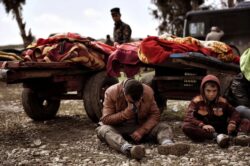
Examines the Pentagon’s treatment of the civilian casualty issue in the Iraq and Afghan wars, reviews the “spin” and “news frames” used by defense officials to shape the public debate over casualties, and critiques the concept of a “precision warfare” as misleading. Case studies include the Baghdad bombing campaign. An appendix provides a comprehensive Guide to Surveys and Reporting on Casualties in the Afghan and Iraq Wars.
Saving General Shinseki: on the future of wheeled armor
(printable PDF version) (HTML version) by Lutz Unterseher. PDA Guest Publication, February 2004. Presents the specifications for a ‘hybrid’ combat vehicle featuring: considerable, versatile firepower (kinetic energy and fragmentation) without the weight penalty of a main gun system; a high degree of crew protection; better strategic mobility than current tracked armor; superior operational mobility; and acceptable tactical mobility.
Selected Major Terrorist Incidents Worldwide since the conclusion of Operation Enduring Freedom
(HTML version) Compiled by Carl Conetta and Melissa Murphy. PDA Briefing Memo #31, 07 January 2004.
The New Occupation: How Preventive War is Wrecking the Military
(HTML version) by Charles Knight and Marcus Corbin, Security Policy Working Group Commentary, 04 January 2004.
European Armed Forces of Tomorrow: A New Perspective
(printable PDF version) (HTML version) (Leicht gekuerzte deutschsprachige Fassung der Studie) by Lutz Unterseher. PDA Guest Publication, 20 October 2003.

This brief models an integrated European Armed Forces. It details a viable all-European force’s conceptual framework, strategic orientation, key functions, posture, resources, personnel, and budget.
The Wages of War: Iraqi Combatant and Noncombatant Fatalities in the 2003 Conflict
(printable PDF version) (HTML version) (summary) by Carl Conetta. PDA Research Monograph #8, 20 October 2003. How many Iraqis died in the 2003 Iraq war? What are the implications for stability in Iraq, the war on terrorism, and the “new warfare”? The report estimates the total number of Iraqis killed in the 2003 war, based on hospital and burial reports, combat statistics, and battlefield testimony from both sides. Uniquely, the report distinguishes noncombatant and combatant civilians. And it compares the experience of Operations Iraqi Freedom and Desert Storm. With two appendices: Appendix 1. Survey and assessment of reported Iraqi combatant fatalities in the 2003 War and Appendix 2. Iraqi Combatant and Noncombatant Fatalities in the 1991 Gulf War.
The Sources of Terrorism
(printable PDF version) by Charles Knight and Melissa Murphy, correspondence published in International Security, Vol. 28, No. 2 (Fall 2003) pp. 192-195, comment on Michael Mousseau, “Market Civilization and Its Clash with Terror,” International Security, Vol. 27, No. 3 (Winter 2002/03) pp.5- 29.
Catastrophic Interdiction: Air Power and the Collapse of the Iraqi Field Army in the 2003 War
(printable PDF version) by Carl Conetta. PDA Briefing Memo #30, 26 September 2003. Examines how air power helped bring about the collapse of the Iraqi Republican Guard and regular army in the 2003 war. Compares the air campaigns of Operation Iraqi Freedom and Operation Desert Storm, and estimates combatant casualties due to air interdiction in the 2003 war.
Fear-mongering and the Next Unnecessary War
(HTML version) by Charles Knight, PDA Commentary, 20 July 2003.
Trends in the Incidence of International Terror Attacks on Americans After the Cold War
(printable PDF version) (HTML version) by Charles Knight and Melissa Murphy. PDA Briefing Memo #29, 26 June 2003.
Burning Down the House: How the Iraq War Will Affect the International System
(printable PDF version) (HTML version) by Carl Conetta. PDA Briefing Report #15, 06 May 2003. Nothing could be worse for arms control prospects and international stability than the widespread impression that military activism and unilateralism are on the rise. This puts a premium on re-militarization and discourages de-militarization.
What Colin Powell Showed Us: The End of Arms Control and the Normalization of War
(printable PDF version) (HTML version) by Carl Conetta. PDA Briefing Report #14, 05 May 2003. An appreciation of the value and limits of arms control is necessary in order to understand how debasing the standards of proof leads ultimately to the demise of diplomacy and the unnecessary resort to war.
Disarming Iraq: What Did the UN Missions Accomplish?
(printable PDF version) (HTML version) by Carl Conetta. PDA Briefing Memo #27, 25 April 2003. A review of the evidence finds that while UN disarmament missions contributed substantially to disarming Iraq and increasing confidence, they also left substantial residual uncertainties. However, the disarmament missions served to tightly constrain Iraq’s WMD capability and undercut its effectiveness and standard military deterrence would have acted to keep this residual threat in check.
Reconstructing Iraq: Costs and Possible Income Sources
(printable PDF version) (HTML version) by Carl Conetta. PDA Briefing Memo #28, 25 April 2003. A review of accounts reveals a severe shortage of reconstruction funds.
As Baghdad Falls Howard Dean Seeks to Reassure the Democratic Establishment of His Support for Unilateralist Options
(HTML version) by Charles Knight, Common Dreams, 14 April 2003. On 17 April 2003 Howard Dean replied on Common Dreams.
Prevention or Preemption?: Towards a clarification of terminology
(HTML version) by Volker Kroening, MdB, PDA Guest Commentary, March 2003.
9/11 and the Meanings of Military Transformation
(HTML version) (PDF version) by Carl Conetta, Project on Defense Alternatives, 06 February 2003. This article examines a ten-year failure to adapt US security policy to post-Cold War realities and assesses how well three different concepts of military transformation correspond to these new realities. Originally published in Security After 9/11: Strategy Choices and Budget Tradeoffs by the Security Policy Working Group, January 2003 (.pdf file). A compilation of eight articles that gauge the cost and effectiveness of post-9/11 US security policy offering assessments of counter-terrorism, homeland security, and military transformation policies in light of alternative options and budget tradeoffs. Executive summaries and author contact information included.